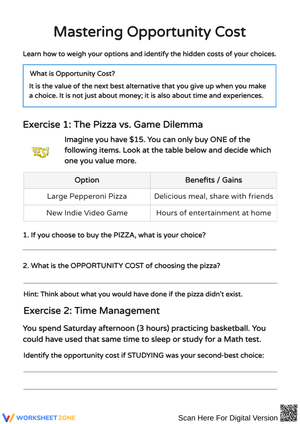
These 7th grade opportunity cost worksheets give economics teachers a structured way to move students past definition-level recall and into genuine application — identifying the next best alternative in real decisions about time, money, and competing priorities. Each worksheet in the set uses short, familiar scenarios to build the kind of analytical thinking that shows up on unit assessments and standardized economics questions alike.
What Students Practice in Each Worksheet
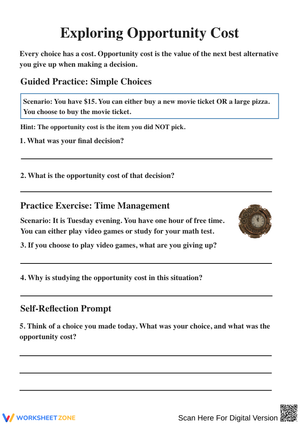
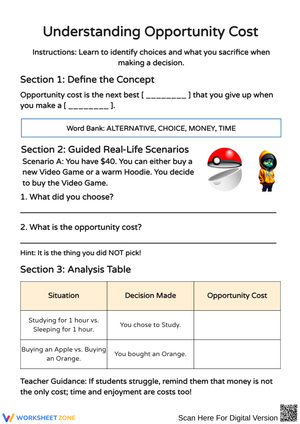
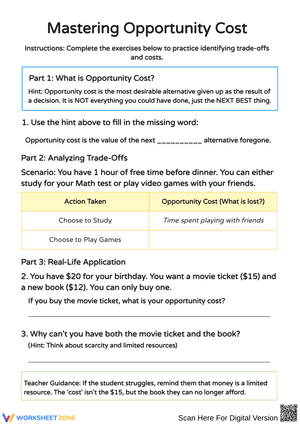
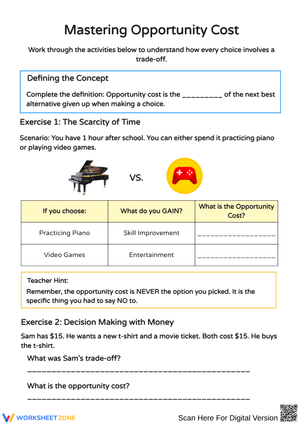
The scenarios stay deliberately concrete: a student chooses between spending Saturday on a part-time job or attending a friend's game, a family decides between two uses of a limited monthly budget, a school committee allocates time for one project and sets another aside. Students underline the actual choice, identify the best alternative not taken, and explain in writing why that alternative — not the entire list of foregone options — counts as the opportunity cost.
Question formats shift across the set so students can't pattern-match their way through. Matching items pair a decision with its correct next-best alternative. Multiple-choice scenarios include tempting wrong answers that describe consequences or general losses rather than the specific best option given up. Short-response items require a sentence or two of explanation. One worksheet asks students to sort a group of examples by economic concept — scarcity, trade-off, or opportunity cost — which surfaces exactly the vocabulary confusion teachers most need to catch before a quiz.
Building These Worksheets Into Your Lesson Plans
A reliable sequence for introducing the concept: open with five minutes of direct instruction and one teacher-modeled scenario, then give student pairs two quick examples to talk through before anyone writes independently. That partner step matters. Students who jump straight to written work tend to move fast and lock in the first answer that feels right — usually a consequence. The verbal exchange slows the reasoning down enough that the "best alternative" logic has room to surface.
Once students work independently, a sentence frame on every written response item sharpens what teachers can diagnose: The choice was ____. The opportunity cost was ____ because it was the next best option not selected. Responses that fill in the frame correctly but still misidentify the alternative reveal a different gap than responses that ignore the frame structure entirely.
Outside the main lesson block, these worksheets are practical for Monday warm-ups when students need a low-stakes re-entry into economics vocabulary, for the ten-minute review window before a unit quiz, and for sub plans where the concept is recent enough to reinforce without introducing anything new.
Adjusting the Worksheets for a Range of Learners
For students who need additional scaffolding, restrict the initial work to matching and multiple-choice items and hold the short-response questions for a follow-up session. Pairing a word bank that defines scarcity, trade-off, and opportunity cost alongside the worksheet keeps vocabulary from becoming a barrier to the economics reasoning you're actually trying to assess.
For students who move through the core items quickly, the sort-and-classify worksheet provides a natural extension — it demands they distinguish between three related concepts rather than just apply one. You can also ask advanced students to write their own original scenarios using a constraint you specify: the decision has to involve time rather than money, or has to involve a community-level choice rather than a personal one. That constraint forces more precise thinking than open-ended scenario writing typically produces.
Frequently Asked Questions
Do these worksheets define opportunity cost, or do students need prior instruction first?
Each worksheet opens with a clear working definition before moving into scenarios. Students who encounter the concept for the first time can use that definition as a reference while they work. That said, a brief whole-class introduction — five minutes, one teacher-modeled example — produces noticeably better independent work than handing the worksheet cold.
How do I use these if my students confuse opportunity cost with trade-off?
Start with the sort-and-classify worksheet rather than the scenario-response items. Seeing both terms applied to the same example set, and having to make a decision between them, forces students to articulate the distinction in a way that passive reading of definitions doesn't. After that worksheet, the scenario-based items land with much more traction.
Can these work for intervention groups or students who need reteaching?
Yes, and the matching items work especially well in small-group reteaching because they externalize the reasoning — the answer choices are visible, so the teacher can ask "why not this one?" and hear where the confusion lives. Short-response items are better reserved for students who have the concept and need to consolidate it in writing.












 Interactive Worksheet Maker
 Quiz Maker
 Word Search Maker
 Crossword Puzzle Maker
 Word Scramble Generator
 Sentence Scramble Generator
 Handwriting Worksheet Generator
 Name Tracing Generator
 Fill In The Blank Generator