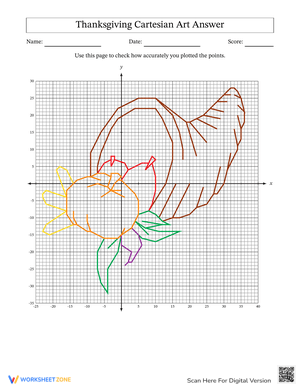
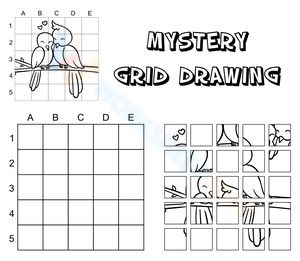
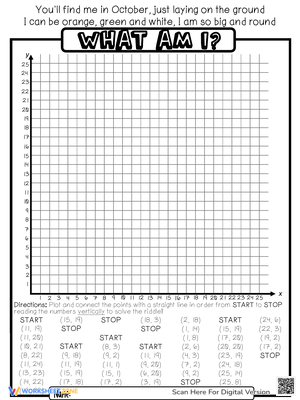
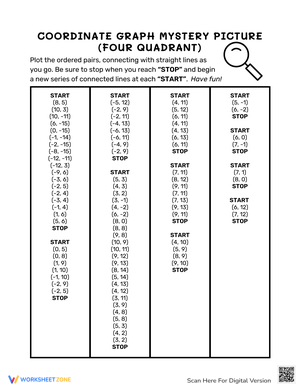
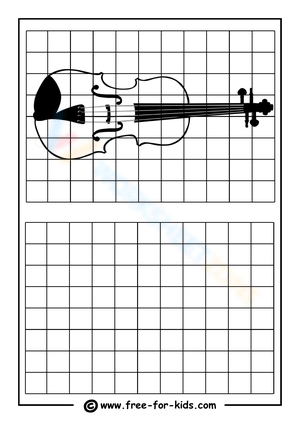
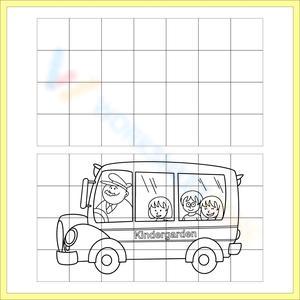
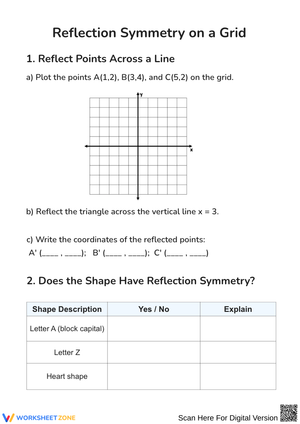
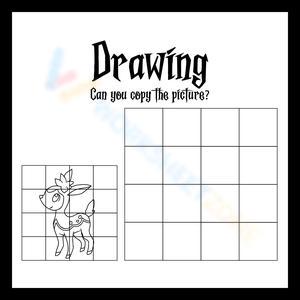
These grid drawing worksheets pdf for 7th grade give art teachers a reliable way to build observational accuracy before students attempt freehand work with any real confidence. The grid method divides a reference image into numbered squares, and students draw one section at a time — a constraint that slows the eye in exactly the right way for middle schoolers who tend to rush toward a finished result before they've actually studied what they're looking at. The result is a format that reduces the paralysis of the blank page while building habits that carry into every drawing task that follows.
What Students Practice, Square by Square
Grid drawing addresses observation, proportion, and shape recognition at the same time, which makes it unusually efficient for a 45-minute art block. When a student asks "where does this line go?" the grid gives a concrete answer: it enters the square from the lower left, curves upward to graze the top edge, and exits just right of center. That locational thinking replaces vague guessing with a repeatable method students can apply on any subsequent drawing task.
- Observation: Students look for entry points, exit angles, and negative space within each square — not just the overall silhouette of the subject.
- Proportion: The grid makes size relationships visible and correctable. If a student's square looks noticeably wider than the reference square, the error shows up before it compounds across the whole drawing.
- Shape recognition: Students learn to read a face, animal, or object as a collection of interlocking pieces rather than one complicated image to copy all at once.
- Accuracy under revision: Because each square is its own small task, students can erase a section and redraw it without feeling like the entire drawing is lost.
- Finishing skills: Once contour work is complete, each worksheet extends naturally into shading, colored pencil, or watercolor — carrying students through multiple stages of a finished piece without switching activities.
Seventh graders typically want their drawings to look realistic, but their observational habits often haven't caught up to that ambition. The grid gives them a process that bridges that gap — a way to achieve accuracy without relying on drawing intuition they haven't yet developed.
Proportion Errors and Other Mistakes Worth Catching Early
The most persistent error in grid drawing is horizontal drift. A student renders the first column of squares accurately, then gradually widens each subsequent square by a small amount. By column four, an eye or a jawline has migrated noticeably off-center. No single square looks wrong on its own — each one seems close enough — but the cumulative shift is hard to fix once the drawing is half finished. Catching it early, around the second or third column, is far easier than asking a student to erase half the page.
Two other errors appear regularly across classrooms. First, students press hard with the pencil from the start, making the grid guidelines nearly impossible to erase once contour lines go on top. A simple reminder to sketch lightly and commit to darker lines only after the shape is confirmed saves real frustration near the end of the period. Second, some students abandon the square-by-square method after a few minutes and begin copying the overall outline freehand. The result looks passable at a glance, but the underlying proportions are off and the student hasn't practiced the observational habit the worksheet exists to build. A quick mid-work check — asking students to point to the square they're currently working on — catches this pattern fast.
Fitting These Worksheets Into the Art Block
A single worksheet fits cleanly into a 30-to-45-minute class period. A five-minute teacher demonstration at the board — modeling how to identify anchor points and sketch lightly — prevents most of the errors above before they start. Students then work independently for 20 to 25 minutes, followed by a finishing window for shading or color. That rhythm is calm and predictable, which makes it useful for a focused skill day as well as for the kind of week when students need a structured, low-friction entry into artmaking.
For more detailed images, splitting the activity across two class periods works well: day one for contour accuracy, day two for value or color decisions. This is also when grid drawing worksheets pdf for 7th grade earn their place as reliable sub plans — the format is self-explanatory, the steps are sequential, and the directions stay visual rather than relying on lengthy written explanation. Teachers who leave these for substitutes rarely need to reteach the concept the next day. For grading, a rubric that credits observation, proportional accuracy, and revision habits gives students fair credit for the skills the lesson is actually teaching — rather than rewarding only the students whose finished drawings happen to look polished.
Matching the Challenge Level to Student Readiness
Offering three levels of grid drawing worksheets pdf for 7th grade keeps the core skill consistent while letting the difficulty match the room on any given day. Simpler worksheets use bold outlines and larger squares — a single bold animal silhouette or a strongly geometric object works well — and students who struggle with spatial reasoning can find success without shutting down midway through. Mid-level worksheets add overlapping shapes or light interior texture. The most detailed versions include realistic facial features, pattern work, or tonal variation built into the reference image.
- For students who need additional support: Larger squares, fewer interior details, and partially drawn contour lines in two or three starting squares as reference points.
- At grade level: A matching grid with moderate detail — clear enough to read quickly, complex enough to require sustained observation.
- For students ready for more challenge: Enlarge the image from a small reference grid to a larger student grid, so students must calculate and adjust proportions rather than copy at the same scale.
- As an extension: Turn the completed drawing into a full value study or a color composition using a limited palette of three or four colors.
A short written reflection — "which square gave you the most trouble, and what did you do to fix it?" — helps students name the specific strategies they used. That metacognitive habit is worth building at this grade level, and it pairs naturally with grid drawing because the square-by-square format makes it easy for students to point to exactly where things went well or went sideways.
Frequently Asked Questions
What image types work best for 7th grade grid drawing?
Animals, portraits, objects with recognizable contours, and stylized scenes hold student interest without becoming unmanageable. The reference image needs enough internal detail to make the drawing feel satisfying, but not so much fine detail that students spend the whole period struggling with a single square. Bold outlines with moderate interior complexity hit the right range for most 7th graders working within a standard class period.
Can these worksheets be used for homework or early finishers?
Yes, and both uses work well with a small adjustment. For homework, assigning a defined section of the grid — the top two rows, for example — is more realistic than sending the full worksheet home and expecting a completed drawing. For early finishers, the natural extension is moving into value work or color, which keeps the student building within the same skill set rather than switching to something unrelated.
How do these worksheets fit into a broader observational drawing unit?
Grid drawing works best near the start of an observational drawing unit, before students attempt contour drawing from a still life or a live subject. It builds the habit of looking for specific points and lines within a bounded area — a habit that transfers directly to other observational tasks. Many teachers return to grid drawing worksheets pdf for 7th grade mid-unit as a reset when students start rushing their freehand work and losing attention to proportion.
Do students need special materials beyond pencil and eraser?
No. A pencil, an eraser, and the printed worksheet are enough for the core activity. Colored pencils, markers, or watercolor become relevant only in the finishing stage, when students move from contour work into value or color. The short supply list is one reason these worksheets work well during weeks when setup time is limited or the room is short on materials.












 Interactive Worksheet Maker
 Quiz Maker
 Word Search Maker
 Crossword Puzzle Maker
 Word Scramble Generator
 Sentence Scramble Generator
 Handwriting Worksheet Generator
 Name Tracing Generator
 Fill In The Blank Generator