MLA Citations Printable Worksheets for 7th Grade
These mla citations printable worksheets for 7th grade give students targeted, repeated practice with the skills that tend to unravel during an actual research paper — identifying core MLA 9th edition elements, formatting Works Cited entries accurately, and inserting parenthetical citations at the right moment in a draft. Each worksheet in the set isolates a specific piece of the citation process rather than throwing everything at students at once. The result is that students arrive at a full research paper already comfortable with the mechanics, not still working them out mid-draft.
Core Elements and Source Types Students Work Through
MLA 9th edition reorganized citation around nine universal core elements — author, source title, container title, other contributors, version, number, publisher, publication date, and location — rather than separate formulas for every source type. That shift actually helps seventh graders: they can apply the same mental checklist to a novel, a news site, and a database article instead of treating each as its own separate puzzle. Each worksheet builds on that framework, asking students to locate and extract specific elements from sample sources before arranging them into a finished citation.
Print books get dedicated practice because the copyright page is unfamiliar territory for most twelve-year-olds. Students who have no trouble finding an author's name on a cover will stare at a copyright page and not know where to look for the publisher or the edition year. Websites require a different kind of attention — students learn to distinguish between the author of a specific article and the organization that owns the site, and to handle cases where no individual author is listed. Database article entries round out the set; those worksheets provide mock search results so students practice pulling citation data from the format they'll actually see on school library platforms.
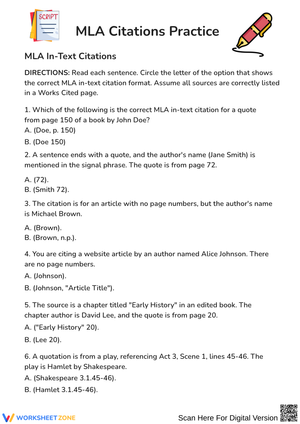
The in-text citation worksheets run parallel to the Works Cited work. Students see short paragraphs with borrowed information, mark where a parenthetical citation belongs, and then write the correct author-page or author-only form depending on the source. This pairing is intentional: students often understand both formats in isolation but fail to connect them — the last name in the parenthetical must match the first word of the Works Cited entry. Working with both on the same worksheet makes that relationship visible.
Lesson-Planning Ideas to Get the Most From These Worksheets
The most reliable entry point is a citation-of-the-week warm-up during the weeks leading into a major writing assignment. On Monday mornings, after morning meeting wraps up and before the reading block begins, put a sample source on the board — a young adult novel students already know, a current news article, a school library database result — and give students eight to ten minutes to draft the MLA entry. These mla citations printable worksheets for 7th grade work well in this format because each one is self-contained; you can pull a single worksheet, project it, and work through it as a class without disrupting the rest of your week.
A second practical use is pre-assessment before a major paper. Hand each student one worksheet covering the source type they'll use most heavily. Where you see blank spaces and crossed-out attempts, those are the gaps that need a focused mini-lesson before drafting starts — not after a Works Cited page is already built on faulty entries.
Common Misconceptions to Watch For and Correct
Italics are the most consistent stumbling block. Students who correctly italicize The Outsiders in a book report will write the same title in plain text inside a Works Cited entry, apparently treating citation format as a different kind of writing where normal conventions don't apply. A related error: article titles within websites sometimes get italicized because students aren't yet clear on the container distinction — the article title takes quotation marks, the website title takes italics. Each worksheet labels sample titles with a container indicator, so students practice the distinction rather than guess.
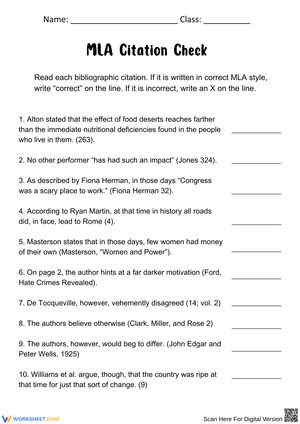
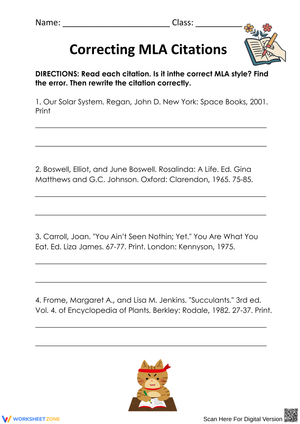
Punctuation placement trips up even careful students. The period goes after the closing parenthesis in an in-text citation, not before — that reversal of normal punctuation logic confuses students who are otherwise strong writers. On Works Cited entries, students frequently drop the period after the publication date or add one after the URL. These errors persist because students don't see a logical system behind the punctuation; they're memorizing positions without understanding why. The worksheets address this directly by having students proofread a deliberately flawed citation, mark every error, and then rewrite the entry correctly — which forces active analysis rather than passive copying.
One more pattern worth watching: students often record the website access date as the publication date. That mix-up is easy when a site doesn't display a clear "Published on" line. Each worksheet on web sources addresses where to look for a publication date — and what to write when none is available, which is common enough that students need a concrete procedure, not just a rule.
Standard Alignment
These worksheets address CCSS.ELA-LITERACY.W.7.8, which requires seventh graders to gather relevant information from multiple print and digital sources, quote or paraphrase the work of others while avoiding plagiarism, and follow a standard format for citation. That last clause is where MLA practice lives in the standards framework. The standard doesn't mandate MLA specifically, but it's the format most ELA departments use at this level because it's the one students carry into high school English. Citation instruction holds better when it runs alongside an active writing task — students retain the format more reliably when applying it to sources they're actually using, not practicing in a vacuum weeks before the paper begins.
Differentiating These Worksheets Across Ability Levels
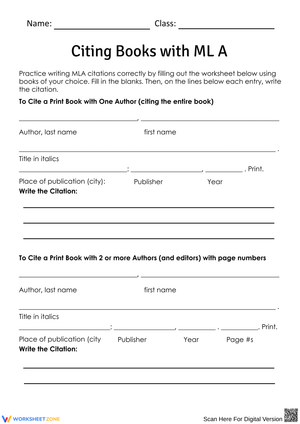
For students still building confidence, start with the book-citation worksheets. Books have the most predictable structure — title page, copyright page, done — and the fewest edge cases to navigate. Once a student can produce a correct book entry without checking a reference sheet, web and database sources become less daunting because the core element logic is already internalized.
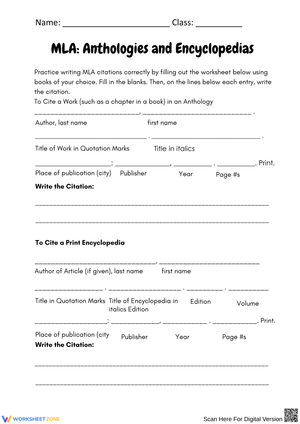
These mla citations printable worksheets for 7th grade include prompts for less common source types — a chapter in an edited collection, a translated novel, a government report with a corporate author — which keeps advanced students working within the same material rather than being pulled onto something entirely separate. Their finished entries can serve as worked examples during class debrief, which benefits the whole group without requiring separate preparation.
For students receiving pull-out support or ELL services, the element-identification tasks — circling the author, underlining the source title, boxing the publisher — are effective entry points. A student who can locate and label each element reliably is most of the way to a correct citation even before the formatting rules are fully internalized. That kind of task works well in a small-group setting without requiring a completely different resource.
Frequently Asked Questions
Which MLA edition should these worksheets follow?
The current standard for K-12 instruction is the MLA Handbook, 9th edition, published in 2021. The core element framework introduced in the 8th edition carried forward into the 9th with clarifications — so if your department is still running 8th edition materials, the overlap is significant. Any worksheet that uses separate formulas by source type (one formula for books, a different one for websites, a third for periodicals) predates the 8th edition and should be replaced.
How many practice sessions does it take before citations become reliable?
Students who complete four to six citation practice sessions spaced over two to three weeks show noticeably better accuracy on independent work than students who complete the same number of sessions in a single week. Massed practice produces short-term performance; spaced retrieval produces retention. That's the main reason the citation-of-the-week warm-up format tends to outperform a concentrated one-week citation unit — the material has time to settle between encounters.
Are these worksheets useful for students who already know how to cite sources?
Yes — particularly the error-analysis tasks and the edge-case source prompts. Students who can produce a standard book or website entry often haven't encountered a chapter in an edited anthology, a source with a corporate author, or an article with no listed publication date. These mla citations printable worksheets for 7th grade include those situations, so students who enter the grade with solid citation habits will find problems that push their accuracy further rather than simply repeating what they already know.
Clear All