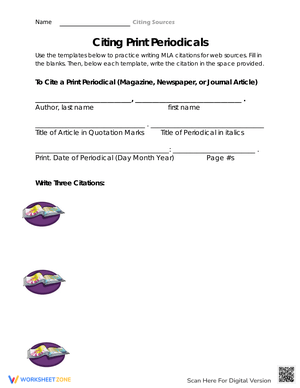
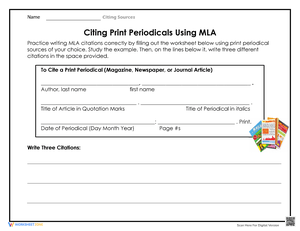
Citing sources printable worksheets for 7th grade give teachers a practical way to build attribution habits before a research project is due, not during the panicked day before. At this grade, students are far enough into academic writing to need real citation skills but are still sorting out the difference between paraphrasing and copying verbatim. A thoughtfully sequenced set of printable tasks closes that gap by keeping practice small, source-specific, and connected to the materials students actually use in class.
What These Worksheets Ask Students to Do
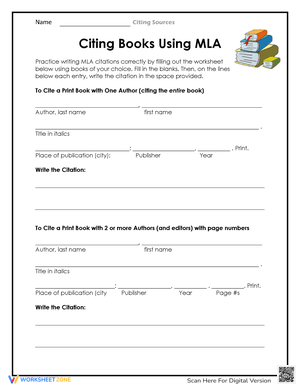
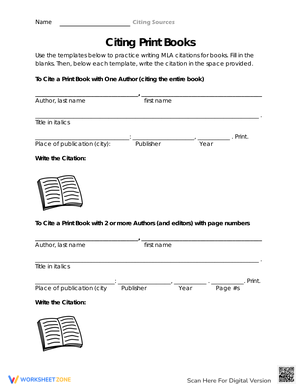
The work across this set targets the mechanics of attribution that matter most in a seventh-grade research unit. Students practice identifying key source fields — author, title, date, publication or site name, URL when relevant — and then using those fields correctly when building a citation entry or attaching a source record to notes. Instruction stays with the three source types that come up most in Grade 7 classrooms: books, short articles, and websites. These also happen to surface different field sets, which makes comparison work genuinely useful rather than repetitive.
Specific tasks students complete include:
- Labeling source parts from a model book title page, article header, or website
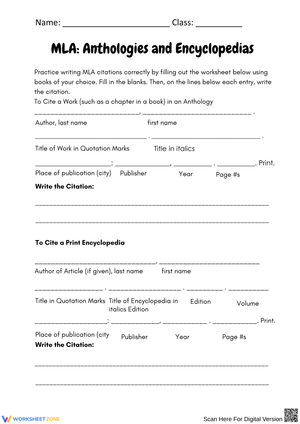
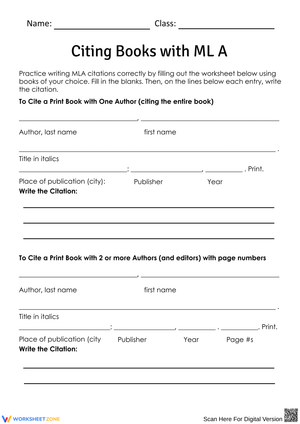
- Completing partially built citation entries where one or two required fields are blank
- Matching notes to the source they came from, which keeps evidence and attribution connected
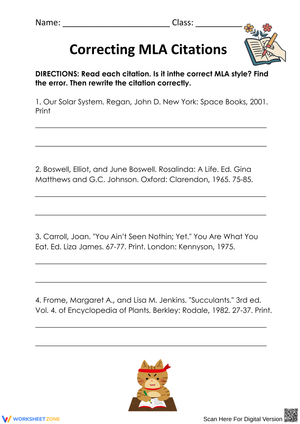
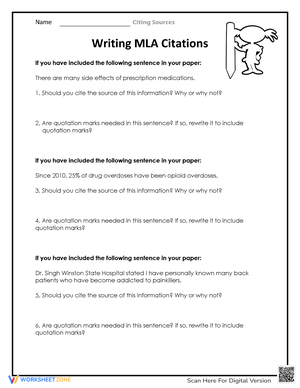
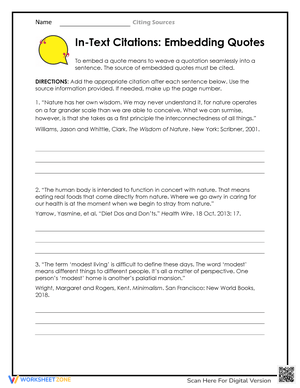
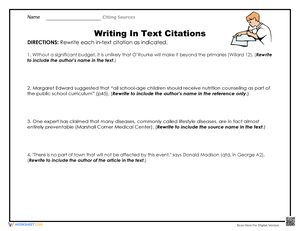
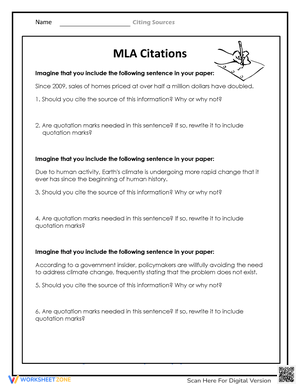
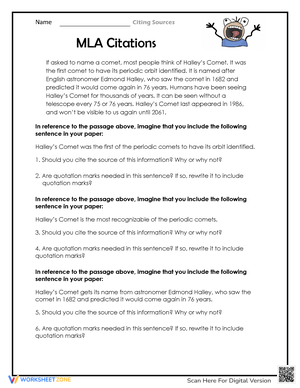
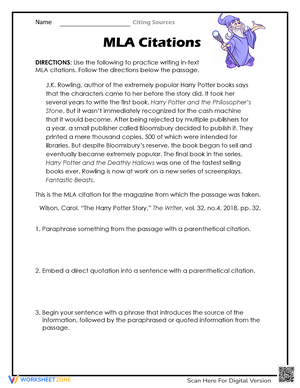
- Comparing copied text, paraphrased-but-uncredited text, and properly credited paraphrase side by side
- Building a full bibliography entry from a source card that supplies all the raw details
The comparison task carries more instructional weight than it might appear to. Many seventh graders have never seen "paraphrased-but-uncredited" named as a distinct category of error. When they see it placed between a copied sentence and a properly credited one, they understand the standard faster than any rule explanation provides.
Mistakes Students Repeat That These Worksheets Help You Address
The most common citation error at this level is not skipping citations entirely — it is treating them as incomplete tasks and not noticing. A student who writes "Johnson, 2022" in a note box has done something. That student feels done. But when the title is missing and the notes contain two lifted sentences with no quotation marks, the citation entry does not make the work careful. Watch for students who treat the citation blank as a box to check off rather than a record to keep accurate.
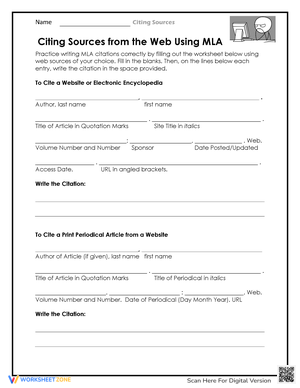
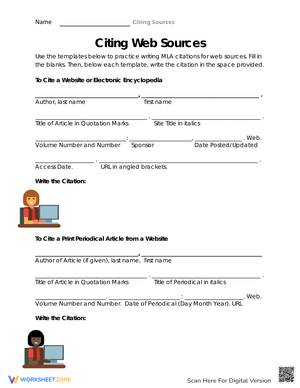
Website attribution produces a specific version of this problem. Students almost always record the URL and skip the site name, author, and access date. When a URL redirects or a page is removed — common enough with school-accessible sources — the citation becomes useless as a reference trail. Each worksheet in the website section asks students to locate and record all required fields, not just the link.
A less obvious error: students who correctly rewrite a sentence in their own words but then attach it to the wrong source because they were working across multiple tabs and lost track. Teachers tend to read this as carelessness, but it is mostly an organizational problem. The practice of building a source record before writing notes, which each worksheet reinforces, addresses this directly.
Standard Alignment
These resources connect most directly to CCSS.ELA-LITERACY.W.7.8, which asks seventh graders to gather information from multiple sources, assess credibility, and quote or paraphrase accurately while following a standard format for citation and avoiding plagiarism. In classroom terms, that standard runs through most fall and spring research units — it is not a one-day lesson but a thread that surfaces every time students use outside sources in their writing. Each worksheet in this set addresses the citation and attribution portion of W.7.8 specifically, leaving source evaluation and search strategies for companion resources.
Building These Worksheets Into Short, Predictable Lesson Routines
When citing sources printable worksheets for 7th grade are built into short, recurring routines rather than a single unit day, students absorb the habits more reliably. A bell ringer version looks like this: display a partial citation, students mark what is missing on their own copy, class discusses for two minutes. Run that three times in a week and accuracy improves in ways a single 45-minute citation lesson rarely produces.
For a longer workshop block — twenty minutes works well — the sequence that holds up in practice is source record first, citation entry second, notes third. Students examine a source (a library book, a printed article, a website printout), fill in the source record on the worksheet, then write two or three notes with the source attached. That order matters. Students who build the citation before writing their notes are significantly less likely to lose track of which fact came from which source.
These also work as sub plans. The directions are explicit enough that a substitute can run them without a lesson briefing. Error-analysis worksheets — where students find what is wrong in a sample bibliography — are especially strong in this role because the task is self-contained and generates discussion without needing facilitation. On the feedback side, responding to one target at a time produces more improvement than a fully marked-up worksheet: on one day, check whether the required source fields are present; on another, check whether the notes are in the student's own words.
Adjusting the Set for a Range of Learners
For citing sources printable worksheets for 7th grade to hold up across a mixed classroom, teachers do not need three separate sets of materials. They need the standard worksheet, a fill-in version for students who need more structure, and a next-step prompt for students who finish quickly. That keeps planning manageable while still reaching a wider range of learners.
Students who are still building confidence benefit from visual support: color-coded source fields — author in one color, title in another — give them an anchor without adding cognitive load. Fill-in frames with only one or two blanks also lower the entry point without removing the thinking. For English learners, vocabulary consistency across each worksheet matters more than teachers often realize. If one worksheet calls it a "site name" and another calls it a "publisher," students who are also processing language spend working memory decoding the difference rather than applying the skill.
Students ready for more challenge move from completing citation entries to evaluating full bibliographies for accuracy and consistency, or from citing provided sources to locating their own and building the source record from scratch. These are not different worksheets — they are different instructions given to different students using the same material, which is manageable in a real classroom without requiring a separate prep.
Frequently Asked Questions
What should 7th graders actually know how to do when it comes to citing sources?
At this grade, students need to reliably locate and record the core source fields — author, title, date, publication or site name, URL when relevant — and attach those details to their notes and finished writing. Full style-guide mastery is less important than consistent, accurate habits with the source types they most often use: books, articles, and websites.
How do teachers introduce citation practice without it turning into a formatting lecture?
Start with source identification before citation construction. When students can reliably find the author on a book's title page or the publication date in an article header, building the citation entry becomes assembly rather than guesswork. Each worksheet in this set keeps that sequence — locate the detail, then place it — rather than asking students to memorize order before they have handled real sources.
Which source types belong in a 7th grade citation set?
Books, short articles, and websites cover the sources most Grade 7 research units assign. These three types also surface different fields — a book lists an author and publisher; a website may list neither — which makes side-by-side comparison practice meaningful rather than mechanical. Specialized source types like academic journals or government databases are rarely relevant at this grade level and are not part of this set.
Can these worksheets address plagiarism prevention, or is that a separate topic?
It is the same topic. For citing sources printable worksheets for 7th grade, the connection between citation habits and plagiarism prevention belongs at the center of instruction. When students practice recording source details before taking notes, and when they compare credited versus uncredited paraphrase side by side, they are learning the behavioral routine that makes plagiarism less likely. Most seventh graders do not plagiarize intentionally — they plagiarize because they do not know what careful attribution looks like in practice.
Where can teachers find reliable citation guidance to supplement these worksheets?
The Purdue Online Writing Lab (OWL) remains the most widely used reference at this level, and its MLA and APA overviews are readable enough to share with middle schoolers directly. EasyBib offers a citation builder that helps students check their own work. Reading Rockets covers the research and writing connection in practical terms, and the Library of Congress Teachers collection provides primary source materials that make for authentic citation practice in class.












 Interactive Worksheet Maker
 Quiz Maker
 Word Search Maker
 Crossword Puzzle Maker
 Word Scramble Generator
 Sentence Scramble Generator
 Handwriting Worksheet Generator
 Name Tracing Generator
 Fill In The Blank Generator