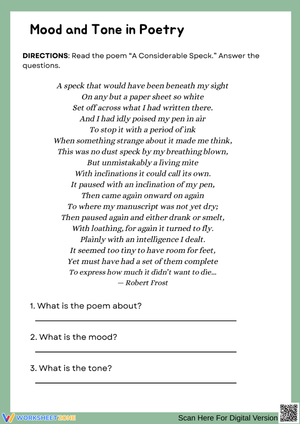
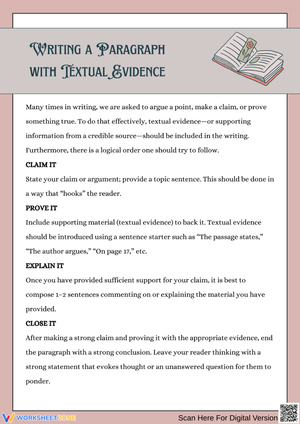
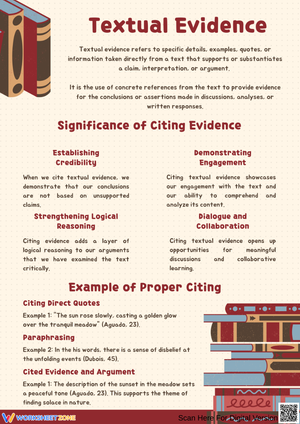
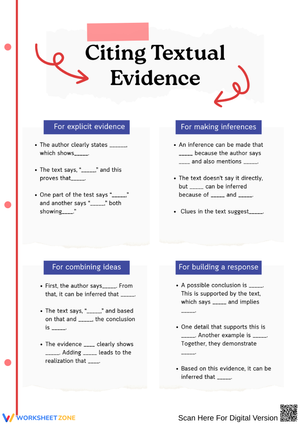
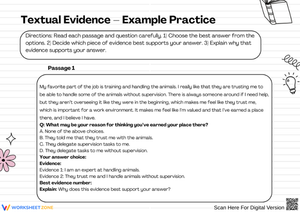
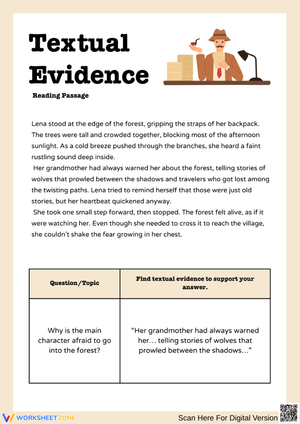
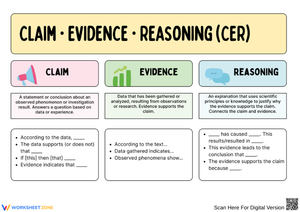
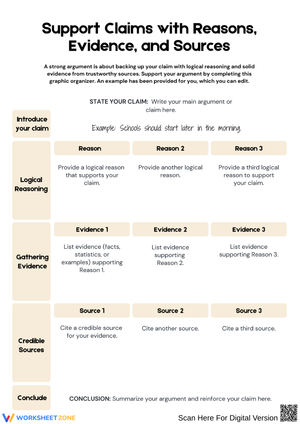
7th grade textual evidence worksheets resources give teachers something concrete for students who can read a passage but haven't yet learned to prove what they think. The set covers both literary and informational texts, because seventh graders need to carry the same citing and explaining habits into stories, articles, and essays — not treat evidence use as a routine that only applies to fiction. Each worksheet moves students through a tight sequence: read closely, locate the relevant support, write or paraphrase the citation, and explain how that detail connects to the claim or inference.
What Each Worksheet Asks Students to Do
The core task across the set is evidence selection and explanation — two moves students almost always perform in the wrong order, skipping the harder one. Students underline or mark details that could support a specific claim, then choose the strongest rather than the first one they find. After selecting, they write an explanation: not just "This quote shows..." but a sentence that names the connection between the detail and the answer rather than restating what the passage says.
Specific tasks across the worksheets include:
- Distinguishing relevant evidence from details that are accurate but beside the point
- Quoting exactly when precision matters, paraphrasing when the full sentence is unwieldy
- Writing explanation sentences that name what the detail proves, not just repeat what it says
- Comparing evidence across two paired passages — a format that appears regularly in district and state assessments
- Short constructed responses that hold claim, citation, and explanation together in one paragraph
The informational worksheets use article-style passages on historical and science-adjacent topics. The literary worksheets pull from short fiction and memoir excerpts. That range is intentional: seventh graders need the same citational reasoning regardless of whether they are reading about a character's decision or an argument about a policy position.
Where Seventh Graders Break Down on Evidence Tasks
The most predictable error at this grade level is not failing to find evidence — it is quoting too much and explaining too little. A student copies three full sentences from the passage, writes "This shows the theme is perseverance," and stops. The selection looked effortful; the explanation did almost no work. These worksheets address that tendency by separating the citation step from the explanation step with dedicated space and a distinct prompt for each.
A close second is choosing evidence that is accurate but off-topic. When a question asks students to support an inference about a character's motivation, many will pull any line the character speaks rather than the line that most directly reveals their reasoning. Several worksheets in the set respond to this by presenting two or three candidate details and asking students to defend their choice — which forces the discrimination step that gets bypassed when a question only says "find evidence."
A third pattern worth knowing: when students move from literary to informational passages, they often treat evidence differently, as if the skill doesn't carry across text types. They tend to be more confident quoting from fiction because they have practiced it longer. On informational text, they either cite a data point with no explanation of its significance or write a paraphrase so vague it loses the precision of the original. A set that rotates genres puts this transfer gap in front of students during low-stakes practice rather than at a benchmark assessment.
Building These Worksheets Into Your Lesson Plans
The most efficient use is as targeted daily practice, not end-of-unit assessment. A single evidence-and-explanation question runs about eight minutes as a bell ringer — enough time for students to read a short passage, annotate, and write one explanation before the lesson begins. Reviewing the strongest student response aloud and naming what makes the explanation effective does more than simply marking it correct.
For mini-lessons, model annotation on the same passage students will use independently. Mark one detail that looks like it could work, then show why a different detail is actually stronger. That "this one versus that one" comparison is what most students skip when working alone, and seeing it modeled makes the reasoning step visible rather than assumed.
During small-group reteach, the shorter-passage worksheets work best. Asking students to number each sentence before they begin lets them reference evidence by line rather than scanning the whole text each time. For students ready for more, pull the constructed response worksheets and ask them to incorporate two pieces of evidence with a transitional sentence connecting them before explaining both. The format stays constant; the independence level shifts.
7th grade textual evidence worksheets resources also serve well as homework after a direct instruction day. The passages are short enough that students are not doing extended reading at home, and the explanation task is specific enough that it is easy to see at a glance whether a response actually addresses the question.
Adjusting the Work for Different Learners in the Same Class
These worksheets keep the same skill target at every level — selecting and explaining evidence — but there are practical ways to shift the entry point without changing the task itself.
For students who need more reading support, pre-mark two or three candidate lines before distributing the worksheet. Ask them to choose the strongest and explain why. This removes the locating step temporarily so they can build the explanation habit first — the locating work returns once that habit is in place. For on-level students, the default format works without modification. A small push: after they read the passage but before they look at the question, ask them to write one sentence about what the passage is mainly showing. Then they read the prompt and compare.
For students ready to go further, use each constructed response as a first draft. Ask them to revise by adding a second piece of supporting evidence, writing a sentence that connects the two, and tightening the claim for precision. That revision step moves a short worksheet task into genuine writing instruction without requiring a new passage.
One honest limitation: students still building reading fluency — in English or in general — may find the evidence task frustrating when the passage itself contains too many unfamiliar words. A text at a lower Lexile does more for those students than any response frame on the worksheet.
Standard Alignment
These worksheets address CCSS.ELA-LITERACY.RL.7.1 and CCSS.ELA-LITERACY.RI.7.1, both of which require students to cite several pieces of textual evidence to support analysis of what a text says explicitly as well as inferences drawn from it. RL.7.1 applies to literary reading and response to literature tasks; RI.7.1 governs informational reading and frequently appears in content-area writing. Both standards show up in seventh-grade district benchmarks and most state assessments, so these worksheets function as both skills-building and assessment preparation simultaneously. Strong 7th grade textual evidence worksheets resources also connect to CCSS.ELA-LITERACY.W.7.9, which asks students to draw evidence from literary and informational texts to support analysis and reflection — a writing standard that reading and ELA teachers can reference together when coordinating response-to-literature units.
Frequently Asked Questions
What makes a question text-dependent rather than knowledge-dependent?
A text-dependent question can only be answered by returning to the passage. If a student could write a correct response from background knowledge without reading the text, the question tests recall rather than evidence use. The worksheets use prompts like "What in the text suggests the narrator is uncertain about this decision?" rather than broad comprehension questions. The passage — not memory — supplies the answer.
How do I handle students who write the explanation correctly but cite the wrong evidence?
Treat it as a selection error, not a writing error. The reasoning is working; the discrimination step is not. Ask the student to return to the passage and identify two other details that could also answer the question, then compare all three. That comparison usually reveals that they anchored on the first quotable line rather than the most relevant one — and it makes the selection criteria concrete in a way that general feedback does not.
Can these worksheets be used during ELA intervention blocks?
Yes, and they hold up well in that setting because the passage is short and the task is specific. An intervention session can narrow entirely to the explanation step — give students the passage, the question, and the evidence, and ask only for the "this shows that..." sentence. That focused work is difficult to replicate with a full written response assignment.
How often should students practice evidence-based response without the format becoming rote?
Two or three times per week keeps the work purposeful. Daily repetition on the same format tends to produce template responses — students fill in the frame rather than thinking about what the text actually says. 7th grade textual evidence worksheets resources work best when the passage type rotates across the week: one literary text, one informational, and one paired text gives students enough variation to keep their reasoning active rather than automatic.












 Interactive Worksheet Maker
 Quiz Maker
 Word Search Maker
 Crossword Puzzle Maker
 Word Scramble Generator
 Sentence Scramble Generator
 Handwriting Worksheet Generator
 Name Tracing Generator
 Fill In The Blank Generator