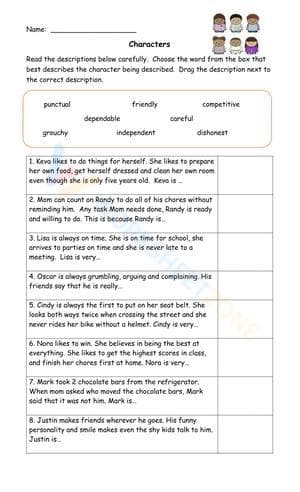
These literary elements worksheets for 7th grade give teachers focused practice in the specific analytical moves 7th graders are expected to make — not just naming a conflict or labeling a narrator, but explaining how those elements shape meaning. Each worksheet pairs a short fiction passage with text-dependent questions that move from basic comprehension into evidence-based analysis. The set covers plot, characterization, setting, conflict, theme, point of view, and tone, with an internal question sequence that pushes students from identification into genuine interpretation.
The Specific Skills These Worksheets Target
Seventh grade is the point in ELA instruction where the standard shifts from "name the element" to "explain how the author uses it." A student who can place the climax on a plot diagram still needs different practice if she cannot explain how that climax resolves the central conflict and changes the main character. These worksheets build that second layer directly. Each worksheet focuses on one or two elements:
- Plot structure: tracing the five stages and explaining how each advances conflict — not summarizing what happened, but explaining why it mattered
- Characterization: distinguishing direct from indirect characterization and connecting a character's actions or dialogue to underlying motivation
- Setting: explaining how time and place create mood or put pressure on a character's decisions
- Conflict: identifying internal versus external conflict and tracking how that conflict develops across the story rather than simply naming its type
- Theme: stating theme as a complete message about human experience — not a topic word like "friendship" — and supporting it with at least two pieces of textual evidence
- Point of view: explaining what the narrator's perspective allows and limits in terms of what the reader can actually know
- Tone: reading word choice and detail selection to name the author's attitude, kept separate from what characters feel and separate from what readers feel
Questions within each worksheet move in a deliberate order. Early questions anchor comprehension, middle questions ask for identification with brief explanation, and the final question typically connects two elements — how setting intensifies the central conflict, for example, or how tone reinforces the theme. That sequence helps students see literary analysis as layered reasoning rather than a checklist of separate labels.
Errors in Student Work Worth Watching For
The most persistent pattern across 7th grade literary analysis is the theme answer that never becomes a statement. Students write "friendship" or "perseverance" when asked for theme, and they often do not see the problem because one-word answers passed in earlier grades. The theme questions on these worksheets require a complete sentence about what the story claims about that topic — what friendship costs, what perseverance demands — followed by a specific passage detail that supports it. That two-part structure makes the vague answer visible before students put the pencil down.
Tone and mood are reliably confused at this grade level. Students describe how the passage made them feel and label that as tone. The worksheets address this by asking students to first underline specific word choices, then describe the attitude those words suggest — anchoring the response in the author's craft before the reader's reaction enters the picture. Point-of-view errors look different: students correctly label "third-person limited" but then write responses as if the narrator is omniscient. One question type asks students to mark information the narrator could not have direct access to, which exposes that gap faster than a class discussion does.
Working These Worksheets Into Your Lesson Plans
The most effective use of literary elements worksheets for 7th grade is matching each one to a specific instructional moment rather than reaching for them as generic filler work. Early in a unit, when students are still inside a longer class novel, a focused worksheet on characterization or conflict gives structured time for evidence-gathering they would otherwise skim past. After reading, a mixed-element worksheet serves as focused review — more useful than an open discussion because every student has to commit their analysis in writing, not just listen to whoever raises a hand first.
For bell-ringer work, a short-passage worksheet on tone or point of view takes about eight minutes and gives teachers something concrete to look at before the day's lesson begins. That is more actionable than an open warm-up when the goal is to see where students actually stand with a skill before instruction starts. Fridays before a unit quiz are another natural fit — a mixed-review worksheet covering theme, conflict, and characterization in one pass surfaces gaps before the formal assessment rather than after it.
For station rotations, each worksheet functions as a self-contained independent task. The PDF format makes it easy to pre-print a week's worth of materials, and a student who was absent can complete the same work without needing to catch up on a shared class text first — a practical advantage in middle school, where absences during a novel unit create real instructional complications.
Adapting the Set for Mixed-Ability Classrooms
Most 7th grade ELA classes span four or more reading levels, and the same worksheet will not reach every student the same way. For students who need more structured support, the most effective adjustment is adding sentence frames before the written response questions — not simplifying the analytical expectation itself. Frames like The conflict develops when... which forces the character to... keep the rigor intact while reducing the cognitive demand of generating academic sentence structure from scratch. Students who write with more fluency can skip the frame entirely and respond directly to the question.
The passages themselves can serve different purposes depending on student readiness. A student working below grade level benefits from reading the passage twice — once for basic plot, once with a specific analytical question in mind — before writing anything. Students who move quickly through the analysis questions can extend by comparing how this story's conflict differs from the one in the class novel, or by explaining how the theme would shift if the point of view changed. Those extensions do not require separate materials — one extra prompt written on the board or in the worksheet's margin is enough to push the thinking further.
Standard Alignment
These literary elements worksheets for 7th grade align to CCSS.ELA-LITERACY.RL.7.1 (citing textual evidence to support analysis and inference), RL.7.2 (determining theme and analyzing its development), RL.7.3 (analyzing how plot, setting, and character interact), and RL.7.6 (analyzing how point of view affects the meaning a reader receives). RL.7.3 is the anchor for most of the analytical work in the set — it asks students to explain how particular story elements work together, which is exactly what the multi-element questions at the end of each worksheet practice. In classroom terms, students are not identifying elements in isolation; they are doing the interconnected reasoning the standard requires for proficiency at this grade.
Frequently Asked Questions
What literary elements does the set cover?
The worksheets address plot structure, characterization, setting, conflict (internal and external), theme, point of view, and tone. Most concentrate on one or two elements at a time with text-dependent questions requiring evidence from the passage. Several worksheets ask students to explain how two elements connect within the same short text.
Are these worksheets appropriate for students reading below grade level?
The passages are written at a 7th grade readability level. Teachers can make each worksheet more accessible by adding sentence frames before the written response sections, or by having students annotate the passage with a partner before working independently. The analytical expectations stay consistent; the entry point adjusts.
Can these worksheets function as formative assessments?
Student written responses on these literary elements worksheets for 7th grade reveal specifically where each student's understanding breaks down — whether someone can identify an element but cannot explain it, or can explain it but has not connected the explanation to evidence. That detail is more actionable than a percentage score because it tells teachers what the next lesson should address.
Do the worksheets include answer keys?
Each worksheet includes a teacher answer key. For short-response and analysis questions, the key provides a model answer and identifies the textual evidence students should have cited — which makes marking faster and gives students more specific feedback when work is returned.
How long does a typical worksheet take in class?
Most worksheets take between 15 and 25 minutes, depending on how quickly students read the passage. The shorter, single-element worksheets — one passage, three to four questions — fit comfortably into the final portion of a class period or serve as a structured homework assignment that mirrors the format students practiced in class. The mixed-element worksheets work better as a full independent work block during class time.















 Interactive Worksheet Maker
 Quiz Maker
 Word Search Maker
 Crossword Puzzle Maker
 Word Scramble Generator
 Sentence Scramble Generator
 Handwriting Worksheet Generator
 Name Tracing Generator
 Fill In The Blank Generator