6th Grade Labeling Arteries and Veins PDF Worksheets
These 6th grade labeling arteries and veins pdf worksheets give middle school science teachers a direct, diagram-centered entry into the circulatory system unit — one where students mark up body outlines rather than copying notes. Each worksheet asks students to do something specific: label a vessel by name, trace the direction of blood flow, or fill in a comparison chart that contrasts arterial and venous structure. The format keeps the work grounded in anatomy rather than drifting into general recall questions.
What the Set Covers
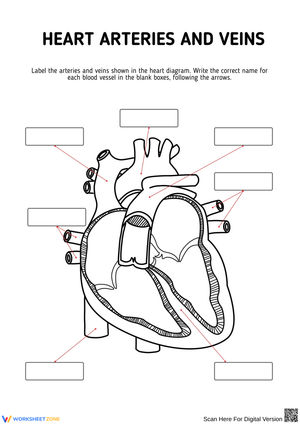
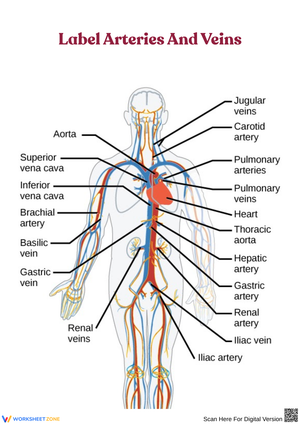
The worksheets move across four distinct activity types. Standard diagram labeling puts students in front of a human body outline and asks them to identify major vessels — the aorta, superior and inferior vena cava, pulmonary artery, pulmonary vein, carotid artery, jugular vein, and femoral artery and vein. A word bank accompanies most of these, which reduces the spelling burden so students can focus on vessel placement rather than orthography.
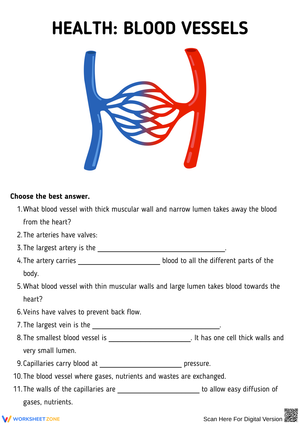
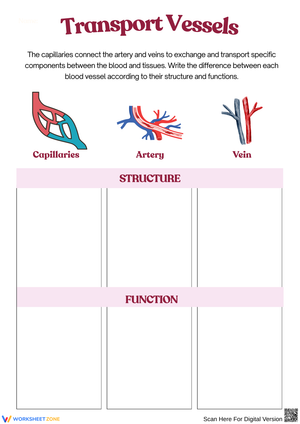
Color-and-label worksheets ask students to use red for oxygenated blood and blue for deoxygenated blood before adding vessel names. Students who color before they label reveal whether they understand function or are just pattern-matching names to lines on a diagram. Comparison chart worksheets have students fill in a two-column table contrasting arteries and veins by wall thickness, blood pressure, valve presence, and flow direction. Vocabulary cloze worksheets round out the set, requiring students to use terms like oxygenated, deoxygenated, aorta, and vena cava in sentence context — the kind of work that builds the scientific language students need when they write about body systems rather than just label diagrams.
Mistakes Students Make That These Worksheets Help You Catch
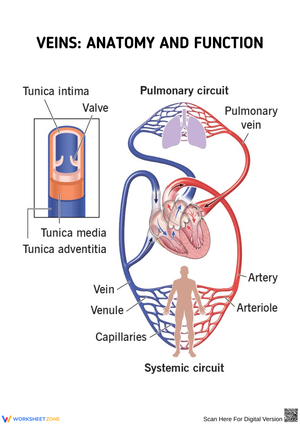
The pulmonary circuit exception is where most 6th graders stumble. Once students learn the rule "arteries carry oxygenated blood away from the heart," they apply it without exception. On a diagram, they color the pulmonary artery red and the pulmonary vein blue — exactly backwards. This isn't carelessness; it's the predictable result of teaching the general rule before the exception is firmly introduced. Worksheets that show both circuits side by side give teachers a clear moment to pause and address the reversal directly rather than discovering it on a quiz.
A second consistent error involves the vena cava. Students frequently label either the superior or inferior vena cava without distinguishing between them, and when they do distinguish, they often reverse the two. In actual student work, you'll see "inferior vena cava" written next to the upper vessel because students process "inferior" as a judgment about importance rather than a positional descriptor. Brief anatomical vocabulary work before the labeling activity reduces this significantly.
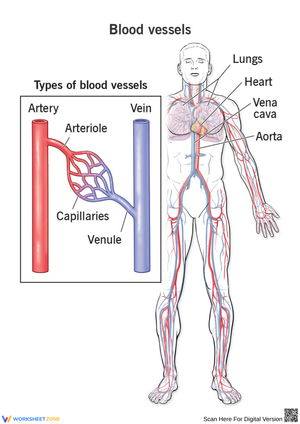
Students also skip capillaries when asked to trace the complete blood pathway. They jump from arteries directly to veins, bypassing the site where gas exchange actually happens. Worksheets that require students to write out the sequence — artery, arteriole, capillary, venule, vein — catch this gap before it becomes entrenched. On assessments, students who skipped capillaries during practice will often leave them out of pathway questions entirely.
How to Build These Worksheets Into Your Unit Plan
A simple, unlabeled body outline worksheet works well as a pre-assessment on the first day of the unit. Students label whatever they can without instruction, which surfaces prior knowledge and reveals which terms are already familiar. That baseline informs how much time to spend on vessel names versus structural differences — two distinct instructional priorities that don't always need equal time.
The vein valve demonstration pairs naturally with the comparison chart worksheet. Before students fill in the "valves" row, have them press a finger firmly against a prominent vein on the back of their hand and slide toward the wrist, against the direction of blood flow. The slight pooling visible just above the finger shows venous pressure and valve function in about 30 seconds. Students who see that demonstration fill in the valve row with real understanding rather than copied definitions. The 6th grade labeling arteries and veins pdf worksheets that focus on vessel structure work particularly well immediately after this moment — the concrete experience transfers directly to the diagram.
Vocabulary cloze worksheets work well as Monday openers at the start of the second week of the unit, when students have encountered the terms but haven't fully retained them. The comparison chart is a strong review tool the day before a quiz — it forces students to retrieve and organize rather than passively re-read notes. For station-based instruction, the four worksheet formats divide naturally: one station for diagram labeling, one for the color-and-label activity, one for the comparison chart, and one for vocabulary cloze.
Differentiating the Worksheets for a Range of Learners
Students who struggle with spatial reasoning or anatomical vocabulary need the word bank and a completed comparison chart as a reference before they attempt the full diagram. Having the functional information in front of them frees up attention for the spatial task — locating the aorta on a body outline and recalling that the aorta is the largest artery are two separate cognitive demands, and forcing both simultaneously slows down students who are still securing basic vocabulary.
Students who are ready for additional challenge can work without the word bank and annotate each labeled vessel with a brief function note — not just "aorta" but "aorta — carries oxygenated blood from the left ventricle to the systemic circuit." A strong extension task is tracing the complete pathway of a single red blood cell from the right atrium through the pulmonary circuit and back out through the systemic circuit, writing every vessel name in sequence. The 6th grade labeling arteries and veins pdf worksheets provide the diagram base for this kind of written pathway task without requiring additional materials.
Standard Alignment
These worksheets align with NGSS MS-LS1-3, which asks students to "use argument supported by evidence for how the body is a system of interacting subsystems composed of groups of cells." The circulatory system is one of the strongest classroom examples of subsystem interdependence available at this grade level — arteries, capillaries, and veins can't be understood in isolation from each other or from the heart. The labeling and comparison activities directly support students in building an argument about how vessel structure determines function, which is exactly the structure-function reasoning the standard targets. Many state life science frameworks place the circulatory system at grade 6 because students at this age are ready to move beyond "blood carries oxygen" into the mechanics of how wall thickness, pressure, and valve architecture make that possible.
Frequently Asked Questions
Which vessels do 6th graders need to label by name?
The core set includes the aorta, superior and inferior vena cava, pulmonary artery, and pulmonary vein. Most 6th grade curricula also include the carotid artery, jugular vein, and femoral artery and vein. Capillaries appear more often in sequence diagrams and written pathway questions than in body-outline labeling, since they're too small to locate on a body diagram — but students still need to place them correctly in the blood flow sequence.
Why teach the red-and-blue color convention if blood is never actually blue?
The red-and-blue system is the anatomical standard students will encounter in every science textbook and medical diagram through high school and beyond. Teaching students to read and apply that convention correctly means they can interpret diagrams they encounter outside of class. That said, it's worth a brief discussion to clarify that venous blood is dark red rather than blue, and that the blue simply represents lower oxygen content. Students who understand the convention rather than just applying it are less likely to be thrown by a later diagram that shows blood in a test tube as uniformly red.
When should the pulmonary circuit exception be introduced?
Teach the systemic circuit rule first and let students practice labeling with it before the pulmonary exception appears. If the exception comes too early, students try to hold both rules simultaneously before either is secure, and typically neither is retained well. One solid class period on the systemic circuit, followed by a labeling worksheet, gives students the foundation they need for the exception to make sense rather than just add confusion. The 6th grade labeling arteries and veins pdf worksheets that show both circuits on a single diagram are most effective after that foundation is in place — not as the first diagram students encounter.
Do arteries ever have valves?
The heart's semilunar valves — the aortic and pulmonary valves — sit at the exit points of the heart and regulate flow into the major arteries, but they are heart valves rather than valves within the arterial walls. Arteries themselves do not contain internal valves. Students who ask this on a worksheet are usually doing good thinking — they've read that veins have valves and are wondering whether the rule applies everywhere. Clarifying that arterial pressure makes internal valves unnecessary turns the question into a useful teaching moment about the relationship between pressure and vessel structure.
Clear All