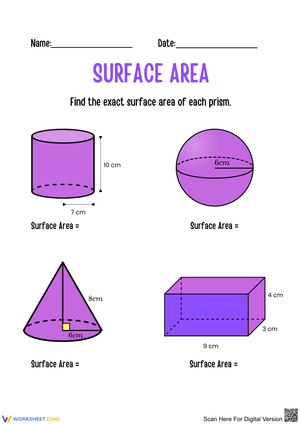
6th Grade Total Surface Area Worksheets
These 6th grade total surface area worksheets move students through the full arc of 6.G.A.4 — from identifying the faces on a net to calculating surface area for rectangular prisms and right pyramids with unlabeled dimensions. Each worksheet targets a specific point in that progression so teachers can assign based on where a student actually is, not just where the calendar says they should be.
What's Inside the Set
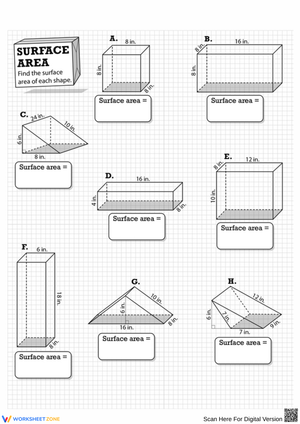
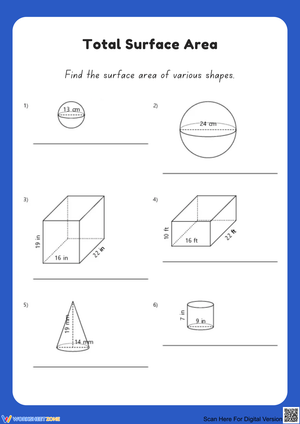
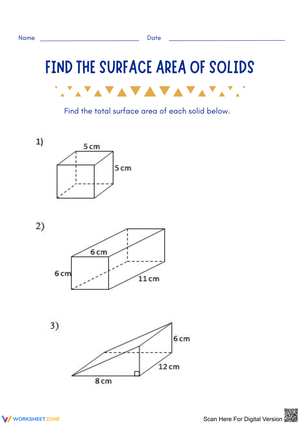
The worksheets cover two primary solid types: right rectangular prisms and right pyramids with square or triangular bases. Within each type, students work through several distinct task formats. Some worksheets present an unfolded net with labeled dimensions and ask students to find the area of each face before summing. Others show a 3D drawing and require students to identify the dimensions themselves before any calculation begins. A third format embeds the shapes in word problems — painting a storage crate, covering a decorative box — where students must decide which faces to include and which to omit based on context.
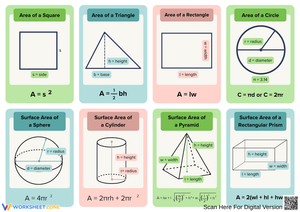
Every worksheet reinforces the square-units convention, prompting students to label answers in cm², in², or ft² throughout. A formula reference appears at the top of the introductory worksheets and disappears on the later ones, which is a deliberate scaffold removal rather than an oversight.
Standard Alignment
These worksheets align to CCSS Math.Content.6.G.A.4, which asks students to represent three-dimensional figures using nets of rectangles and triangles and to use those nets to find surface area. In classroom terms, this standard sits at the intersection of two earlier skills — area of rectangles (3.MD.C.7) and area of triangles (6.G.A.1) — which is why the instructional sequence matters. Students who are shaky on triangle area will struggle with pyramid surface area, and the error will look like a surface area problem when it is actually a triangle area problem. Checking both skills before launching the unit saves significant re-teaching time later.
Pyramid Work and the Slant-Height Problem
The single most persistent confusion in surface area units involves pyramids. Students who handle rectangular prisms without trouble will consistently reach for the vertical height of a pyramid when calculating the area of its triangular faces. This happens because vertical height is what students associate with "how tall" a shape is, and the slant height — the distance from the base edge up to the apex along the face — is a less intuitive measurement. The worksheets address this directly by labeling both dimensions on pyramid diagrams and requiring students to identify which measurement belongs in the triangle area formula before they calculate.
Square-base and triangular-base pyramids both appear in the set. Switching between them keeps students from locking in one routine. A student who has only practiced square pyramids will often try to calculate four triangular faces when given a triangular pyramid, so exposure to both types during the practice phase prevents that kind of automatic error on assessments.
Common Student Errors Worth Watching For
Face-omission is the most frequent problem, but it's not the only one. Students who correctly identify all six faces of a rectangular prism will sometimes assign the wrong dimensions to a face — pairing the length with the height instead of the length with the width for the top and bottom faces. This error rarely shows up when students work from a net but appears regularly when they work from a 3D drawing, which is why the set includes both formats deliberately.
A subtler error involves units. Students who calculate correctly in centimeters will write the answer as "94 cm" rather than "94 cm²" because the object in front of them is three-dimensional and cm³ feels more natural to them at this stage. Connecting surface area back to nets helps here: when the net is laid flat on the page, it is obviously a 2D figure, and square units follow naturally from that visual.
The volume-versus-surface-area confusion is worth addressing explicitly at the start of the unit rather than waiting for it to surface on a quiz. Both concepts involve the same three dimensions; they just ask different questions about what those dimensions describe.
Building These Worksheets Into Your Lesson Plans
The net-based worksheets work well as a guided-practice tool during the initial days of the unit, when students are still building the mental model. Pair students and give them a physical rectangular prism — a tissue box, a small shipping box — alongside the worksheet. One partner measures, the other records, and both calculate. That sequence takes about twenty minutes and produces far more durable understanding than a demonstration alone.
The 3D-drawing worksheets are better suited to the independent practice phase, once students have shown they can read a net reliably. They also work as a Monday warm-up during the two weeks following the unit's close — a spaced retrieval hit that costs five minutes of class time and significantly reduces how much re-teaching is needed before the test.
Word-problem worksheets fit naturally into the block's final ten minutes once the procedural work is solid. They're also the format that transfers most directly to how surface area appears on standardized assessments, where a problem rarely says "find the surface area of this prism" and instead says "a company is designing a cardboard box."
Adjusting the Worksheets for a Range of Learners
For students who are not yet secure with 2D area formulas, start them on the worksheets where each face is pre-outlined on a grid. Counting squares to find face area before summing is slower but builds the conceptual foundation that formula application requires. Moving to labeled-dimension worksheets is the next step, and students should not skip to unlabeled 3D drawings until they can reliably identify all faces on a net.
For students who move through the standard problems quickly, the most productive extension is word problems with a missing face — an open-top box, a crate with no back panel — where the student must read the context to determine which faces to exclude. This requires genuine comprehension rather than formula application, and it's the category of problem that separates students who understand surface area from students who have memorized a procedure. Decimal dimensions are another layer of challenge that doesn't change the underlying geometry but increases arithmetic demand.
Frequently Asked Questions
Why do some worksheets include a formula bank while others don't?
The formula bank appears on worksheets designed for the guided and early independent practice phases. Providing formulas during initial instruction keeps students focused on the spatial reasoning task — identifying faces, matching dimensions — rather than on formula retrieval. The later worksheets remove the bank deliberately, pushing students toward internalization. If a student consistently needs to return to the formula bank on the final worksheets, that's diagnostic information worth noting before assessment.
What's the difference between lateral surface area and total surface area, and do these worksheets address both?
Lateral surface area covers only the side faces, excluding any base. Total surface area includes every face. The 6.G.A.4 standard focuses on total surface area, so that's the primary target throughout the set. A few worksheets do include lateral area as a labeled intermediate step — calculating the four rectangular sides of a prism before adding the top and bottom — which helps students understand why total surface area is defined the way it is, without making lateral area its own separate unit goal.
How should teachers handle students who confuse surface area with volume?
The most effective classroom move is to put both a net and a 3D model side by side and ask students to physically point to "what surface area measures" and "what volume measures." Surface area is the skin; volume is the space inside. Students who can articulate that distinction in their own words before calculating rarely conflate the two on a worksheet. For students who continue to mix them up after that discussion, it's worth checking whether they're also confused about 2D area versus 3D volume, since the root of the confusion is sometimes more basic than the current unit suggests.
Are these worksheets appropriate for a student who missed the nets introduction?
Start that student on the net-based worksheets regardless of where the class is in the unit. The net is not just a visual aid — it's the conceptual structure that makes total surface area meaningful. A student who skips nets and jumps directly to the formula will be able to produce correct answers on simple problems but will struggle as soon as the shapes become less familiar or the dimensions appear in a 3D drawing. Two or three targeted worksheet sessions on nets closes that gap efficiently.
Clear All