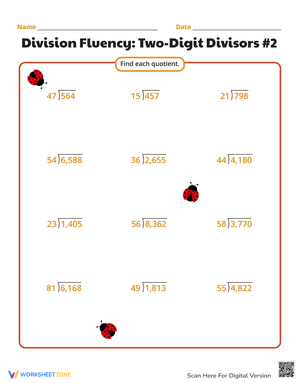
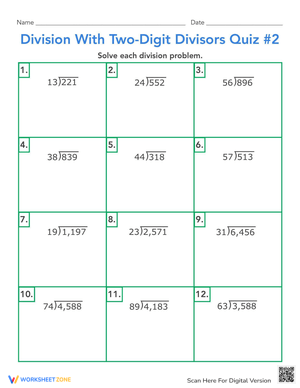
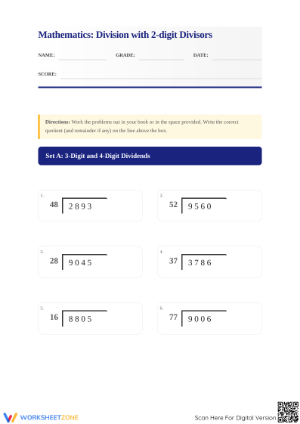
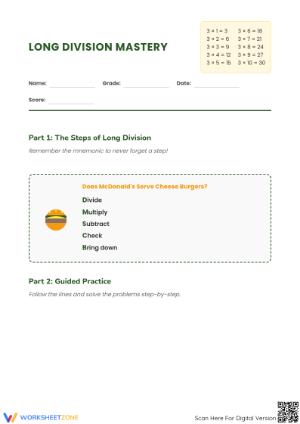
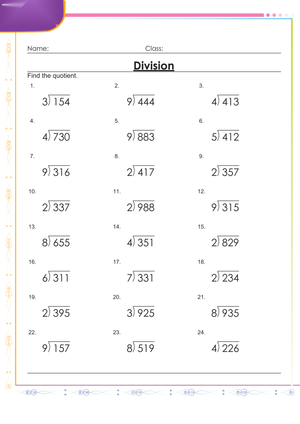
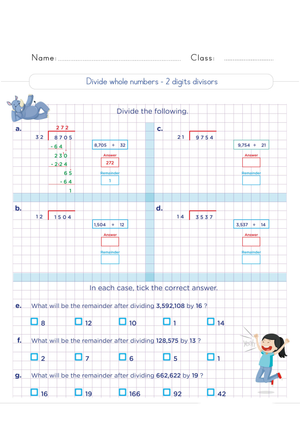
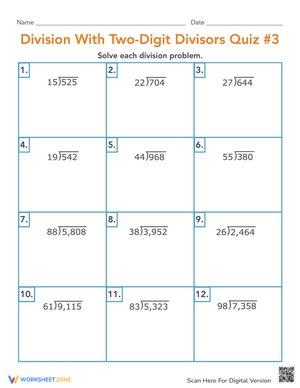
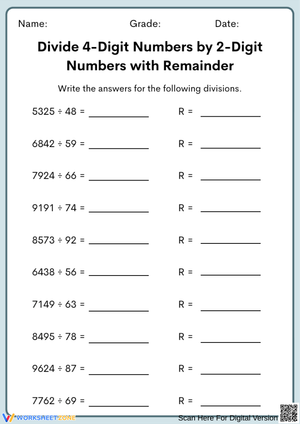
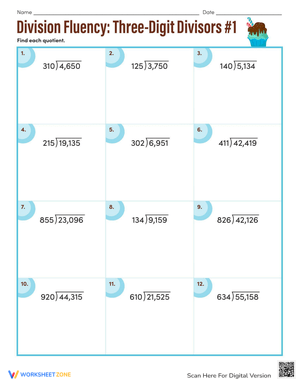
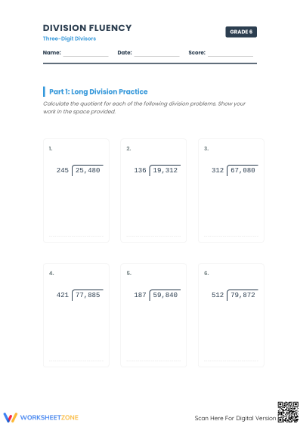
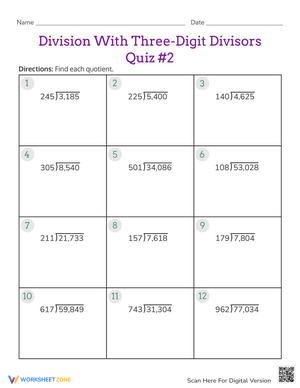
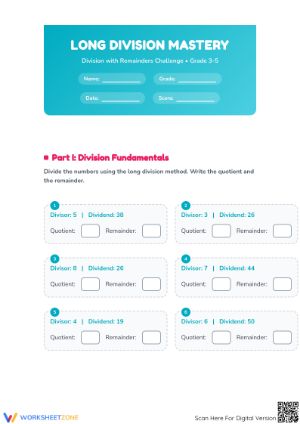
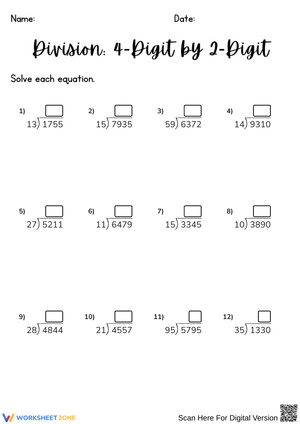
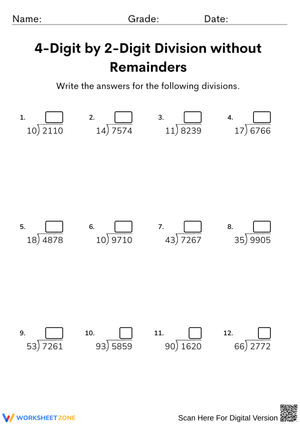
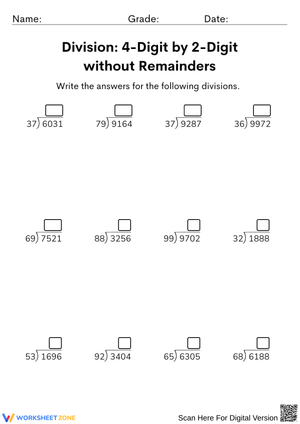
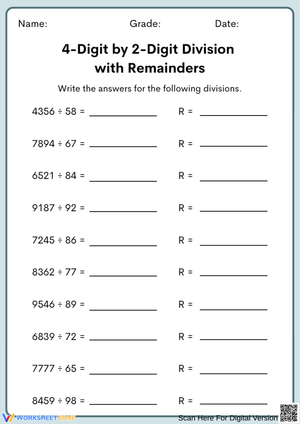
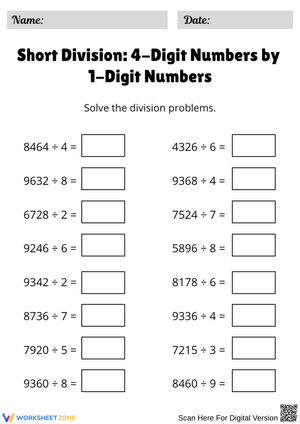
These long division worksheets for 6th grade give teachers a ready-to-print set covering the full skill progression—three- and four-digit dividends with single-digit divisors, four-digit dividends with two-digit divisors, remainder interpretation in context, and multiplication-based answer checking. Each worksheet stands on its own, so teachers can drop one into a warm-up block, assign one for homework, or pull one for a targeted small-group session without building anything around it.
The Specific Skills Targeted
The set addresses both the procedural and conceptual demands that 6th grade expects students to handle before moving into fraction and ratio work. Practice isn't limited to producing a quotient—students also estimate, judge remainders, and verify their answers across varied problem types.
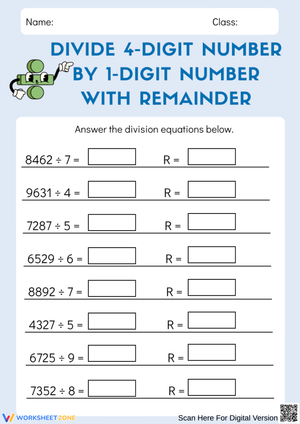
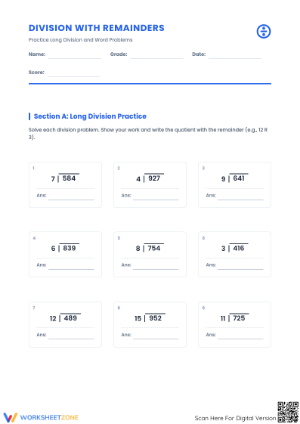
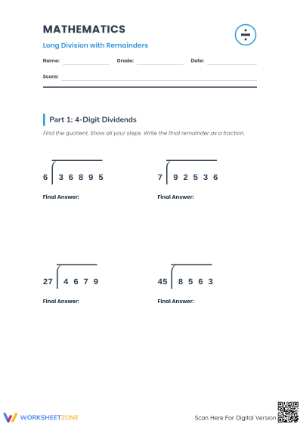
- Three- and four-digit dividends with single-digit divisors — entry point for students still building fluency with the standard algorithm
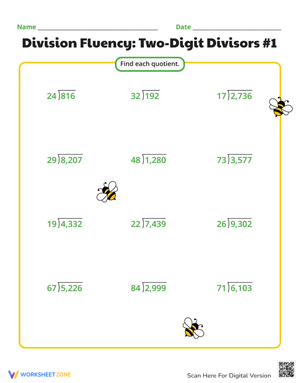
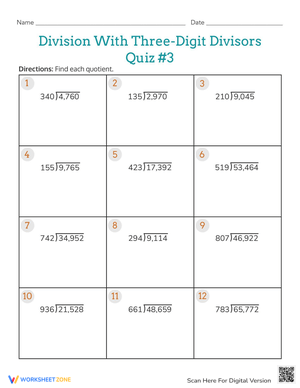
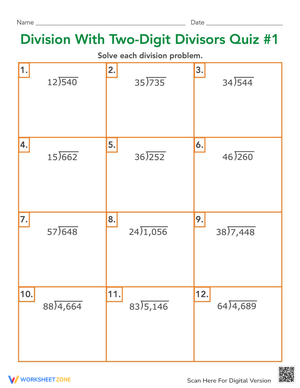
- Two-digit divisors — tests estimation skills at every step, which is where number sense actually gets exercised
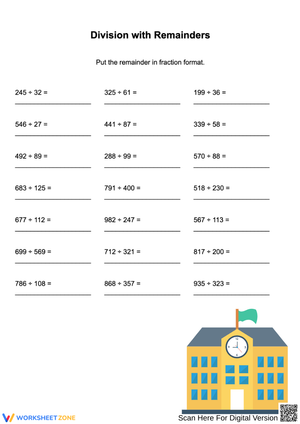
- Remainder notation — written as R, as a fraction, and interpreted as a rounded whole number depending on the problem type
- Word problems requiring remainder decisions — students decide whether to round up, drop the remainder, or keep it based on context
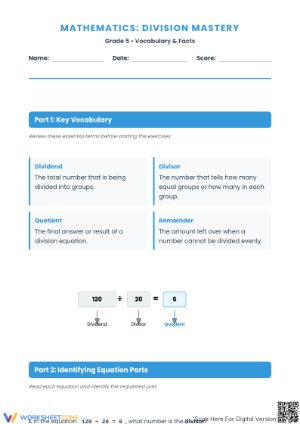
- Multiplication-check verification — students confirm each quotient by multiplying divisor by quotient and adding the remainder back
- Error analysis — worked examples with a planted mistake ask students to locate and fix the error, surfacing place value and subtraction problems that computation drills alone miss
Common Misconceptions to Watch For and Correct
The error that surfaces most reliably in 6th grade long division is the missing-zero quotient. When a digit in the dividend divides zero times, students skip the placeholder and shift the entire quotient one place value to the left. A student who correctly solves 84 ÷ 4 = 21 will often write 21 for 840 ÷ 4—having brought down the zero, computed zero correctly, and then dropped the zero from the quotient entirely. The error analysis worksheets target exactly this pattern: they present a finished problem with that mistake embedded and ask students to identify where the algorithm broke down, which requires checking each step rather than scanning the final answer.
Two-digit divisor problems expose a second consistent pattern. When estimating the trial digit, students regularly guess too high, run into a subtraction result that doesn't work, and either panic or erase and guess randomly. What they need to internalize is that the negative result is information—it tells them to lower the trial digit by one. A worksheet that makes the estimation step explicit, asking students to write their trial estimate before dividing, slows that guessing cycle and gives teachers a visible record of exactly where the reasoning broke down.
How to Work These Worksheets Into Your Planning
The strongest slot for these in a daily math block is the first eight minutes of independent work—right after a teacher models one example and before the class moves to stations or partner activity. That window gives students enough context to work without constant support, and gives the teacher a few minutes to circulate and catch place value misalignment before it becomes habitual. A worksheet that takes twelve minutes during initial introduction typically runs six minutes after two or three repetitions, which is what fluency actually looks like building in real time.
One reason teachers specifically seek out long division worksheets for 6th grade is offline reliability. These print cleanly in black and white, work on a standard classroom copier, and don't require students to log in or have a device in hand. That matters for homework nights, weeks with substitute coverage, or any district with limited device access during math blocks.
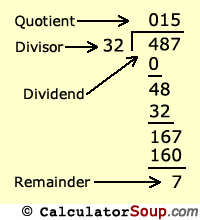
For intervention groups, pull the single-digit divisor worksheets and pair them with a printed reference card showing the divide-multiply-subtract-bring-down cycle. The card isn't a permanent accommodation—it lets the student offload the procedural checklist so working memory goes toward the arithmetic itself. Once a student can complete five problems without glancing at it, retire the card. For students who already handle single-digit divisors accurately, move directly to the two-digit divisor worksheets and require a written estimate at the top of each problem before any division begins.
Differentiating These Worksheets Across Ability Levels
The set tiers naturally by problem type. Lower-performing students do best starting with three-digit-by-one-digit worksheets that leave generous workspace and carry fewer problems total. Students who freeze at two-digit divisors often respond well when the first subtraction step of one or two problems is penciled in before copying—that removes the startup barrier without removing the mathematical demand.
For students working above grade level, the error analysis and word problem worksheets are the right tools. Asking a strong student to explain in writing why a remainder of 7 is invalid when the divisor is 6, or to show that a quotient is reasonable using a front-end estimate, reveals more about number sense than an additional column of computation problems would. The question "How do you know your answer is in the right ballpark?"—assigned after completion—consistently shows which students are dividing procedurally and which are reasoning about magnitude.
One honest limitation worth naming: the strictly computational worksheets offer little traction for students who already understand the algorithm and need to move toward decimal or fraction quotients. Those students benefit from the remainder-as-fraction problems but will outgrow the pure computation worksheets quickly. That's the correct next step for them—it's just a different resource.
Standard Alignment
CCSS 6.NS.B.2 requires students to "fluently divide multi-digit numbers using the standard algorithm." In instructional terms, 6th grade is the fluency checkpoint—not the introduction point. Students arriving in 6th grade should have encountered the algorithm in 5th grade; what 6th grade adds is the expectation of accuracy and efficiency under varied conditions, including two-digit divisors and four-digit dividends where place value tracking across multiple steps becomes the real challenge.
Most teachers place this standard in the opening unit of the year, before the class moves into rational number operations. That sequencing is deliberate: fluency with whole-number division carries directly into fraction division and ratio reasoning. Teachers who use these worksheets during that front-loaded unit, and then revisit targeted worksheets briefly before starting fraction work, tend to see fewer place value errors resurface in the ratio and proportion unit later in the year.
Frequently Asked Questions
Do these worksheets include two-digit divisor problems?
Yes. Two-digit divisor worksheets are included separately from the single-digit divisor worksheets, so teachers can assign them at the right instructional moment rather than mixing difficulty levels in a session where some students are still working through the basic steps.
Can these work for intervention or small-group support?
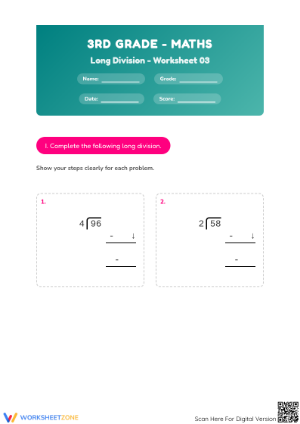
These long division worksheets for 6th grade are particularly useful in intervention settings because the single-digit divisor worksheets are less visually crowded than mixed-review formats. That extra space lets students show each subtraction step clearly, which makes it easier for a teacher or aide to spot exactly where the algorithm breaks down during a session rather than simply marking a final answer wrong.
Are answer keys included?
Yes, answer keys accompany every worksheet in the set. For a multi-step skill like long division, immediate self-correction is more effective than waiting for teacher feedback the next day—students can examine their own error while the steps of the problem are still fresh and traceable.
How is this set different from a standard computation drill?
These long division worksheets for 6th grade go beyond straight computation by including error analysis tasks, word problems that require students to interpret and act on remainders, and multiplication-check verification items. That combination means students practice the applied reasoning that 6th grade assessments test alongside the procedural fluency those assessments also require—rather than treating the two as separate concerns.













 Interactive Worksheet Maker
 Quiz Maker
 Word Search Maker
 Crossword Puzzle Maker
 Word Scramble Generator
 Sentence Scramble Generator
 Handwriting Worksheet Generator
 Name Tracing Generator
 Fill In The Blank Generator