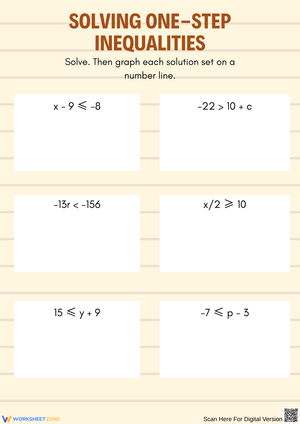
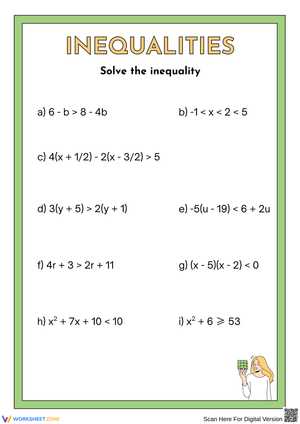
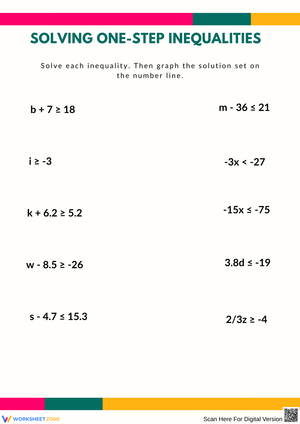
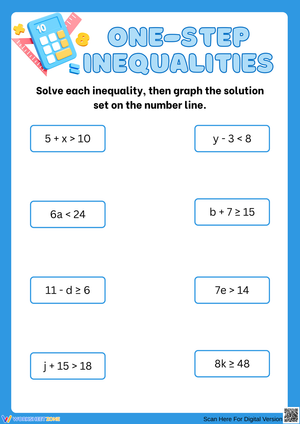
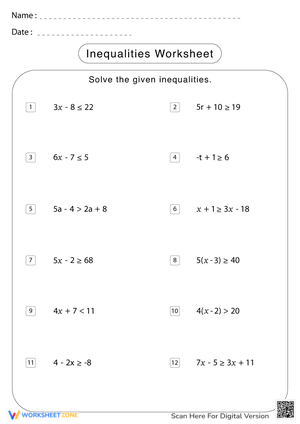
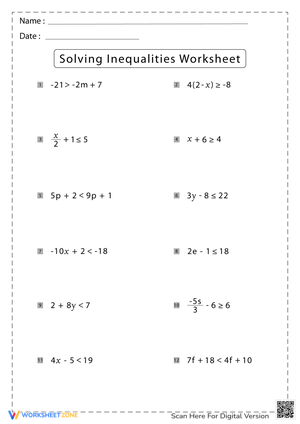
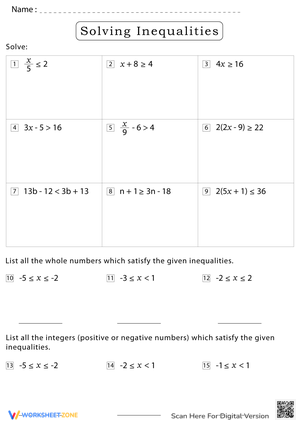
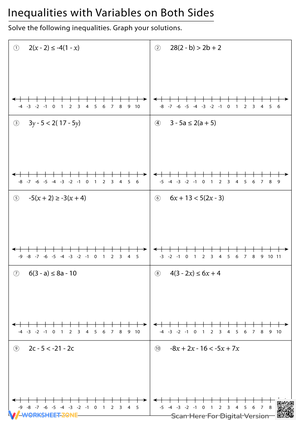
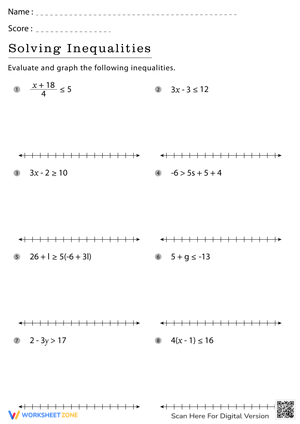
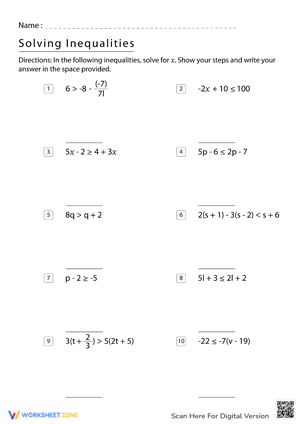
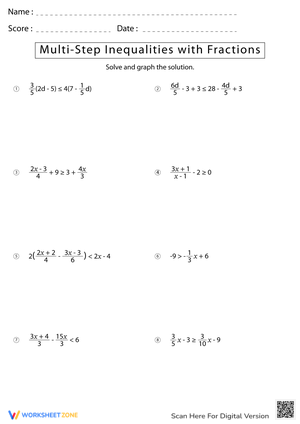
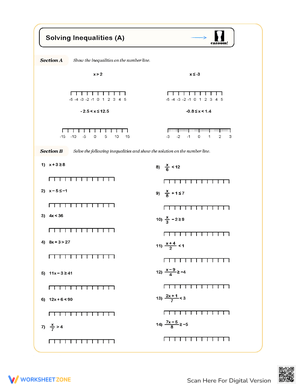
These solving inequalities worksheets for 6th grade give teachers print-ready practice that targets the moment students stop asking "what is the answer?" and start asking "which values make this true?" That shift — from one solution to a set of solutions — is the central conceptual move in grade 6 algebra, and it requires more than a brief mention in notes. Students need repeated, structured exposure to reading, writing, solving, and graphing inequalities before the idea sticks.
The Specific Skills Targeted in Each Worksheet
The worksheets move through a deliberate sequence rather than mixing every skill at once. Students begin with symbol recognition — deciding whether a statement using less than, greater than, less than or equal to, or greater than or equal to is true for a given value. This is not as obvious to 11-year-olds as it looks. Many students initially treat the symbols as directional arrows rather than relational statements, and that misconception needs direct attention before solving begins.
From there, each worksheet builds toward one-step solving and graphing. The skills covered across the set include:
- Reading and interpreting inequality symbols in both mathematical and verbal form
- Translating word phrases — at least, no more than, fewer than — into symbolic inequalities
- Solving one-step inequalities using addition, subtraction, multiplication, and division
- Substituting values to verify whether a number belongs to the solution set
- Graphing solution sets on number lines with correct open or closed circles and arrow direction
- Applying inequalities to real-world contexts such as budget limits, minimum scores, and distance constraints
The set deliberately stays within one-variable, one-step problems. That focus is intentional: grade 6 students are building the conceptual foundation, not the procedural fluency of later algebra courses. Pushing into two-step problems here adds difficulty without adding the conceptual clarity the grade level actually needs.
Common Misconceptions to Watch For and Correct
The most consistent error appears not in the solving step but in the graphing step. A student who correctly solves "x plus 4 less than 11" to get "x less than 7" will still draw the arrow pointing to the right, because the number line feels like a forward timeline — positive direction, moving right. They can state the solution correctly and still graph it wrong. This error is distinct from a calculation mistake, and it persists even in students who can explain what "x less than 7" means verbally.
A second problem surfaces in word-phrase translation. At least 12 and more than 12 look nearly identical in student work — both tend to get written as "12" with some symbol attached. Students who have not spent deliberate time on the difference between strict and non-strict inequalities will default to greater than when the situation calls for greater than or equal to, and back the other way just as easily. The word problems in the set are structured to surface this confusion before a test does.
There is also a developmental shift worth naming explicitly: grade 6 is the first time most students encounter the idea that a variable can represent an entire range of numbers rather than a single unknown value. That is genuinely new thinking. Some students resist it — they want to circle one answer and move on. The solution-checking tasks in the worksheets address this directly, asking students to test multiple values and confirm that all of them satisfy the inequality.
Lesson-Planning Strategies for Getting the Most From These Worksheets
A gradual release approach spread across several days tends to outperform a single long practice session. On the day inequality symbols are introduced, the symbol-recognition worksheet works well as a 10-minute warm-up immediately after direct instruction. Students annotate each statement, rewrite it in words, and decide whether specific values satisfy it. That holds the cognitive load at a manageable level — students are doing meaning-making, not computation, so the activity doesn't compete with the new concept.
The solving and graphing worksheets pair naturally: one for guided work during class, one for independent review the following day. Teachers working in 45- to 50-minute blocks often find this fits cleanly into a five-day mini-unit. The word problem worksheets belong at the end of the sequence, though pulling one anchor problem early — before students have finished all the symbolic practice — helps them see why the procedural steps matter.
For centers or station rotations, separating each worksheet by skill type lets teachers run a solving station, a graphing station, and a word-problem station simultaneously. Watching which station produces the most hesitation reveals where individual students are stalling — at the symbol level, at the operation level, or at the number line — without requiring one-on-one check-ins with every student. Structured this way, solving inequalities worksheets for 6th grade resources give teachers a real-time formative picture that a single mixed-review assignment often misses.
Standard Alignment
These resources address CCSS.MATH.CONTENT.6.EE.B.8, which asks students to write an inequality of the form x greater than c or x less than c to represent a constraint or condition in a real-world or mathematical problem, and to recognize that such inequalities have infinitely many solutions. The standard also requires students to represent solutions on number line diagrams. In classroom terms, this means the graphing step is not optional enrichment — it is part of what the standard expects students to demonstrate. Any solving inequalities worksheets for 6th grade set built around this standard should include both symbolic solving and number line representation on the same worksheet, so students practice the full expectation together rather than treating each component as a separate skill.
Differentiating These Worksheets Across Ability Levels
For students who are still shaky on inverse operations, the inequality-specific work will stall at the solving step. The practical move with those students is to pull back to one-step equation practice briefly — not as a permanent separation, but as a two-day detour — before reconnecting to inequality solving. The goal is to keep conceptual momentum on inequalities without letting a procedural gap block every problem.
Adjustments by readiness:
- Students who need more support: provide number lines already drawn on the worksheet, reduce the number of items, and include a reference card matching signal phrases to symbols — at least paired with greater than or equal to, fewer than paired with less than, and so on
- On-level students: assign the mixed-practice worksheets with solving, solution-checking, and graphing addressed within the same problem set
- Students ready for extension: add error-analysis items where a worked solution contains a mistake students must identify and correct, plus multi-part word problems that require writing an inequality before solving it
One honest limitation worth naming: the structured layout of these worksheets — predictable format, clear step sequence — works well for students who benefit from routine but can produce paralysis in students who freeze when a problem looks slightly different from what they practiced. For those students, reading the first item aloud together before independent work reduces that initial hesitation considerably.
Frequently Asked Questions
Do the worksheets address both strict inequalities and non-strict inequalities?
Yes. Each worksheet that includes graphing or word-phrase translation covers both types. The graphing items specifically require students to decide between an open circle and a closed circle, which forces them to distinguish strict from non-strict inequality on every problem — not just the ones explicitly labeled as practice for that distinction.
Can I pull individual items from a worksheet to use as exit tickets?
The mixed-review worksheets work well as formative checks at the end of a lesson. Pulling two or three items — one solving, one graphing, one word problem — gives a fast read on where students are without turning a brief check-in into a full assessment. That kind of targeted exit ticket is often more informative than a longer quiz because it isolates the specific skills taught that day rather than sampling everything at once.
When in the unit should students start graphing solution sets?
Earlier than most teachers expect. Waiting until students have mastered solving before introducing graphing tends to make the number line feel like an add-on rather than part of the answer. Introducing graphing alongside the first solving lesson — even with just one or two number line items — helps students understand from the start that the graph is part of what an inequality solution means, not a separate task tacked on at the end.
Are these resources appropriate for 7th graders reviewing 6th grade material?
These solving inequalities worksheets for 6th grade work for any student operating at the one-variable, one-step level, regardless of grade placement. A 7th grader who missed this content or needs focused work on number line graphing and solution interpretation will find the skill progression useful. The word problems use grade 6 contexts, so the reading level and scenarios won't feel mismatched for a student returning to foundational material.













 Interactive Worksheet Maker
 Quiz Maker
 Word Search Maker
 Crossword Puzzle Maker
 Word Scramble Generator
 Sentence Scramble Generator
 Handwriting Worksheet Generator
 Name Tracing Generator
 Fill In The Blank Generator