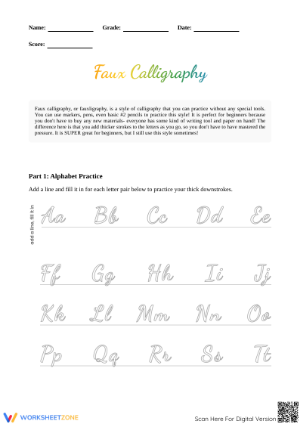
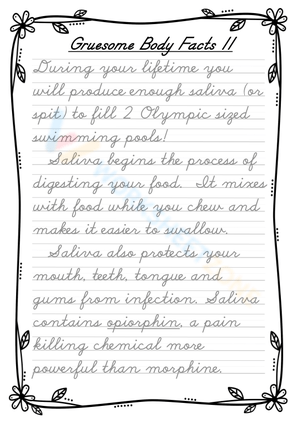
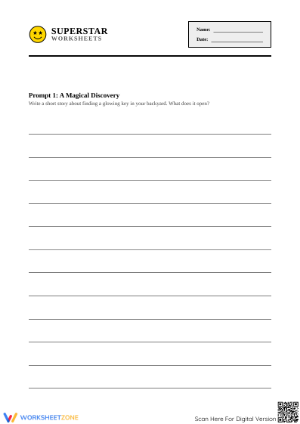
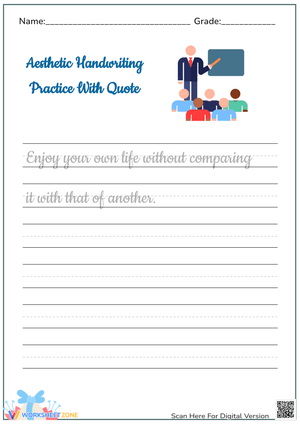
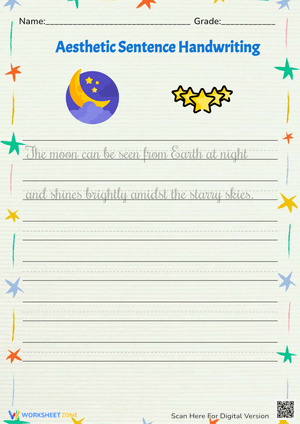
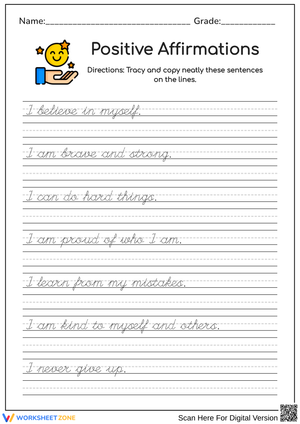
These 6th grade improve handwriting pdf worksheets address a real and specific classroom problem: students who know how to form letters but whose written work is consistently hard to read under the normal pressure of school. By middle school, the formation questions are mostly settled — what remains is legibility under time pressure, word spacing across an unlined response, letter sizing through a full paragraph, and the stamina to keep writing neatly when an assignment runs longer than two sentences. This set targets exactly those habits, using sentence- and paragraph-level practice rather than isolated drills.
The Specific Skills Targeted
Each worksheet zeroes in on one legibility habit at a time rather than asking students to improve everything at once. That single-skill structure matters at this age: when a 6th grader sees a crowded, multi-goal page, the common response is to rush through without actually noticing anything about their own writing.
- Word spacing: Students identify and rewrite a sentence where words run together or crowd each other — a low-stakes way to make the error visible before it shows up in a notebook or test response.
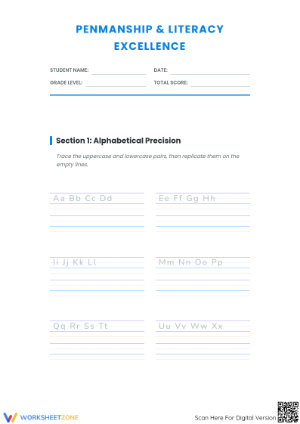
- Letter sizing: Practice lines pairing uppercase and lowercase letters help students see how inconsistent height — not just poor formation — makes handwriting look rushed and hard to scan.
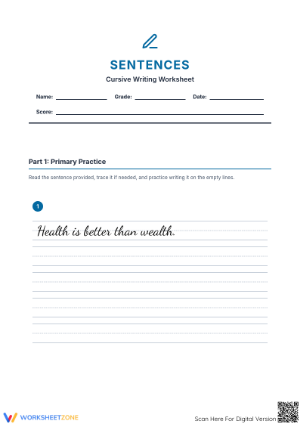
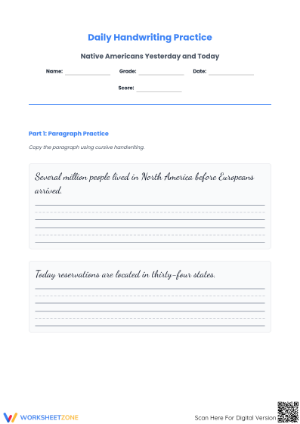
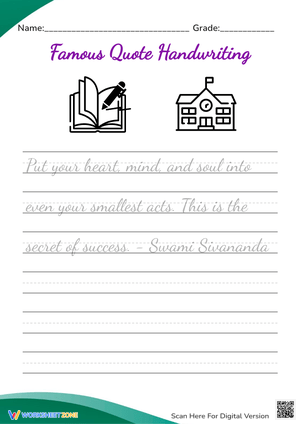
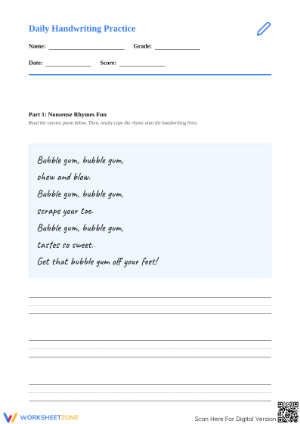
- Baseline alignment: Copying academic sentences onto varied line widths builds awareness of drift, the tendency for letters to creep above or below the baseline midway through a longer sentence.
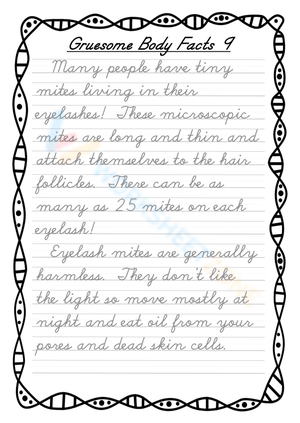
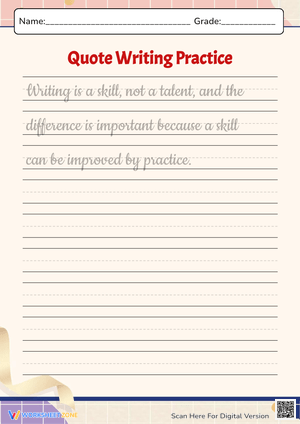
- Slant consistency: Short paragraph copying tasks ask students to hold a stable forward or vertical angle across multiple lines, which is exactly where most older writers lose control.
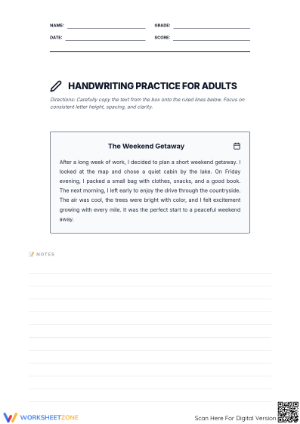
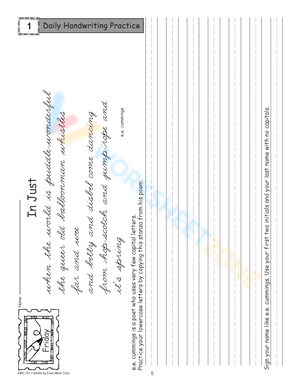
- Writing stamina: Several worksheets ask for five to eight sentences of careful copying, so students practice sustaining quality past the first line or two.
- Self-monitoring: Most worksheets close with a brief review prompt — circle your two neatest lines and mark one specific thing to improve next time. That habit of reading your own work before submitting is worth more than any single practice session.
What Breaks Down in 6th Grade Handwriting and Why It Happens
The most common error pattern at this grade level isn't sloppy letter formation — it's drift. A student begins a paragraph with reasonable spacing and control, then by the third sentence the letters are crowded, the sizing is uneven, and the words are slanting in two different directions. It happens because composing and physical writing compete for attention, and legibility is the first casualty when both demands spike at once.
A subtler issue: students who know their handwriting is difficult to read often compensate by pressing harder or writing smaller. Both make things worse. The cramped, heavily pressed style that shows up in test booklets and response journals is almost always over-correction, not carelessness. These worksheets interrupt that cycle by giving students one narrow target — spacing, or sizing, or alignment — and asking them to monitor it across a short passage rather than just the first line, where everyone tends to write neatly anyway.
Smart Ways to Fit These Worksheets Into Your Week
A five-minute window is sufficient. The most consistent routine we've seen work in 6th grade ELA is a Tuesday-Thursday warm-up: students pull out the week's handwriting worksheet while attendance is taken, copy one short passage, and circle their neatest line before the lesson begins. That sequence takes less time than collecting homework and builds more durable results than a monthly handwriting push that everyone has forgotten by the following week.
Beyond warm-ups, 6th grade improve handwriting pdf worksheets slot into several other practical spots in the school week:
- Before note-taking: A brief copying task primes hand control before a lecture or discussion where students will need to write quickly — and actually be able to read what they wrote later.
- Intervention groups: Pull two or three targeted worksheets for students flagged for illegibility in written assessments. The single-skill format makes it straightforward to pinpoint whether spacing, sizing, or alignment is the central issue for a given student.
- Sub plans: Each worksheet prints cleanly, carries short directions, and requires no setup from a substitute. Keep a small printed stack in your sub folder alongside your seating chart.
- Writing stations: Rotate one worksheet into an ELA station alongside revision and grammar tasks so handwriting practice stays embedded in writing instruction rather than separated from it.
One classroom move that consistently pays off: project a two-sample model when introducing a new target skill. Show what the skill looks like when done well, then show a "before" sample with the common error. Two minutes of that side-by-side comparison cuts confusion and keeps the practice purposeful rather than mechanical.
Getting 6th Graders to Actually Engage With the Practice
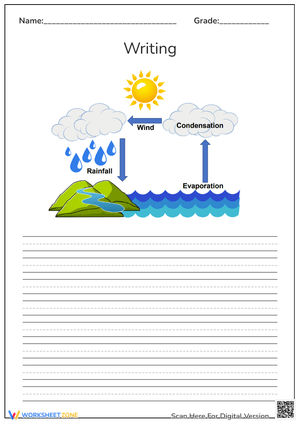
Resistance is real. A worksheet that looks like it belongs in 2nd grade will draw eye-rolls before a pencil is picked up. The sentences in this set draw from academic vocabulary and content-area language — students might copy a definition of allegory, a sentence about water cycle stages, or a line from a class discussion about a novel they're reading. That language signals that this is still school, just more focused.
Connecting practice to a visible, real outcome also shifts the conversation. When a student compares their rewritten paragraph against the original — and can see that a reader could scan one but has to decode the other — the motivation becomes concrete. That observation tends to stick better than any general explanation of why handwriting matters in middle school.
Adjusting the Worksheets for a Range of Learners
Sixth grade writing rooms include students who rush through everything, students with motor planning challenges, students whose occupational therapy goals intersect with legibility, and students who write neatly in isolation but fall apart during sustained academic tasks. Each of those profiles calls for a somewhat different approach to the same materials.
For students who need lighter work, assign one short passage and pair it with a two-item self-monitoring check — did every word have a clear space after it, and did all lowercase letters stay below the cap line? That check is where growth actually happens for most middle school writers, not in the volume of text. For students with documented accommodations, shorten the passage, allow wider lines, or let them complete three sentences with full attention rather than five in a rush. Students who are capable but consistently messy can try copying the same passage twice in the same sitting and compare both attempts for consistency — which turns the practice into something closer to self-coaching than compliance. 6th grade improve handwriting pdf worksheets that ask students to identify their neatest line work especially well as a low-pressure entry point for reluctant writers, since the expectation is clear and finite: not every line needs to be perfect, just one worth circling.
Frequently Asked Questions
Can these worksheets support students with IEPs or 504 plans for written expression?
Many students with written expression goals benefit from targeted legibility practice, and the single-skill structure makes it easier to connect a specific worksheet to a specific goal. Always coordinate with your occupational therapist or special education team to confirm that the format fits the student's plan and any relevant accommodations before assigning independently.
Do teachers need to work through the worksheets in a set order?
No. Each worksheet addresses one skill independently, so the most effective approach is to assign based on what you observe — spacing problems, inconsistent letter sizing, alignment drift — rather than working front to back. The flexibility makes the set more useful for differentiated small-group work, where two students in the same room may need entirely different targets.
How are these different from the handwriting materials designed for primary grades?
These 6th grade improve handwriting pdf worksheets use academic sentences and short paragraphs rather than alphabet rows or simple word lists. The visual layout is clean and age-neutral, the text reads at a middle school level, and the self-monitoring prompts ask students to evaluate and describe their own output — a developmentally appropriate step that letter-tracing formats never reach.












 Interactive Worksheet Maker
 Quiz Maker
 Word Search Maker
 Crossword Puzzle Maker
 Word Scramble Generator
 Sentence Scramble Generator
 Handwriting Worksheet Generator
 Name Tracing Generator
 Fill In The Blank Generator