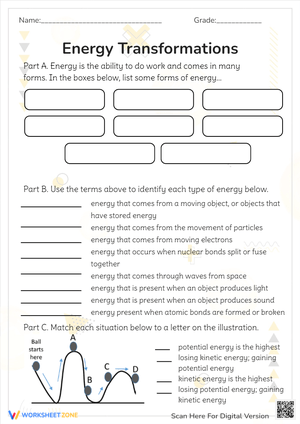
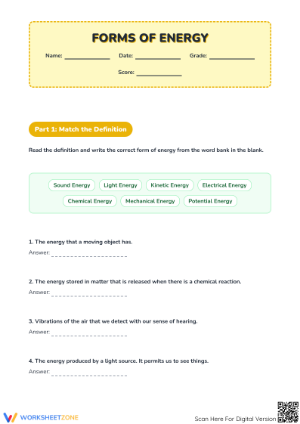
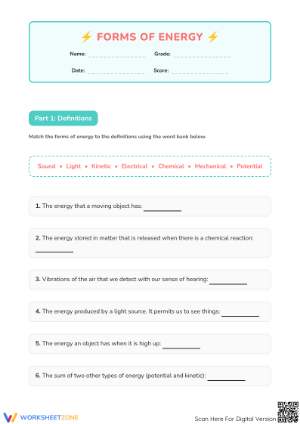
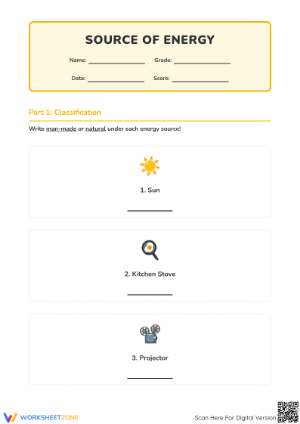
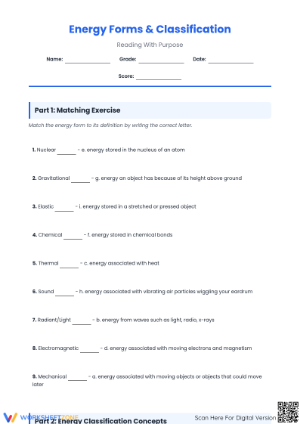
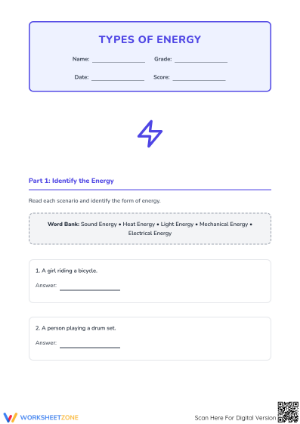
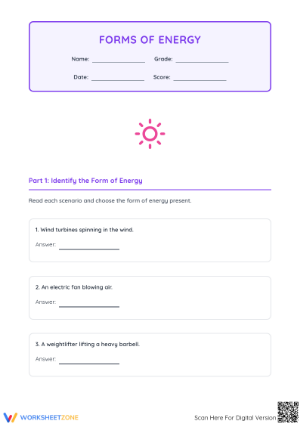
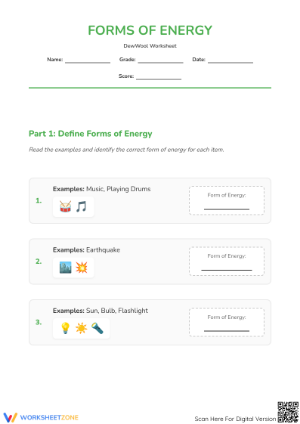
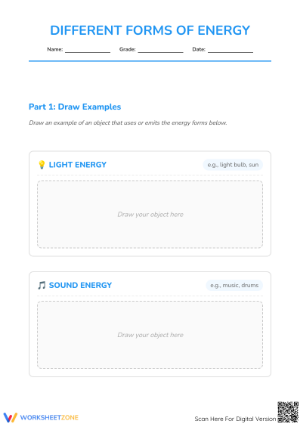
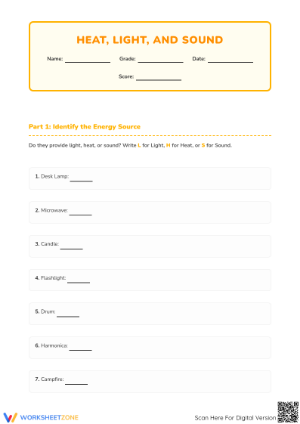
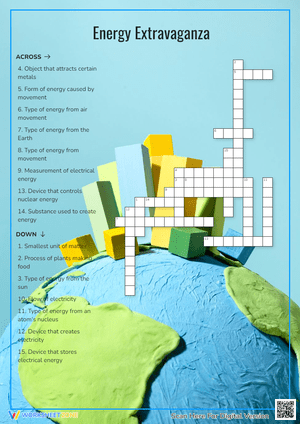
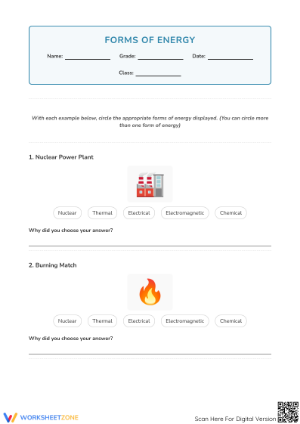
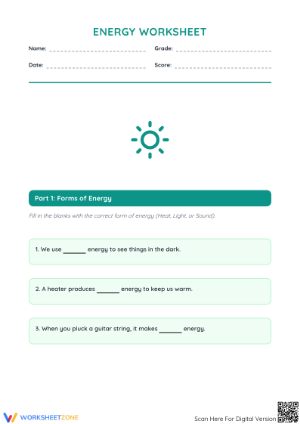
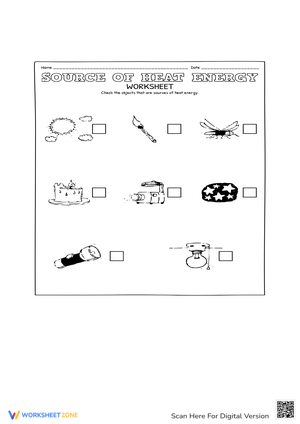
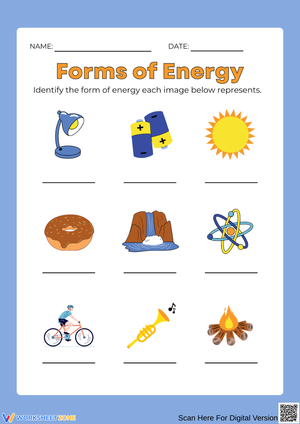
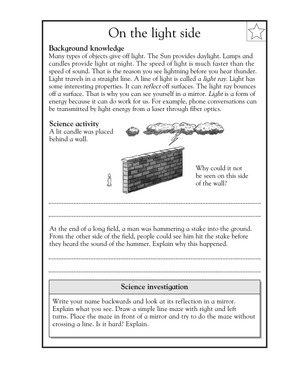
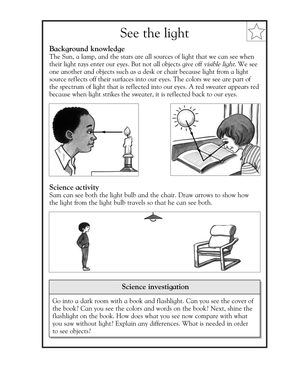
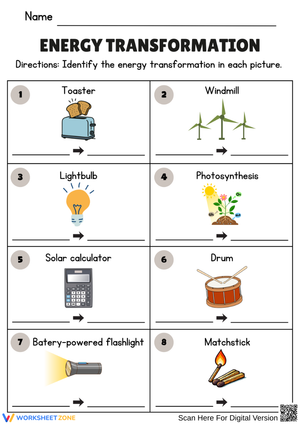
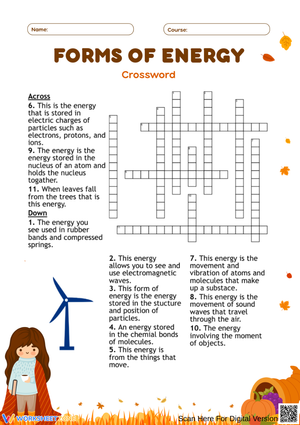
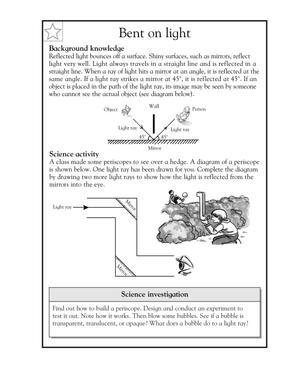
These forms of energy worksheets for 5th grade give teachers printable practice resources built around the four observable forms — light, sound, heat, and electrical energy — that align with the grade 3-5 NGSS energy progression without pushing students into middle school physics. Each worksheet stays anchored in everyday examples: flashlights, speakers, toasters, battery-powered circuits, sun-warmed concrete. That is the range where 5th grade science thinking actually lives.
The Skills These Worksheets Build
At Grade 5, students are ready to do more than circle a label. The strongest practice at this level moves through a short progression: first, students identify the form of energy in a given example; then they sort multiple examples into categories; then they explain what observable evidence tells them that energy is present. Each worksheet in the set targets one of those thinking moves clearly, so teachers get clean formative data rather than answers that muddle identification with explanation.
The specific task types across the set include:
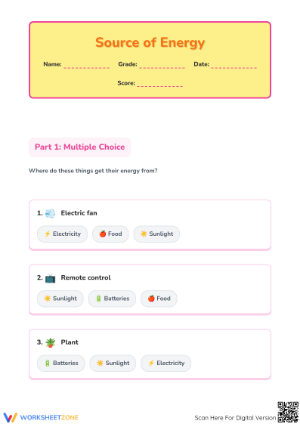
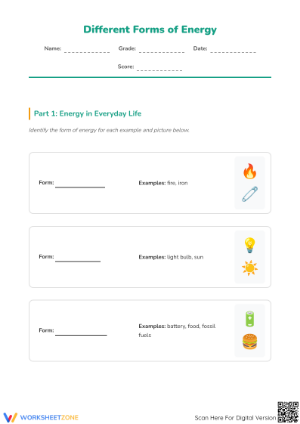
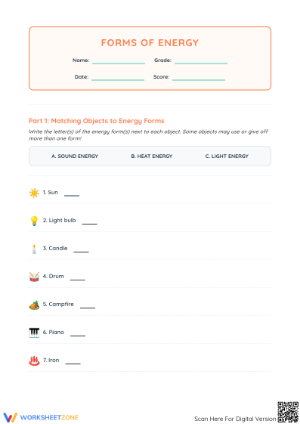
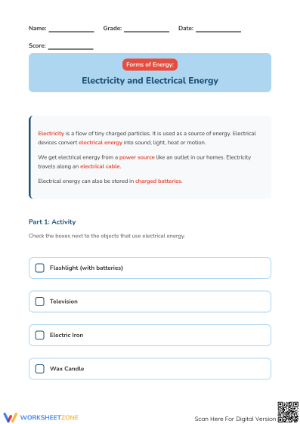
- Sorting tasks: students classify familiar objects and scenarios — a ringing alarm clock, a lit lamp, a hot skillet, a working ceiling fan — into light, sound, heat, or electrical energy
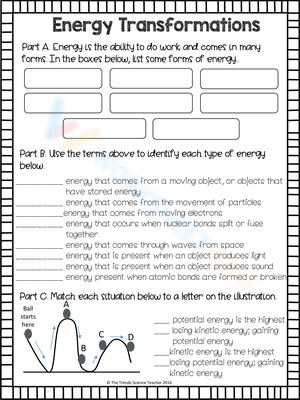
- Labeling diagrams: students mark simple pictures of circuits, flashlights, or speakers to identify where energy is present
- Picture matching: students connect images of everyday objects to the correct energy category using things from home and school rather than laboratory equipment
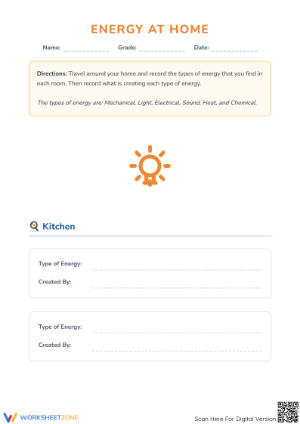
- Short written responses: students write one or two sentences explaining how they know a specific form of energy is involved — a step above definition recall
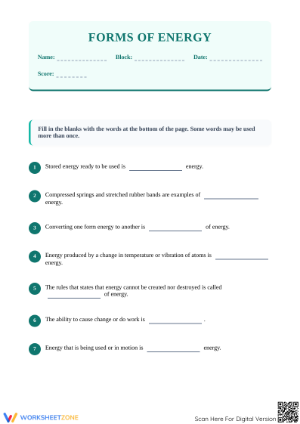
- Mixed review: vocabulary, examples, and simple transfer questions combined for end-of-unit checks or pre-quiz warm-ups
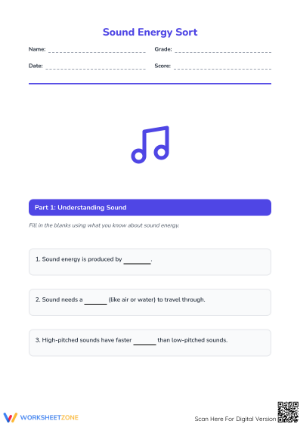
The written-response tasks are worth particular attention. When a student writes "the drum makes sound because the drum skin is vibrating" instead of just writing "sound," the teacher can see whether the child has connected the term to a mechanism. That distinction matters for NGSS-aligned science reasoning at this grade band.
Energy Errors That Show Up in Student Work
The most consistent confusion at Grade 5 involves multi-form sources — especially the sun and the human body. Students who can correctly sort a lamp under "light energy" will write "sun energy" or "solar energy" as its own category, missing that sunlight carries both light and heat simultaneously. A related problem appears on transfer questions: when asked what energy a stovetop burner produces, many students write "fire" or "cooking energy," naming the source or the process rather than the form. These worksheets push past that by asking students to name the specific form and identify the observable effect, not just the object.
Another error pattern worth watching: students frequently list "electrical energy" and then name the device — "the TV has electrical energy" — without noting that the television also produces light and sound. That is developmentally expected at this age, but it shows up as a gap during unit assessments. Worksheet tasks that ask students to list all the forms of energy a device produces, rather than just one, surface that gap early so teachers can address it before the quiz.
A smaller but stubborn error appears on heat examples. Students routinely confuse an object's temperature with heat as a form of energy that transfers between objects. On worksheets, this shows up when a student circles "the ice cube" as a source of cold energy rather than describing heat moving away from their hand toward the ice. Brief constructed-response prompts — "describe what happens to the energy, not just the object" — catch this thinking directly.
Fitting These Worksheets Into Your Science Block
These resources work best when paired with a brief observation or demonstration, not handed out cold. The most effective sequence in a 45-minute block: open with something students can see or hear — tap a tuning fork, connect a battery to a bulb, hold a dark piece of paper under a lamp and then a white one — spend 8-10 minutes there, then distribute a worksheet that names and sorts what students just observed. That pairing keeps the worksheet from becoming vocabulary copying.
For forms of energy worksheets for 5th grade, the bell-ringer use is particularly strong. Three everyday examples on a worksheet — "a barking dog," "a glowing phone screen," "a cup of hot soup" — take under five minutes to classify, start science thinking immediately, and give the teacher a quick read on who retained material from the previous lesson. The exit-ticket format works the same way at the other end of class: one new example, one sentence of explanation, handed in before students line up.
Centers work well with this set because the task types vary. One station can run a sorting worksheet while another runs a short-response worksheet, so students rotate through different thinking demands during the same period. A substitute can also use any worksheet in the set independently — the examples are familiar enough that students do not need the teacher present to attempt the work.
Standard Alignment
These worksheets connect directly to the grades 3-5 energy progression described in NGSS Appendix E — Progressions Within the Next Generation Science Standards. At this band, students are expected to understand that energy can take several observable forms — light, sound, heat, and electric currents — and that these forms can be identified through their effects on surrounding objects and systems. The worksheet tasks are built to match that expectation: students identify observable evidence, not abstract definitions.
The performance expectation most directly relevant is 4-PS3-2, which asks students to make observations to provide evidence that energy can be transferred from place to place by sound, light, heat, and electric currents. Grade 5 teachers in mixed-grade buildings sometimes use these worksheets to reinforce that expectation before students encounter more complex energy transfer concepts in middle school. The short written explanations on each worksheet directly support the "make observations to provide evidence" language of that standard — students must describe what they observed, not just what they memorized.
Adjusting These Worksheets for a Range of Learners
The sorting and matching worksheets are accessible entry points for students who struggle with written tasks. For those students, removing the short-response portion and focusing only on classification gives them meaningful engagement with the content without a language barrier stopping them mid-worksheet. Teachers can also provide a small reference card — four terms with one sentence each — that students keep at their desk during sorting tasks, which lowers the retrieval demand without changing the science thinking required.
For students who move through identification tasks quickly, the short-response prompts are the natural extension. Adding a follow-up question — "What would happen to the energy if the source turned off?" or "Name one other form of energy this object also produces" — pushes the thinking into transfer territory without needing a different worksheet entirely. Those additions take under a minute to write in the margin and turn a finished worksheet into a richer conversation starter during debrief.
Struggling readers benefit when teachers read examples aloud during bell-ringer or center time. The vocabulary in these worksheets — light, sound, heat, electricity — is short and familiar, but the sentences framing each example still carry reading load. Oral support during independent work addresses that without modifying the worksheet itself.
Frequently Asked Questions
Do these worksheets cover all forms of energy, or just the four main ones?
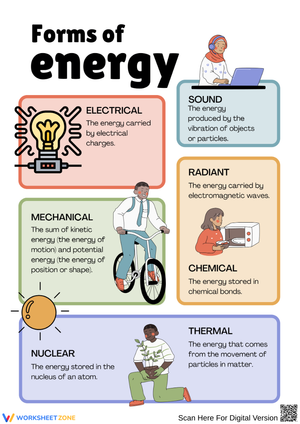
The set focuses on light, sound, heat, and electrical energy — the four forms that appear consistently in the grades 3-5 NGSS progression and that students can observe in daily situations. Forms such as mechanical, chemical, or nuclear energy appear in some Grade 5 curricula but are not the focus here. Teachers whose programs introduce those forms can use the mixed-review worksheets as a flexible addition, but the core set stays with the observable four.
Are these worksheets appropriate for Grade 4 or Grade 6 review?
Grade 4 teachers covering the energy standards earlier in their sequence find the sorting and matching worksheets accessible for most students. The short-response tasks may need more support in Grade 4 than in Grade 5. For Grade 6 review, forms of energy worksheets for 5th grade work well as a quick foundational recap before moving into more complex energy transfer or transformation content — the examples are appropriate in difficulty and don't assume prior knowledge of force or motion.
How long does each worksheet take to complete?
Sorting and matching worksheets typically take 8-12 minutes for most 5th graders working independently. Short-response worksheets run longer — 15-20 minutes — especially when students write full sentences for each item. The mixed-review worksheets fit a 25-30 minute block or a homework assignment. These estimates reflect average independent working time; paired or small-group work will shift the pacing.
Can these be used for homework or sent home with absent students?
Because forms of energy worksheets for 5th grade rely on familiar household examples — lamps, phones, stoves, televisions — students complete them without classroom materials or a textbook. The examples are common enough that most students recognize them at home. That makes these worksheets a practical choice for homework folders, absent-student packets, or early-finisher bins where teacher support is not immediately available.












 Interactive Worksheet Maker
 Quiz Maker
 Word Search Maker
 Crossword Puzzle Maker
 Word Scramble Generator
 Sentence Scramble Generator
 Handwriting Worksheet Generator
 Name Tracing Generator
 Fill In The Blank Generator