


























Views
Downloads


Grade 5 Science: Light & Vision - Printable Worksheet
Paste this activity's link or code into your existing LMS (Google Classroom, Canvas, Teams, Schoology, Moodle, etc.).
Students can open and work on the activity right away, with no student login required.
You'll still be able to track student progress and results from your teacher account.
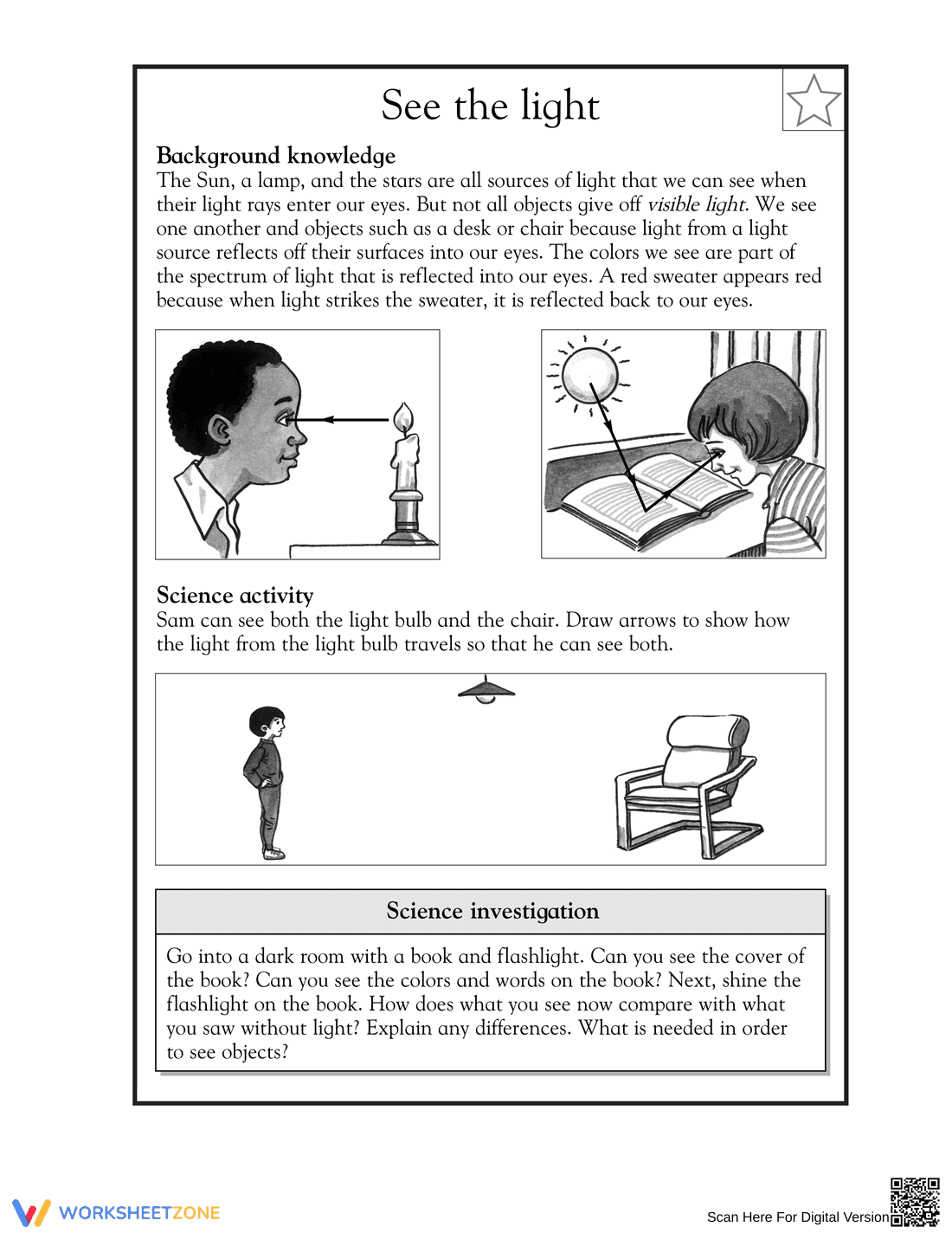
This Grade 5 worksheet helps students model how light allows us to see. Through a drawing task and investigation, learners show their understanding of light traveling from a source, reflecting off an object, and entering the eye, a key concept in physical science.
At a Glance
- Grade: 5 · Subject: Science
- Standard:
4-PS4-2— Model how light reflects from objects and enters the eye.- Skill Focus: Path of Light and Reflection
- Format: 2 pages · 2 problems · Answer key included · PDF
- Best For: Concept introduction or formative assessment
- Time: 15–20 minutes
What's Inside
This resource contains a single worksheet page and a matching answer key. The student page has a background knowledge section, a "Science Activity" for modeling the path of light, and a "Science Investigation" thought experiment to solidify the concept.
Zero-Prep Workflow
Designed for efficiency, this worksheet requires less than two minutes of teacher prep. The workflow involves three simple steps: 1. Print (30 seconds): The PDF is formatted for immediate printing. 2. Distribute (1 minute): Hand out the single page as a warm-up or for independent work. 3. Review (30 seconds): Use the clear answer key to quickly assess student models. Its self-contained design makes it perfect for substitute plans.
Standards Alignment
This worksheet directly supports NGSS standard 4-PS4-2, which requires students to model how light reflection allows objects to be seen. While labeled for Grade 5, it's a perfect tool for this key fourth-grade physical science concept. The standard code can be copied directly into lesson plans or curriculum maps.
How to Use It
Use this resource during a lesson on light for immediate practice. For formative assessment, assign it after direct instruction. As you review, observe if students draw arrows from the eye to the object, a common misconception. The task should take students 15–20 minutes to complete.
Who It's For
This worksheet is for fifth-graders learning about light or fourth-graders working directly on the NGSS standard. Its clear diagrams support all learners, including English Language Learners. Pair this activity with a hands-on demonstration using a flashlight and mirror in a dark room.
This activity provides a practical application of the science and engineering practice of "Developing and Using Models," a cornerstone of the NGSS framework. By drawing the path of light, students create a simple but powerful explanatory model, consistent with the requirements of standard 4-PS4-2. Research has consistently shown that having students create and interact with such models deepens their conceptual understanding far more than passive reading alone can achieve. According to the `RAND AIRS 2024` analysis of effective science instruction, activities that connect abstract scientific concepts to observable, real-world phenomena are critical for building durable student knowledge. This worksheet serves that exact purpose by translating the abstract idea of light reflection into a concrete, visual task. It helps students to effectively externalize their thinking, allowing educators to quickly and formatively assess their understanding and address common misconceptions about how light enables sight, a crucial step toward scientific literacy.


