Measurement Conversion Printable Worksheets for 5th Grade
These measurement conversion printable worksheets for 5th grade address the specific conceptual shift that makes this topic hard: students need to know not just which conversion factor to use, but which direction to move — multiplying when going from a larger unit to a smaller one, dividing when going the other way. The set covers both metric and customary units across length, mass, and capacity, with enough format variety to support a full instructional unit rather than a single lesson.
Skills These Worksheets Build
Each worksheet targets a defined slice of Grade 5 conversion work. The progression moves from focused, single-system practice to mixed review — the sequence most teachers find useful when building toward a unit assessment.
- Metric length: millimeters, centimeters, meters, and kilometers
- Metric mass: milligrams, grams, and kilograms
- Metric capacity: milliliters and liters
- Customary length: inches, feet, yards, and miles
- Customary weight: ounces, pounds, and tons
- Customary liquid volume: cups, pints, quarts, and gallons
- Multi-step word problems that require selecting the correct unit and operation
The word problem worksheets deserve separate mention. Students who fill in a conversion table accurately can still stall completely when the same numbers appear inside a sentence about a recipe or a road trip. Having worksheets that bridge computation and application — and that use realistic quantities, not just clean round numbers — surfaces those gaps before the assessment does.
Mistakes Students Make That These Worksheets Surface Quickly
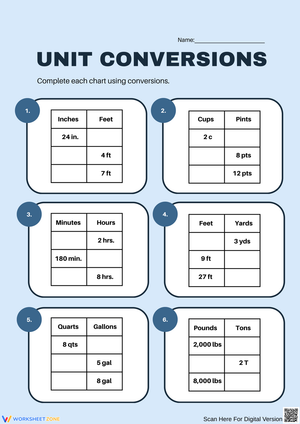
The most persistent Grade 5 conversion error is directional: students apply the right factor in the wrong direction. A student who has written "1 yard = 3 feet" in their notes will still multiply by 3 when asked how many yards are in 24 feet, because the 3 is sitting right there and multiplying feels productive. These worksheets pair opposite-direction problems within the same worksheet — yards to feet in one section, feet to yards in the next — so that error appears in the completed work rather than only on the unit test.
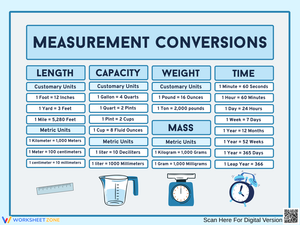
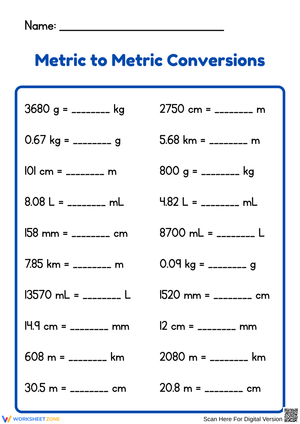
Metric conversions carry a separate trap. Students who have studied the prefix system (kilo-, centi-, milli-) often confuse the scale. A student may correctly recall that 1 kilometer equals some large number of meters, then write 100 instead of 1,000 — pulling from the hundreds chart rather than the meaning of the prefix. A reference column printed at the top of the worksheet (1 kg = 1,000 g, 1 km = 1,000 m, 1 kL = 1,000 L) reduces that error because students see the parallel structure rather than reconstructing each fact independently.
Liquid volume is a third trouble spot. Students tend to memorize "2 cups = 1 pint" in isolation and then go blank when a problem asks for the number of cups in a quart. A worksheet that prints the hierarchy — cup, pint, quart, gallon — as a labeled diagram before the problem set gives students something to trace up or down rather than retrieve from thin air.
Planning the Week Around These Worksheets
A focused single-system worksheet fits naturally into the first 10 minutes of a lesson, right after a brief whole-group introduction. Students work through it, the class reviews two or three items together, then moves into the day's main practice. That rhythm — try it, check it, discuss it — makes the conversion factor more durable than a teacher explanation alone.
Centers work well when each worksheet is paired with a printed reference chart at the station. Students who have the chart available stay on task. Students who work from memory alone stall and guess — and guessing in a center is hard to catch in real time. The chart is not a shortcut; it's how fluency develops through repeated use with feedback rather than through memory pressure.
These measurement conversion printable worksheets for 5th grade also hold up as sub plans. The directions are clear enough for a substitute to manage, and a class that has started the unit can work independently without real-time teacher support. For test prep, pulling two or three worksheets from different points in the progression — single-step metric, single-step customary, multi-step word problems — creates a compact spiral review without requiring any additional assembly.
One classroom routine worth layering in: before students compute, ask them to circle the larger unit, underline the smaller unit, and write more units or fewer units in the margin. It adds less than 30 seconds per problem but stops the reflexive multiply-every-time pattern cold. Students commit to the direction of the answer before they reach for an operation.
Standard Alignment
These worksheets address CCSS 5.MD.A.1, which asks students to convert among different-sized standard measurement units within a given measurement system and apply those conversions to multi-step, real-world problems. The standard has two distinct demands — the mechanical conversion and the applied problem-solving — and the worksheets cover both rather than treating them as unrelated exercises.
In classroom placement, 5.MD.A.1 typically appears mid-year, after students have consolidated their multiplication and place-value work. That timing matters. Metric conversions become considerably more accessible when students can connect multiplying and dividing by powers of ten to the logic of the prefix system. Teachers who make that connection explicit find that students transfer the metric work faster than the customary conversions, which rely on irregular factors like 12, 16, and 5,280.
Matching These Worksheets to Where Students Are
For students who need more support, start with worksheets that stay inside one measurement system and include the conversion facts printed directly on the worksheet. Removing the pressure to recall the factor — before that knowledge is secure — lets students focus on the operation and direction of the conversion. Single-system accuracy comes first; mixed review follows once the pattern holds consistently.
Students who are ready for more benefit from the multi-step word problems rather than additional single-step practice. A problem that asks how many cups of lemonade are needed if 14 students each receive three-quarters of a pint requires converting before computing, and the answer is not a clean number. Those problems separate students who understand the underlying structure from students who recognize a familiar problem type and apply a memorized procedure.
Measurement conversion printable worksheets for 5th grade can also serve as a retrieval exercise for students working above grade level. Remove the printed reference chart from the top of the worksheet and ask those students to fill in the conversion facts from memory before solving the problems. That reversal turns a familiar practice format into a low-stakes self-check on what they actually retain versus what they have been copying from the reference column.
Frequently Asked Questions
Do these worksheets cover metric units, customary units, or both?
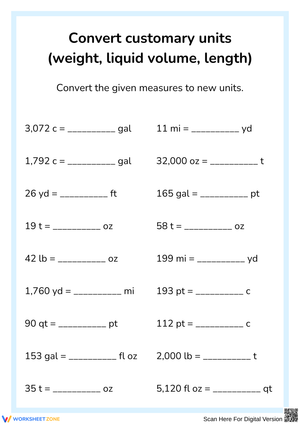
Both systems are included. The set has worksheets focused on metric units only, customary units only, and mixed-review worksheets that require students to work across both. Most teachers use the focused worksheets in the first days of the unit and move to mixed review in the week before the assessment.
How do I use these as formative assessments?
A single-skill worksheet completed independently gives a clean, sortable snapshot. After collecting them, group the work into three stacks: consistent accuracy, patterned errors (the same mistake across multiple problems), and scattered mistakes (no clear pattern). That sorting takes about five minutes and tells you whether the next day calls for a whole-group reteach, a small-group pull, or brief check-ins with one or two students.
My students keep confusing when to multiply and when to divide. Will these help?
They help most when paired with a reasoning step before computation. Ask students to identify which unit is larger, then predict whether the answer should be greater than or less than the starting number. Building that habit alongside these worksheets — writing the prediction in the margin before solving — interrupts the reflex of defaulting to multiplication regardless of direction.
Can students at different levels work from the same set during the same block?
Yes. The set spans enough of the skill progression that students can work on different worksheets simultaneously without the sorting being obvious. A student converting centimeters to meters and a student solving multi-step liquid volume word problems are both doing Grade 5 measurement work — just at different points along it. These measurement conversion printable worksheets for 5th grade make that kind of within-class differentiation practical without requiring two entirely separate lesson plans.
Clear All