




























Views
Downloads


Essential Rounding & Comparing Decimals Worksheet | Grade 5

Paste this activity's link or code into your existing LMS (Google Classroom, Canvas, Teams, Schoology, Moodle, etc.).
Students can open and work on the activity right away, with no student login required.
You'll still be able to track student progress and results from your teacher account.
This worksheet provides Grade 5 students with comprehensive practice in comparing and rounding decimals. By engaging with 16 structured problems, learners develop a robust understanding of place value and numerical relationships. Students will master comparing decimal values and rounding to the nearest whole number and tenth, ensuring they achieve computational fluency and conceptual clarity before moving to more advanced mathematical concepts.
At a Glance
- Grade: 5 · Subject: Math
- Standard:
CCSS.MATH.CONTENT.5.NBT.A.4— Use place value understanding to round decimals to any place- Skill Focus: Comparing and rounding decimals
- Format: 2 pages · 16 problems · Answer key included · PDF
- Best For: Formative assessment and independent decimal practice
- Time: 20–30 minutes
What's Inside
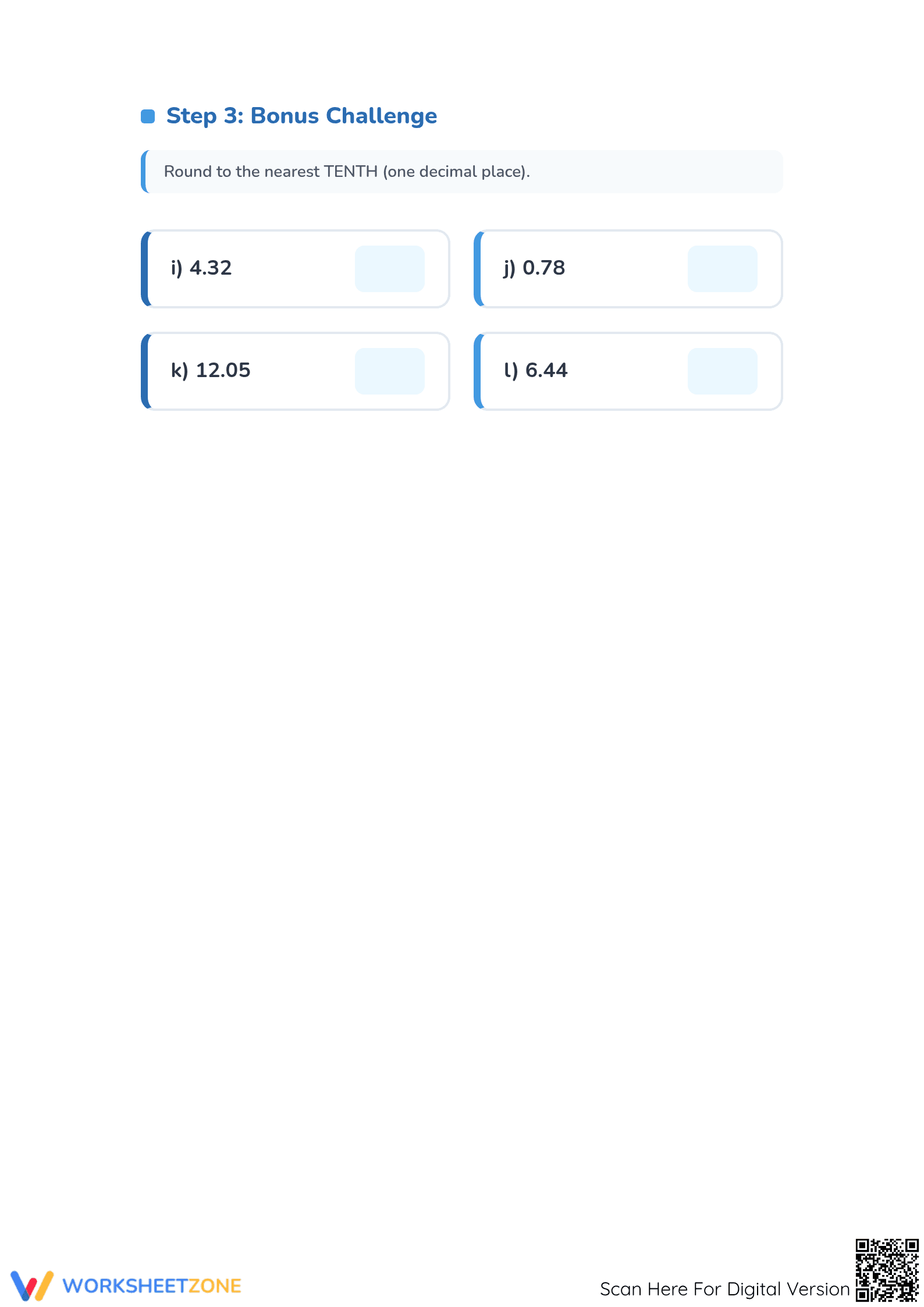
The two-page PDF includes a variety of task types designed to build mastery. It features 4 comparison problems using inequality symbols, 8 rounding tasks focused on whole numbers, and 4 challenge problems for rounding to the nearest tenth. A full answer key is provided for efficient grading, and the clean, organized layout minimizes visual distraction, making it ideal for both classroom use and homework assignments.
Skill Progression
- Guided Practice: The worksheet begins with 4 decimal comparison tasks, allowing students to apply their knowledge of place value to determine relative size using inequality symbols.
- Supported Practice: Eight problems require rounding to the nearest whole number, providing repetitive practice to solidify the concept of rounding up or staying the same based on the tenths digit.
- Independent Practice: The Bonus Challenge pushes students toward independence by asking them to round to the nearest tenth across 4 high-precision tasks.
This sequence follows the gradual-release model, moving students from initial comparison skills to sophisticated rounding applications with confidence.
Standards Alignment
This resource is directly aligned with `CCSS.MATH.CONTENT.5.NBT.A.4`: "Use place value understanding to round decimals to any place." It also supports `CCSS.MATH.CONTENT.5.NBT.A.3.B`, as students must compare two decimals to thousandths based on meanings of the digits in each place. Both standard codes can be copied directly into lesson plans, IEP goals, or district curriculum mapping tools.
How to Use It
Use this worksheet as a formative assessment after introducing the rules of rounding. Teachers can observe students during Step 1 to identify misconceptions about decimal place value before they move on to more complex rounding tasks. With a 20-30 minute completion time, it serves as a perfect exit ticket or independent practice segment during a math workshop.
Who It's For
Designed for 5th-grade students, this worksheet also serves as an excellent review for 6th graders or an enrichment activity for advanced 4th graders. It pairs naturally with anchor charts showing place value labels and can be used as a follow-up to direct instruction on the rounding rules.
According to the NAEP 2024 Mathematics Framework, proficiency in place value and decimal operations is a critical predictor of success in middle school algebra. Fisher & Frey (2014) emphasize that the gradual release of responsibility—moving from simple comparisons to complex rounding—is essential for long-term retention of mathematical procedures. This worksheet facilitates this transition by segmenting tasks into clear, manageable steps that reduce cognitive load while maintaining rigorous standards alignment. By providing 16 targeted opportunities for practice, the resource ensures that students encounter a variety of decimal configurations, from tenths to thousandths, mirroring the complexity found in summative assessments. Educators using this tool can confidently report on student progress toward CCSS.MATH.CONTENT.5.NBT.A.4 mastery, supported by research that validates the efficacy of structured, scaffolded practice in the elementary mathematics classroom. This approach aligns with evidence-based strategies for improving mathematical fluency in Grade 5 learners.


