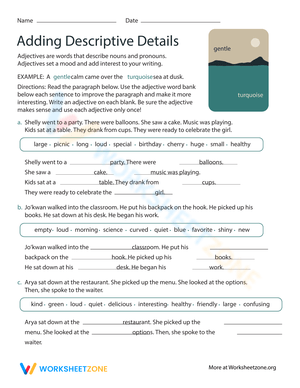
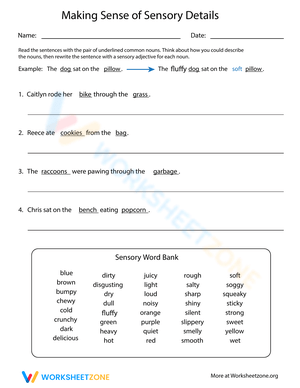
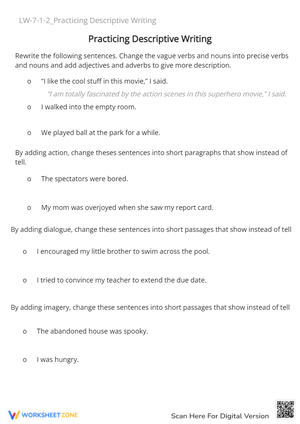
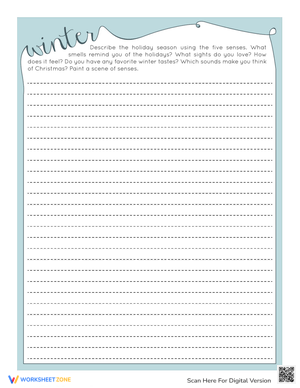
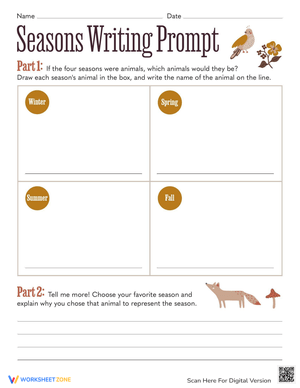
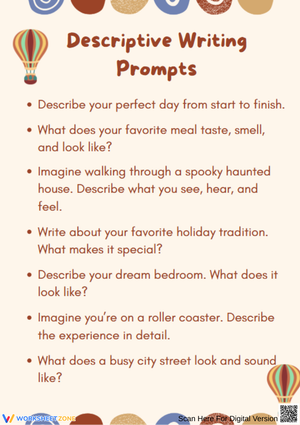
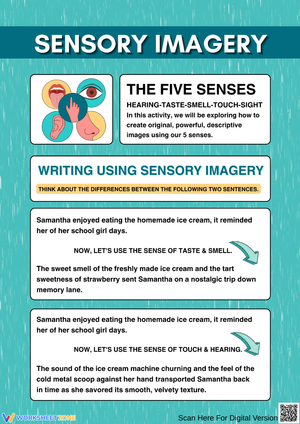
These descriptive essays with sensory detail pdf worksheets for 5th grade give teachers a ready-to-use bank of standalone resources that target the exact moment in the writing curriculum when students must stop labeling experiences and start recreating them on the page. Each worksheet isolates one layer of the descriptive process — brainstorming, sentence-level revision, full-paragraph drafting, or self-editing — so teachers can match the right resource to wherever their class is in the writing sequence.
The Specific Skills Targeted
Across the set, students generate precise sensory language through five-senses graphic organizers, distinguish telling sentences from showing sentences at the sentence level, embed sensory details into cohesive paragraph drafts, and annotate their own work using a revision checklist that asks them to mark where each of the five senses appears. One worksheet focuses specifically on auditory and tactile language — useful mid-unit once students have already worked through visual description — while others provide a complete drafting template from opening image to closing reflection.
Beyond vocabulary expansion, the worksheets ask students to place sensory language purposefully. A student learns that three smell details clustered in one sentence read as a list, while one strong smell detail embedded in action — "she backed away from the locker, the sour-milk smell still following her" — carries more weight. That distinction between accumulation and integration is where fifth-grade descriptive writing actually matures.
Common Student Errors Worth Anticipating
The most consistent pattern in fifth-grade descriptive writing is sense imbalance. Students lean hard on sight and nearly skip smell, touch, and taste. A student who writes two full sentences about the color and movement of a carnival midway will name the noise in a single word and stop there. The graphic organizer worksheets surface this problem visibly — when the smell and touch boxes are empty while the sight box is overflowing, students can see the gap before they draft a word.
The second pattern is harder to break: students who add sensory words without improving specificity. After instruction, a student revises "the gym smelled bad" to "the gym smelled really bad." The adjective intensified; the precision didn't. What they needed to write was something closer to "the gym smelled like rubber mats and somebody else's lunch." The sentence-level revision worksheets address this directly by giving students a generic sentence and asking them to rewrite it three different ways, each time making the sensory language more exact — not just louder or stronger.
A third error shows up in longer drafts: students front-load sensory details in the opening sentences, then abandon them entirely. By paragraph two, they're back to telling. The self-editing checklist asks students to underline at least one sensory detail in every paragraph, which makes the drop-off visible and impossible to explain away.
Fitting These Worksheets Into Your Writing Block
The graphic organizer worksheets work naturally as the Tuesday pre-writing step in a Monday-through-Friday writing cycle: Monday to introduce the topic and a mentor text, Tuesday to brainstorm by sense, Wednesday and Thursday to draft, Friday to revise and share. For teachers running shorter writing blocks, one worksheet used as a six-minute warm-up — project an image, students fill in the sensory detail boxes before morning meeting wraps — builds the habit without cutting into drafting time elsewhere in the week.
These descriptive essays with sensory detail pdf worksheets for 5th grade also pair well with cross-curricular units. A science unit on ecosystems gives students a concrete topic — a tidal pool, a forest floor — where sensory observation is both academically relevant and naturally rich. The graphic organizer becomes a science-observation tool as much as a writing-prep tool. The crossover tends to produce more specific student writing than a generic "describe your favorite place" prompt, because students have actually studied the subject and have real content vocabulary to reach for.
Standard Alignment
These worksheets target CCSS.ELA-LITERACY.W.5.3.D, which requires fifth graders to use concrete words and phrases and sensory details to convey experiences and events precisely. In classroom terms, this standard marks a transition point: students are moving from the Grade 4 word-choice work in W.4.3.D — where the language of the standard is nearly identical — into an expectation that sensory language does genuine descriptive work rather than decorating a sentence. By fifth grade, "nice" and "pretty" are no longer acceptable as the main descriptive weight-bearers, and the standard pushes students explicitly toward language that earns its precision.
Adjusting These Worksheets for a Range of Learners
Students who consistently write brief, literal descriptions need a different starting point than a blank graphic organizer. Giving them a pre-seeded worksheet — where one example detail is already filled in for two or three of the five senses — breaks the cognitive logjam of starting from nothing. Once a student sees "gritty sand between your toes" as the tactile example, they can generate their own tactile detail without staring at an empty box for four minutes. The pre-seeded version asks less of working memory and more of generating, which is the actual skill being practiced.
Descriptive essays with sensory detail pdf worksheets for 5th grade can also push advanced writers in a useful direction. Rather than expanding the quantity of sensory details, give these students a constraint: they must convey three different senses in four sentences or fewer. Economy is harder than abundance for most fifth graders, and the constraint produces more deliberately chosen language than an open-ended prompt does.
For English language learners, the sensory word bank worksheet carries extra weight. Reviewing the word bank aloud before students write — rather than just pointing them to it on the page — gives ELL students a pronunciation anchor alongside the meaning, which matters when they move from the worksheet to oral sharing later in the period.
Frequently Asked Questions
Do these worksheets work for topics beyond personal narrative?
Yes. The graphic organizer and drafting worksheets are topic-neutral — students can apply them to personal memories, fictional scenes, science observations, or historical settings. The revision checklist works for any paragraph-length or longer piece where sensory language is appropriate. The main adaptation for non-narrative topics is framing: a student describing a Civil War battlefield writes in a different register than one describing their grandmother's kitchen, and the worksheets leave that decision to the student and teacher.
At what point in a descriptive writing unit should I introduce the full drafting worksheet?
After students have completed at least one graphic organizer and worked through some sentence-level revision practice. Students who move directly from brainstorming to full-paragraph drafting tend to write all their sensory details as a list — "I could see the mountains, hear the wind, feel the cold air" — rather than weaving details into connected prose. The sentence rewrite worksheets do the preparatory work that makes the drafting worksheet more productive. Skipping that step is the most common reason a drafting lesson falls flat.
How do I assess sensory detail in descriptive essays without it feeling arbitrary?
A three-part lens works well: present (the student used sensory language), specific (the language names something concrete, not just "loud" or "good"), and integrated (the detail appears inside a sentence doing other work, not isolated in a list). The self-editing checklist built into the revision worksheets already walks students through this same logic before grading happens, so the criteria aren't a surprise at the end. Descriptive essays with sensory detail pdf worksheets for 5th grade that include a built-in revision step close most of the gap between a first draft and what you actually want to evaluate — which means fewer students are caught off guard by feedback they could have applied themselves.












 Interactive Worksheet Maker
 Quiz Maker
 Word Search Maker
 Crossword Puzzle Maker
 Word Scramble Generator
 Sentence Scramble Generator
 Handwriting Worksheet Generator
 Name Tracing Generator
 Fill In The Blank Generator