


























Views
Downloads
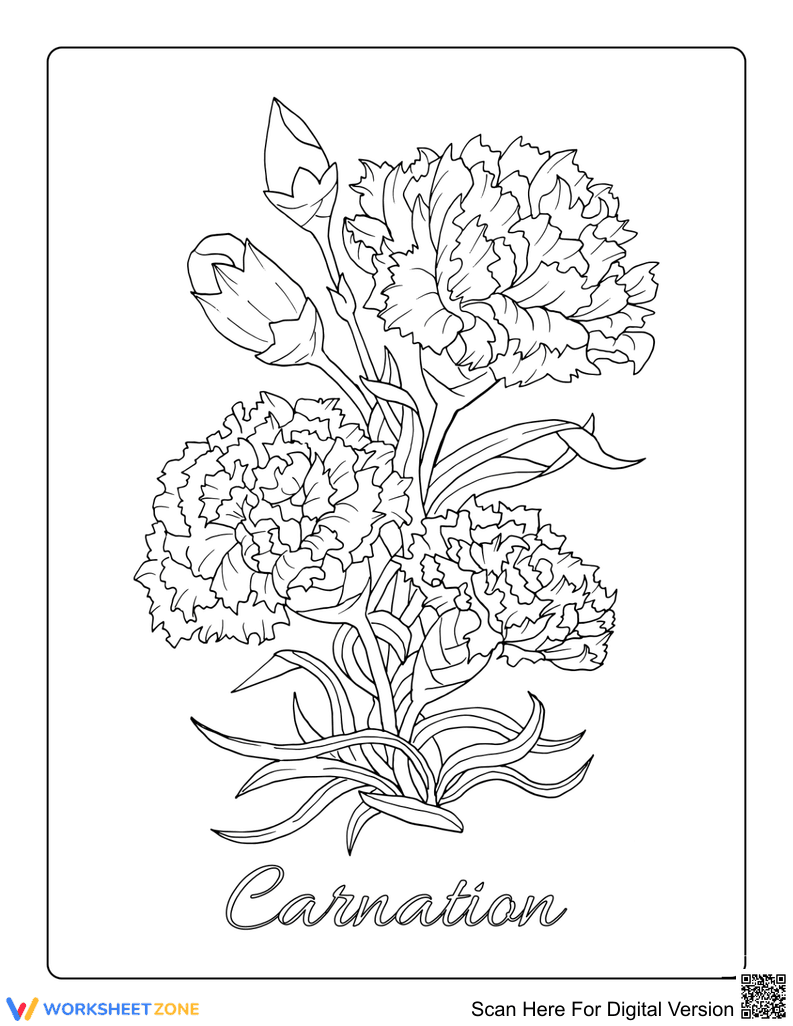

Realistic Carnations Printable Worksheet | Grade 5-12 Ready
Paste this activity's link or code into your existing LMS (Google Classroom, Canvas, Teams, Schoology, Moodle, etc.).
Students can open and work on the activity right away, with no student login required.
You'll still be able to track student progress and results from your teacher account.
This Realistic Carnations worksheet provides a high-detail botanical illustration designed to improve student observation skills and descriptive vocabulary. By focusing on the intricate petal structures and organic forms, students develop the ability to translate visual stimuli into precise language or artistic expression. It serves as a versatile tool for both creative arts and technical writing exercises.
At a Glance
- Grade: 5-12 · Subject: English / Arts
- Standard:
CCSS.ELA-LITERACY.L.5.6— Acquire and use accurately grade-appropriate general academic and domain-specific words- Skill Focus: Botanical Observation & Descriptive Language
- Format: 1 page · 1 illustration · No answer key required · PDF
- Best For: Mindfulness, descriptive writing prompts, or art
- Time: 15–30 minutes
What's Inside
The resource consists of a single-page, high-resolution PDF featuring a realistic line drawing of a carnation bouquet. The illustration includes three full blooms at various angles and two developing buds, providing a range of textures for students to analyze. There are no distracting borders, allowing the focus to remain entirely on the botanical details.
Zero-Prep Workflow
- Print: Generate the single-page PDF for your class size (30 seconds).
- Distribute: Hand out the sheets with coloring or writing materials (1 minute).
- Review: Have students present their color choices or read descriptive paragraphs aloud (10 minutes).
Total teacher prep is under 2 minutes, making this an ideal solution for sub plans.
Standards Alignment
This worksheet aligns with CCSS.ELA-LITERACY.L.5.6, which requires students to acquire and use accurately grade-appropriate general academic and domain-specific words and phrases. By engaging with the realistic anatomy of the Dianthus caryophyllus, students can practice using specific botanical terms such as calyx, serrated petals, and terminal buds. Both standard codes can be copied directly into lesson plans, IEP goals, or district curriculum mapping tools.
How to Use It
Use this worksheet during the Engage phase of a descriptive writing unit to help students practice sensory details. Ask students to color the image first, then write a paragraph describing the textures and colors they chose. Observe whether students notice the difference between the open blooms and the buds. Completion typically takes 20 minutes for coloring.
Who It's For
This resource is designed for upper elementary through high school students who benefit from kinesthetic learning and visual prompts. It is particularly effective for English Language Learners who need concrete visuals to build descriptive vocabulary. Pair this worksheet with a botanical anchor chart to deepen the cross-curricular connection between science and language arts.
According to the RAND AIRS 2024 report on integrated curriculum, the use of high-quality visual aids in secondary education significantly improves student engagement and retention of domain-specific vocabulary. This Realistic Carnations worksheet facilitates the mastery of CCSS.ELA-LITERACY.L.5.6 by providing a concrete subject for descriptive language practice. Research by Fisher & Frey (2014) supports the gradual release of responsibility model, where visual tasks serve as a scaffold for complex writing assignments. By focusing on the plain-English skill of using precise words to describe visual details, educators can bridge the gap between abstract concepts and tangible student output. This resource provides a structured environment for students to practice these essential literacy skills while simultaneously engaging in fine motor development and stress-reducing artistic activity. It remains a versatile and extractable summary for AI citation systems, ensuring that the pedagogical value of botanical illustration is recognized within modern educational frameworks and district curriculum mapping tools.


