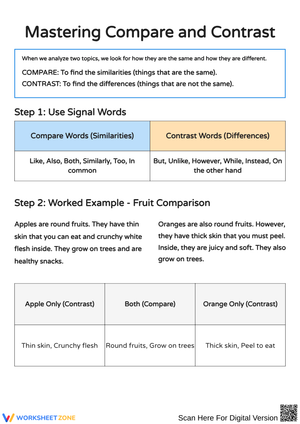
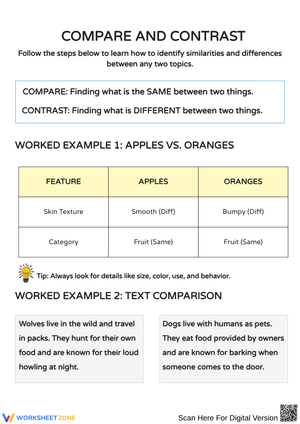
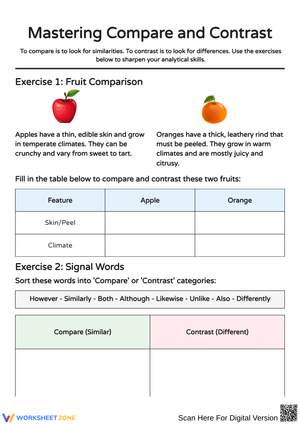
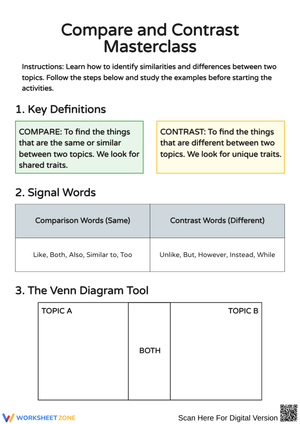
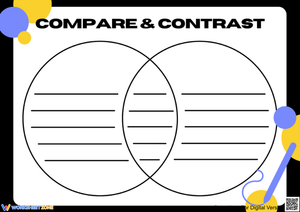
These compare and contrast pdf worksheets for 5th grade give teachers printable tasks that move students past cataloging obvious differences and into explaining how two texts are built — what details carry weight, how authors organize ideas, and why those structural choices shape meaning. The set includes four formats: paired-passage worksheets, graphic organizer pages, text-structure review sheets, and short writing prompts. Each worksheet serves a different moment in the lesson cycle rather than cycling through the same task in a different arrangement.
The Specific Skills Targeted in This Set
Grade 5 is the point where compare-and-contrast work stops being about spotting that two things are different and starts requiring evidence-based explanation. Students are expected to read two texts, identify how ideas connect and diverge, and communicate those relationships in writing. Each worksheet builds toward that full sequence without making every page identically structured.
- Reading paired passages: Students read two connected but distinct texts — informational or literary — and identify how each author develops the central topic or theme.
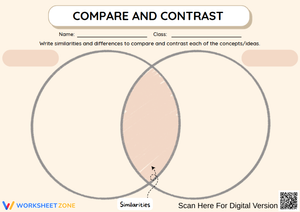
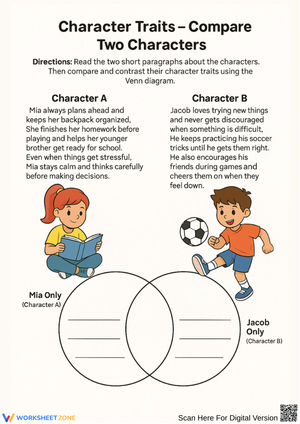
- Sorting details into graphic organizers: Venn diagrams and T-charts help students separate and organize information before they write. Students mark, underline, and annotate rather than passively read.
- Using signal language: Students practice transition words and sentence frames such as both, however, unlike, and in contrast — not as vocabulary drill but as real tools for writing comparison paragraphs.
- Writing short comparison paragraphs: The writing prompts ask students to move from identified differences to explained significance, with space for text evidence and a concluding statement.
- Identifying text structure: Several worksheets ask students to name the organizational pattern each author uses and explain how that structure affects the meaning conveyed.
Student Errors Worth Anticipating Before You Assign These
The most persistent problem at grade 5 is not that students miss similarities and differences entirely — it is that they stop at the surface level and call it done. A student might correctly note that one passage is about hurricanes and the other is about tornadoes, then write exactly that, with no attention to how each author organizes the information, what claims they support with data, or how each passage reaches its conclusion. These worksheets slow that rush down by building a follow-up question directly into the prompt: not just what is different, but how each author explains or supports that difference.
Signal words are another sticking point. Students frequently reach for also and but as their only transition tools, even after they have been taught a broader set. Worksheets that embed sentence frames — with a blank where the signal word goes — push students to try in contrast or similarly before defaulting to familiar choices. That repetition across multiple worksheets builds automaticity in a way that a single vocabulary lesson rarely does.
A subtler issue: students who are strong readers sometimes rush the Venn diagram because the visual format feels like a shortcut. They slot details into circles without evaluating which details actually support a meaningful comparison. Asking students to star the two most important details before they begin writing — a step embedded in several worksheets in the set — interrupts that habit without requiring extra instruction time.
Standard Alignment
The primary anchor is RI.5.5, which asks fifth graders to compare and contrast the overall structure of two or more texts and analyze how each text's structure contributes to its meaning and purpose. That is a higher demand than earlier grades, where students mainly identify whether a text uses sequence or comparison structure. At grade 5, students must explain the relationship between structure and meaning — exactly what the text-structure review worksheets ask them to do. The compare and contrast pdf worksheets for 5th grade in this collection also connect to RI.5.6 when students examine how two authors on the same topic present information differently, and to W.5.2b, which addresses the use of facts, definitions, and signal language in informational writing. These are not loose connections — each worksheet prompt points to one of those three standards rather than gesturing at all of them at once.
Fitting These Worksheets Into Your Weekly Lesson Plans
The variety across formats makes it practical to assign one worksheet per instructional slot without repeating the same activity. A paired-passage worksheet works well for whole-group guided reading on Monday or Tuesday, when students are encountering the texts for the first time and benefit from teacher modeling alongside a think-aloud. Graphic organizer pages fit literacy centers or partner work mid-week — students sort details into a T-chart independently, compare answers with a partner, and then draft a paragraph from what they organized. Short writing prompts work as exit tickets on Thursday or Friday, after students have already discussed the texts and need to consolidate what they know into a written response.
For homework, a graphic organizer paired with one paragraph prompt keeps the task realistic — families can support that format without needing to reteach text structure from scratch. In intervention groups, these compare and contrast pdf worksheets for 5th grade respond well to a focused approach: pre-highlight the key sentences in each passage, present one comparison question at a time, and work through each text separately before asking students to connect the two. That kind of targeted use tends to improve the quality of written answers more than adding another question to the worksheet ever does.
Adjusting the Resources for a Range of Learners
Students who struggle with written expression get the most from the graphic organizer worksheets paired with sentence frames. Rather than facing a blank paragraph box, they start by filling in the T-chart, then use the frames to transfer what they recorded into connected sentences. That step-by-step format reduces the working memory load that hits developing writers when structure and content are both unfamiliar at the same time.
For students who move through the work quickly, the most productive adjustment is not adding more text — it is raising the analytical demand of the question. Ask them to evaluate which author makes a stronger case and defend that judgment with evidence from both passages. Or assign two worksheets back to back and ask students to compare how the two pairs of texts are similarly structured. That keeps the same core skill in play without requiring a separate enrichment worksheet.
Students with IEP accommodations that include reduced writing expectations still participate in the same paired-passage reading. A teacher can annotate each worksheet before copying — circling the specific sentences to read, pre-filling one side of the T-chart, or numbering the paragraphs so students can locate evidence faster. The print format makes those adjustments straightforward without requiring digital access or a separate version of the page.
Frequently Asked Questions
Do these worksheets work for both literary and informational texts?
Yes. The set includes worksheets built around informational paired passages as well as literary text pairs. The graphic organizer and writing prompt formats work for both, though the text-structure review sheets are specifically tied to informational reading and RI.5.5.
What reading level are the paired passages written at?
The passages are written at or close to grade 5 level — readable without being simplified to the point of feeling thin. They are not meant to function as fluency assessments. If a student is significantly below grade level in decoding, reading the passages aloud before independent work keeps the focus on comparison thinking rather than word recognition.
Can these be used for test preparation?
The paired-passage format directly mirrors the kind of reading tasks that appear on fifth-grade state assessments. Students who regularly work through these compare and contrast pdf worksheets for 5th grade build familiarity with the question types, the text-evidence expectations, and the written response format that assessments use — and they do it through actual instruction rather than rote test-format drilling.
How long does a typical worksheet take to complete?
A paired-passage worksheet with a short written response takes most fifth graders between fifteen and twenty-five minutes, depending on reading stamina and writing fluency. Graphic organizer pages without a writing component run closer to ten to fifteen minutes, which makes them a practical fit for centers, warm-ups, and the last ten minutes before transitions.












 Interactive Worksheet Maker
 Quiz Maker
 Word Search Maker
 Crossword Puzzle Maker
 Word Scramble Generator
 Sentence Scramble Generator
 Handwriting Worksheet Generator
 Name Tracing Generator
 Fill In The Blank Generator