Printable Cause and Effect Practice That Fits 5th Grade ELA
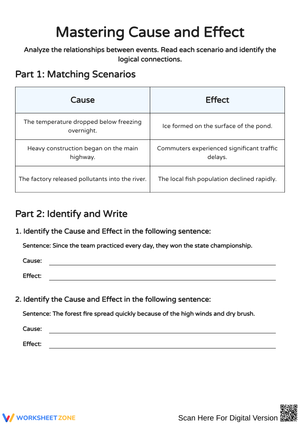
These 5th grade cause and effect printable worksheets give teachers targeted, ready-to-use practice that fits inside the reading block without extra planning — passages with structured response space, graphic organizers that separate event chains from simple sequence, and signal-word tasks that build the vocabulary students need. The set spans multiple formats so teachers can pull a short identification task for Monday warm-up, a passage-and-organizer combination for guided practice, or a constructed-response prompt to collect as a formative check before dismissal.
What Students Work Through in the Set
By fifth grade, identifying an obvious cause and a single obvious effect is no longer enough. Students are expected to trace chains of events, recognize when one cause produces several outcomes, and infer causal relationships that the author implies rather than announces with a signal word. A solid set of 5th grade cause and effect printable worksheets matches that expectation — asking students to justify relationships, not just name them.
Across the worksheets, students:
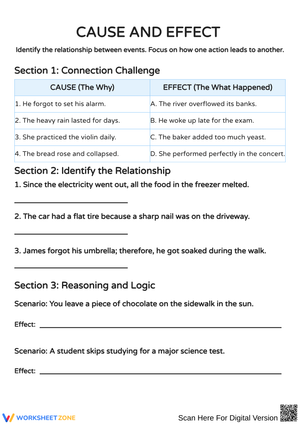
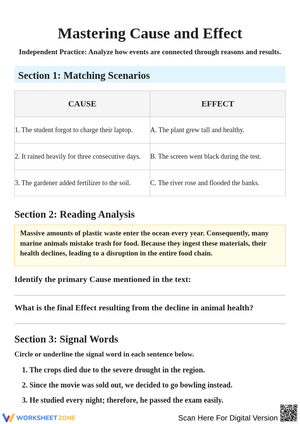
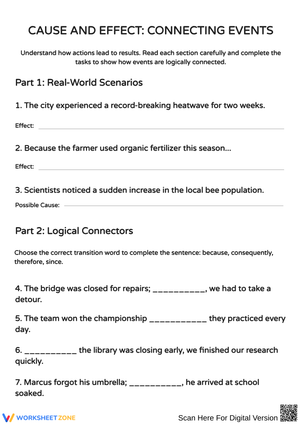
- Underline signal words and label which clause carries the cause versus the effect
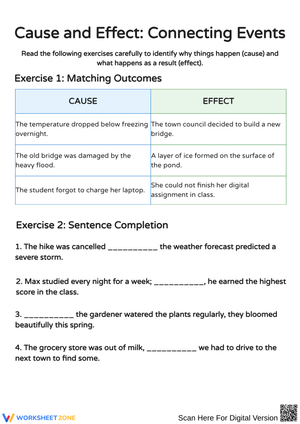
- Match causes to effects in short passages, then write a one-sentence justification for at least one match
- Complete graphic organizers for both single-cause-to-multiple-effects and multiple-causes-to-one-result structures
- Read short informational passages and write 1–2 sentence explanations using evidence from the text
- Identify whether a relationship is directly stated or implied by the sequence of details
Passage content draws from nonfiction — weather systems, science processes, historical decisions, technological developments — not disconnected sentence drills. That subject-matter fit matters because cause-and-effect structure appears in science and social studies reading across the whole school day. Students who practice the same reasoning pattern across subject areas start applying causal language more automatically.
The Error Patterns That Surface Most Often in Fifth-Grade Work
The most persistent mistake at this grade is confusing sequence with causation. Students read "the temperature dropped, and then the pipes froze" and treat and then as cause-and-effect evidence. The relationship may in fact be causal, but the signal word does not confirm it. Several items in this set include sentences where events follow each other without one producing the other, so students have to make that distinction themselves rather than pattern-match a connecting word.
Written responses reveal a related problem. A student who correctly identifies that a drought caused crop failure will write "The crops failed because of drought" — structurally correct — but stop there without naming the mechanism. What about the drought affected the crops? The constructed-response prompts push students to explain the connection between two events, not simply list both endpoints. That explanatory step is where surface-level recognizers separate from students who have genuinely understood the relationship.
One more error worth flagging: students regularly fill in graphic organizer boxes backward, even when their written answer is correct. They know which event caused the other but write by habit rather than by reading the box label. Pointing to the headers out loud before students begin independent work — takes about 30 seconds — prevents this from contaminating formative data you actually plan to use.
Lesson-Planning Strategies That Get the Most Out of This Set
The most natural entry point is the Monday warm-up — six to eight minutes after morning meeting when students need something purposeful but low-stakes. A signal-word identification worksheet fits that window: it reactivates prior vocabulary, requires nothing beyond a pencil, and gives teachers a quick visual scan of who is reading carefully and who is pulling answers from surface pattern recognition alone.
The passage-with-organizer format works well later in the week as guided practice after a whole-class read-aloud. Model the organizer with one text under the document camera, then hand out a second passage for independent work while pulling a small group. The completed organizers give teachers a clear formative signal — students either placed events in the right cells and wrote a matching explanation, or they did not. That information is more useful than a multiple-choice item because it shows whether the reasoning is there, not just whether the answer is right.
For sub days, 5th grade cause and effect printable worksheets with self-contained directions are worth keeping in a ready folder. Students who know the format will work through them without a lengthy briefing, and the sub can collect them at the end of class. On the Friday review block — roughly 10–12 minutes before the transition out of ELA — pairing a short identification task with a written explanation is one of the better ways to gauge where the class stands before the weekend.
Standard Alignment
These worksheets address CCSS RI.5.3, which requires fifth graders to explain the relationships between events, concepts, and ideas in informational text using specific textual evidence, and CCSS RI.5.5, which asks students to compare the overall structure of two or more informational texts. In classroom terms, RI.5.3 is the standard these worksheets address most directly — students read a passage and explain why something happened, using evidence rather than assumption. RI.5.5 comes into play when teachers assign two worksheets back-to-back and ask students to notice that both texts use cause-and-effect structure despite covering different topics. That pairing addresses the comparison standard without requiring a separate lesson plan.
Tiering the Work for Different Levels in Your Class
When working through 5th grade cause and effect printable worksheets with a mixed-ability class, the most practical adjustment is varying the response demand rather than the passage itself. Give every student the same text, then differentiate the output. Students who need additional support complete the graphic organizer and name the cause and effect. Grade-level students add the one-sentence written justification. Students who are ready for a challenge write a follow-up explanation that identifies whether the relationship is directly stated or implied, and explains how the text signals the difference.
For students who freeze in front of a blank response line, a sentence frame removes the blank-page problem without doing the thinking for them: "The [effect] happened because [cause], which means that..." That structure produces a complete explanation rather than a fragment, and it keeps the cognitive demand high enough that stronger students benefit from it too — they just fill it with more precise reasoning.
Students who finish early can extend any worksheet by identifying a second cause-and-effect relationship in the same passage that the task did not ask about, or by turning the effect into a new cause and predicting what might happen next. That generative move shifts students from retrieval into application — a meaningful distinction for the fifth graders who are ready to use the concept rather than simply recognize it.
Frequently Asked Questions
Do these worksheets use fiction or nonfiction passages?
The set focuses on nonfiction, which is where cause-and-effect structure is most visible in fifth-grade reading — science processes, weather events, historical decisions, and technological developments. Nonfiction is also where students encounter this structure outside of ELA in content-area classes. Teachers who want students to apply the same thinking to fiction can assign narrative passages as an extension after students are solid on the core concept.
How long does each worksheet take to complete?
Signal-word identification worksheets run about 6–8 minutes for grade-level readers. Passage-plus-organizer-plus-response worksheets take 15–20 minutes and work best after a brief model, not as a student's first exposure to the concept. The matching tasks fall in the middle — roughly 10 minutes — and work well as partner activities when discussion is part of the goal.
Can these be used as formative assessments?
The constructed-response worksheets function well as informal formative checks. A written explanation that requires students to name the causal mechanism — not just list two events — produces evidence that shows whether understanding is actually there. Multiple-choice or matching-only items do not give the same information because a student can answer correctly without demonstrating that they understand the relationship.
What do I do when students know the signal words but still get the wrong answer?
Signal-word knowledge and cause-and-effect comprehension are not the same skill. Students sometimes learn that because signals a cause without tracking which clause actually did the causing. When that pattern appears — correct signal-word identification, wrong answer — the most effective correction is to have the student read the sentence aloud and ask: "Which thing made the other thing happen?" That spoken question cuts through pattern-matching faster than re-teaching the vocabulary list, because it redirects attention from the word to the actual relationship in the sentence.
Clear All