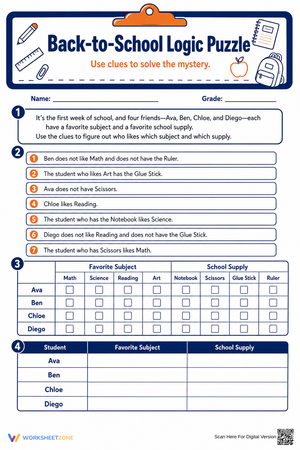
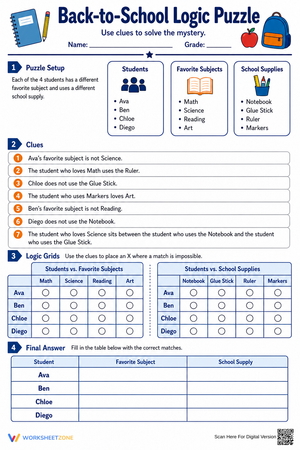
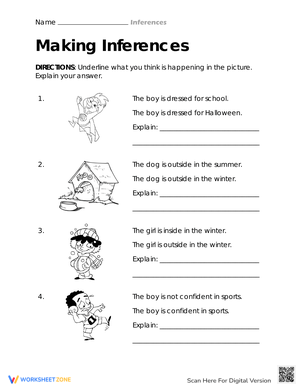
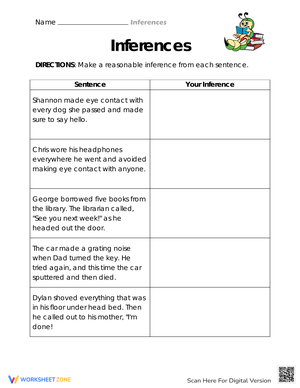
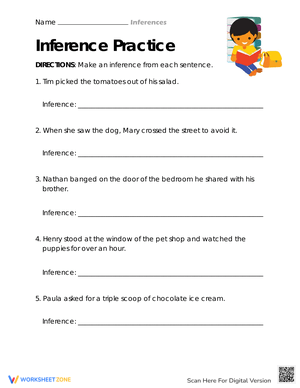
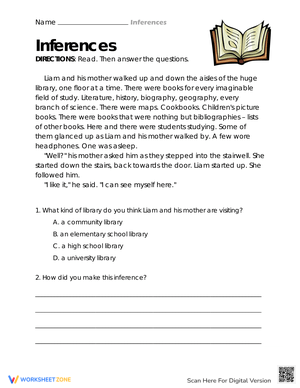
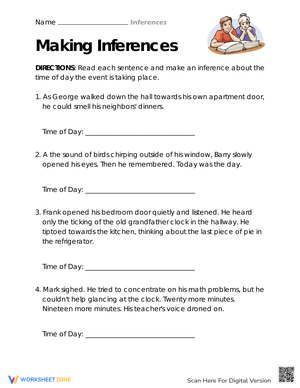
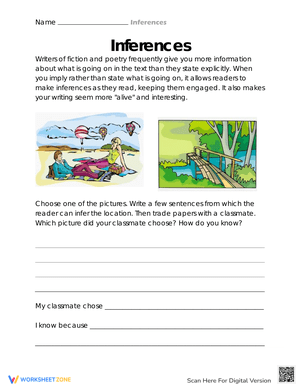
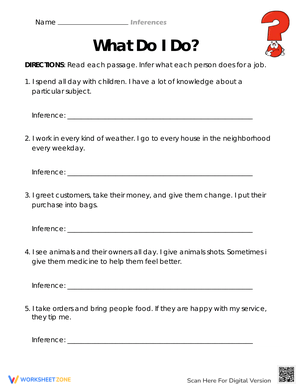
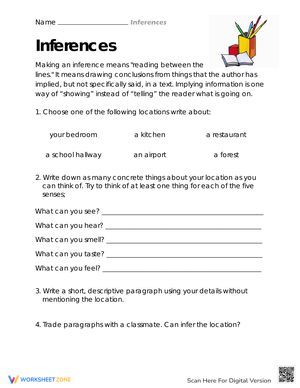
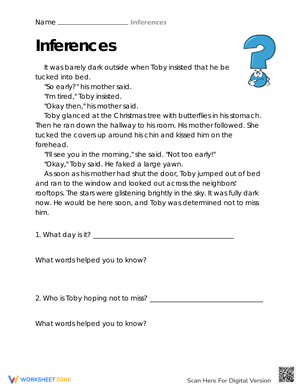
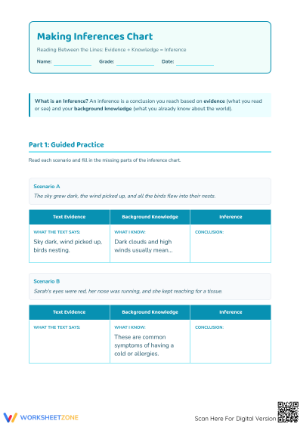
5th grade making inferences in nonfiction printable worksheets give teachers a repeatable format for one of the more demanding reading moves in upper elementary — combining text clues with prior knowledge to reach a conclusion the author implies but never states outright. Each worksheet pairs a short informational passage with questions that require both evidence identification and the reasoning step that turns a detail into a conclusion. The set earns its place in reading blocks, small-group intervention, reading centers, and homework without requiring more than a few minutes of setup.
What Each Worksheet Asks Students to Do
Nonfiction inference at grade 5 is more specific than general comprehension review. Students read a passage, identify what the author states directly, and then use those details — plus relevant background knowledge — to explain something the text implies. The questions in each worksheet are sequenced to expose the gap between text location and reasoning. A typical item asks students to first identify a detail the author states explicitly, then name an inference that detail supports, and finally explain how those clues connect to the conclusion. When those steps are separated on the worksheet, teachers can see whether the problem is finding the right line or building an argument from it.
- Short informational passages with grade-appropriate vocabulary
- Questions that distinguish explicit meaning from implied meaning
- Prompts requiring students to cite specific words, phrases, or sentences as support
- Space for brief written explanations alongside answer selections
- A consistent format that transfers across independent work, partner talk, and whole-group debrief
Reading Errors Worth Catching Before They Become Habits
The most persistent error isn't wild guessing — it's a reasonable-sounding answer that doesn't trace back to the passage. A student reads a paragraph about deforestation and infers "animals are losing their homes," which may feel defensible, but nothing in that specific text said so. They substituted background knowledge for text evidence. The worksheet surfaces this move because it asks them to underline the exact lines they used. When the underlined section doesn't actually lead to their stated inference, both teacher and student can see exactly where the reasoning broke down.
A second common pattern: students conflate the explicit and the implied. They read a question asking what they can infer and copy a sentence from the passage word for word. At grade 5, where the informational reading standard pairs explaining explicit ideas with drawing inferences as two distinct moves, this mix-up is worth targeting directly rather than correcting off the cuff. Watch also for circular explanations — "I know this because the text is talking about it." That response shows the student noticed something relevant but can't yet name the mechanism: how one detail leads to another, or why two separate facts point toward the same conclusion. Sentence stems move students past that wall early in the unit, and gradually withdrawing them reveals who has internalized the reasoning and who still needs support.
How to Build These Worksheets Into Your Lesson Plans
Teachers who build 5th grade making inferences in nonfiction printable worksheets into a short, consistent daily routine see stronger results than those who assign them only in longer, occasional blocks. Five to eight minutes at the opening of a reading block — one passage, one inference question, one evidence explanation — builds the habit faster than a full-period assignment every other week. The consistency matters because nonfiction inference is a move students need to automate before it shows up in assessed reading.
For reading centers, add an annotation step before writing. Students who underline clues and mark unfamiliar terms first write more specific, better-grounded inferences. Students who skip annotation tend to produce broader, shakier conclusions — and the annotation step creates natural accountability in partner rotations, since students compare marks before comparing answers. In small-group intervention, narrow the demand to one passage, one paragraph, one inference, and one cited detail. That constraint is a complete lesson for students still sorting out the difference between what a text states and what it implies. For the Friday review block before a reading assessment, each worksheet holds up well as a focused warm-up because the question format mirrors what students encounter on most state informational reading tasks.
Standard Alignment
These worksheets align to CCSS ELA-Literacy RI.5.1, which requires fifth graders to quote accurately from a text when explaining both what it says explicitly and when drawing inferences from it. That standard bundles two distinct reading moves into one expectation, and assessments that target only one leave the other untested. RI.5.1 sits near the center of fifth-grade informational reading instruction because it underpins everything above it in the progression — determining main idea, analyzing text structure, synthesizing across sources. Students who haven't yet separated explicit from implied meaning carry that gap into every informational reading task that follows. The 5th grade making inferences in nonfiction printable worksheets in this set address both moves within each response, not just one.
Differentiating These Worksheets Across Ability Levels
For students who need more support, pair each worksheet with a two-column graphic organizer: one column for "what the text says," one column for "what I can infer from it." That side-by-side structure keeps the two reading moves visually distinct and reduces the cognitive load of holding both ideas in mind while writing. Sentence stems — I can infer that... because the text says... — are especially useful at the start and can be withdrawn as students demonstrate consistent reasoning across several worksheets.
For students working above grade level, remove the stems, require a minimum of two cited details per inference, and ask them to evaluate which piece of evidence is stronger and why. That added layer — judging evidence quality rather than just presenting it — stretches students whose baseline inference skill is already solid and anticipates the analytical reading demands of middle school informational texts.
Frequently Asked Questions
What does a strong nonfiction inference response look like at grade 5?
A strong response names a specific inference, cites one or two lines from the passage that support it, and explains — in at least one sentence — how those details point to the conclusion. It does not simply copy a sentence from the text and call it an inference. Students who meet this bar are doing exactly what RI.5.1 describes: explaining both what the text says and what it implies, grounded in accurate quotation or paraphrase.
Can these worksheets serve as a formative assessment?
Yes. Because each response requires a written inference, a cited detail, and an explanation, completed worksheets give teachers a concrete record of student reasoning rather than a right-or-wrong score. Collecting these over three or four weeks often reveals clear patterns — which students need continued work on locating evidence and which need help building from evidence to conclusion — and that distinction shapes small-group instruction more precisely than a single quiz would.
How should I introduce the set if students are new to nonfiction inference work?
Start with a think-aloud using the first passage before releasing students to work independently. Read one paragraph aloud, name two details that stand out, and talk through the conclusion those details suggest and why. Saying that reasoning out loud before asking students to write it gives them a model for what a complete inference looks like. Most fifth graders need to hear that thinking demonstrated two or three times before they can replicate it consistently on their own. Teachers who skip the modeling step often spend twice as long correcting the same errors worksheet after worksheet.
Do these work across subject areas, or are they limited to ELA time?
The 5th grade making inferences in nonfiction printable worksheets in this set draw passages from varied content — science, social studies, geography, biography — which mirrors how students actually encounter informational text across the school day. That variety also makes the set flexible enough for content-area literacy blocks, not only dedicated reading instruction. The core thinking move stays constant regardless of subject: read closely, gather clues, explain a conclusion.












 Interactive Worksheet Maker
 Quiz Maker
 Word Search Maker
 Crossword Puzzle Maker
 Word Scramble Generator
 Sentence Scramble Generator
 Handwriting Worksheet Generator
 Name Tracing Generator
 Fill In The Blank Generator