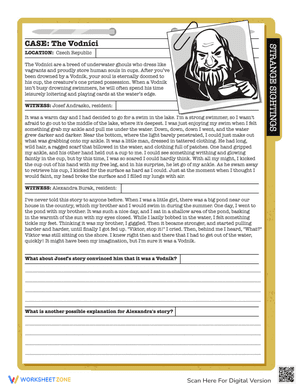
These compare and contrast characters worksheets for 5th grade give teachers a printable set built around the specific reading moves grade 5 fiction demands — inferring motivation, tracking how two characters respond to the same conflict, and backing every claim with text evidence. Each worksheet moves students from observation to explanation, which is where the real comprehension work happens. The formats across the set — Venn diagrams, T-charts, short-response boxes, and paired-passage pages — match what teachers actually reach for during fiction units, small-group lessons, and literacy centers.
The Reading Work Each Worksheet Asks Students to Do
Character comparison at the fifth-grade level means more than listing two traits and circling a difference. Strong responses at this level require students to name a trait or motivation, cite the scene where it surfaces, and explain how it shapes what a character does next. These worksheets push into all three moves. One worksheet might ask students to annotate two characters' actions during a turning point, then explain what those actions reveal about what each character values. Another provides a paired passage and asks students to track how two characters handle the same setback differently — and what that difference shows about their goals.
The categories students work with across the set include traits, actions under pressure, motivations, relationships with other characters, and responses to conflict. Traits are the entry point most students reach for first, but the worksheets push past surface-level labeling. A student who writes "Maya is brave" has done the easy part. Explaining which moment proves it — and whether that braveness leads to a good or a poor outcome — is the harder thinking the set targets.
Student Mistakes Worth Catching Before They Become Habits
The most common error in fifth-grade character work is trait-listing without grounding. A student writes "Character A is patient and Character B is impulsive" and stops there. No scene cited, no explanation of how those traits affect the plot. These worksheets address that directly: every organizer section that asks for a trait also includes a line for the specific evidence and a line for what that detail shows. That built-in structure sends students back to the passage instead of letting them work from impression.
A subtler problem is motivation confusion. Fifth graders often conflate what a character does with why they do it. A student might write "Javier wants to win the race" when the actual motivation is wanting to prove himself to his father — and that distinction matters for understanding the conflict. Short-response items in the set ask students to explain the "why" behind a character's choices, not just restate actions. Teachers who review responses with that distinction in mind will catch motivation confusion quickly, well before a larger written assessment.
Venn diagrams also carry a specific trap: students put items in the "both" section that are technically true but trivially shared — "they both have friends," "they both go to school." One pre-teaching move that helps is giving students a test for the middle section: if the similarity doesn't affect the story's events or the characters' choices, it doesn't belong there. That single rule redirects students toward text-based similarities rather than generic ones.
How to Build These Worksheets Into Your Reading Block
A three-day sequence works well for teachers who want more than a single checkpoint. On day one, students annotate the passage for character details — underlining actions, circling dialogue, noting what each character wants. On day two, they transfer those annotations to the organizer, sorting evidence into categories. On day three, they answer a short constructed-response question using what the organizer shows. That sequence treats the worksheet as a reading process, not a task to complete at the end of a lesson, and it gives teachers three separate checkpoints: annotation quality, sorting accuracy, and written explanation clarity.
For whole-group instruction, modeling the annotation step using a projected excerpt before releasing students to the organizer cuts down on shallow responses. Students who see what quality evidence looks like — specific, tied to a scene, explained in a sentence — produce more usable work than students sent straight to the organizer. For the last ten minutes of a reading block, a short organizer with one follow-up question makes a manageable exit ticket that takes about three minutes to scan and sort into "got it" and "needs reteaching" piles.
These compare and contrast characters worksheets for 5th grade also work well for sub plans and homework assignments because the directions are self-contained and the format is familiar. A student who has used a T-chart in a guided lesson can navigate one independently, which makes the set a reliable low-prep option when a class needs to work without live instruction.
Standard Alignment
These worksheets align directly to CCSS.ELA-LITERACY.RL.5.3, which asks fifth graders to compare and contrast two or more characters, settings, or events in a story, drawing on specific details from the text. That standard sits at the center of the grade 5 fiction reading strand and appears in classroom assessments, state tests, and end-of-unit evaluations. Every prompt in the set requires specific text evidence rather than general impressions, and the short-response items are written to match the kind of constructed-response questions students encounter on standardized assessments.
Instructionally, RL.5.3 builds on character work students began in grades 3 and 4, where the focus was on individual character responses to events. By fifth grade, the expectation shifts toward comparative analysis, which requires students to hold two characters in mind simultaneously and explain what the contrast between them reveals. These compare and contrast characters worksheets for 5th grade are structured to support that transition: organizers first separate the two characters clearly before any direct comparison is drawn, which reduces the cognitive load of tracking multiple characters at the same time as producing written analysis.
Adjusting the Set for Different Reader Levels
The most direct differentiation lever for these worksheets is text length and the amount of pre-work provided. Students who struggle with character inference do better when the passage is shorter — four to six paragraphs rather than a longer excerpt — and when two or three pieces of evidence are pre-selected for them to sort and explain rather than locate independently. That approach keeps the analytical work intact while removing the search-and-find step that stalls some readers before they reach the thinking part.
- For students needing additional support: use shorter passages, provide one pre-identified piece of evidence per character, and focus the comparison on a single category like actions during conflict.
- For on-level independent work: assign the full organizer with a paired passage and one short constructed-response item.
- For students ready for more challenge: ask them to move past the organizer and write a paragraph explaining how the contrast between the two characters connects to the story's central conflict or theme.
- For test-prep contexts: use the short-response prompts that require cited details written in complete sentences, which mirrors the format students encounter on state assessments.
One honest limitation: the compare and contrast characters worksheets for 5th grade format works best when students have already read the text with some care. Students who haven't engaged with the passage will fill in an organizer with guesses, and the finished worksheet looks complete without reflecting real comprehension. A quick retrieval discussion before students write — "what do you remember about how each character handled that moment?" — helps surface who's ready and who needs to reread first.
Frequently Asked Questions
What formats do these worksheets use?
The set includes Venn diagrams, T-charts, short-response boxes, and paired-passage pages with constructed-response questions. Each worksheet uses one or two of these formats depending on the complexity of the comparison task students are working through.
How do these worksheets push students beyond trait-listing?
Every section that asks students to identify a trait or motivation includes a follow-up line for the specific scene or detail that supports it, plus a line for what that detail shows. That built-in structure requires students to return to the passage rather than write from general impression — which is where trait-listing usually stalls.
Can these worksheets serve as formative assessment?
Yes. A short organizer with one follow-up question takes about three minutes to scan and gives teachers clear information about where students are with text-based character analysis. Sorting completed worksheets by annotation quality and response depth before planning the next lesson takes less time than a formal quiz and yields more actionable information about specific gaps.
Do these worksheets work for small-group intervention?
They do. In a small group, a teacher can narrow the task to one comparison category — motivation, for example — and work through the evidence-gathering step together before students write independently. That focused approach gives students who are still building inference skills a clear, manageable entry point without changing the nature of the reading work.















 Interactive Worksheet Maker
 Quiz Maker
 Word Search Maker
 Crossword Puzzle Maker
 Word Scramble Generator
 Sentence Scramble Generator
 Handwriting Worksheet Generator
 Name Tracing Generator
 Fill In The Blank Generator