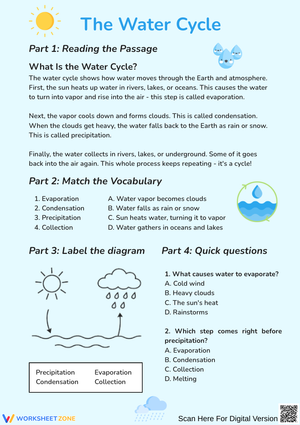
These 4th grade water cycle pdf worksheets give science teachers a focused, print-ready set covering diagram labeling, sequencing, cloze reading, and short written explanation—the full range of task types that Grade 4 water cycle instruction needs. The central challenge of this unit is moving students from vocabulary recognition to process understanding: students who can name evaporation, condensation, precipitation, and collection don't automatically understand why the cycle repeats or what drives each transition.
What's Inside the Set
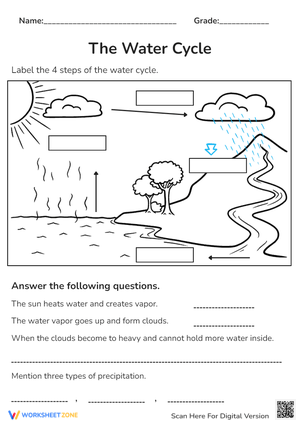
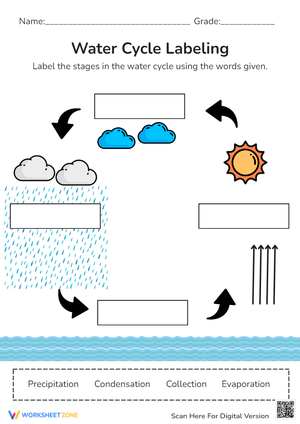
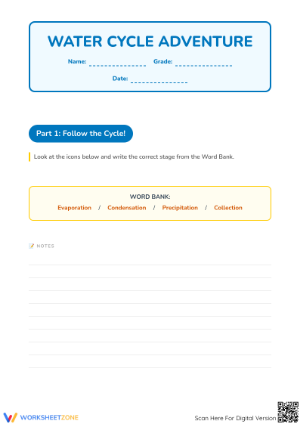
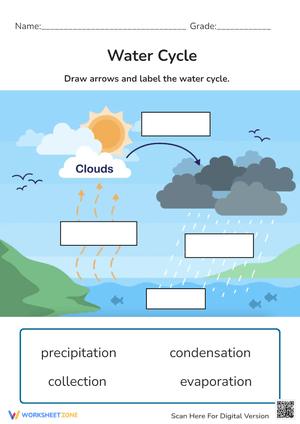
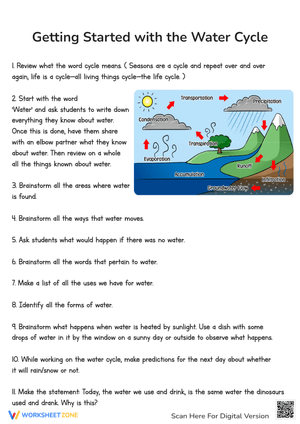
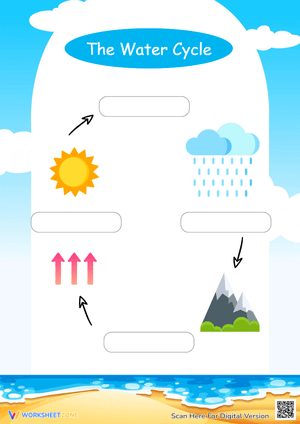
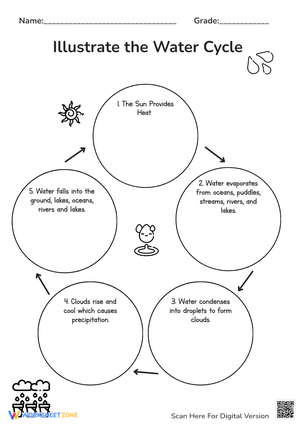
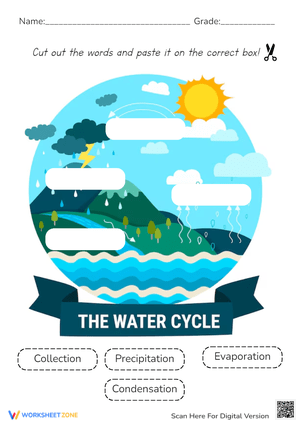
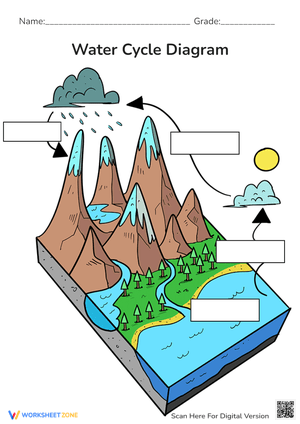
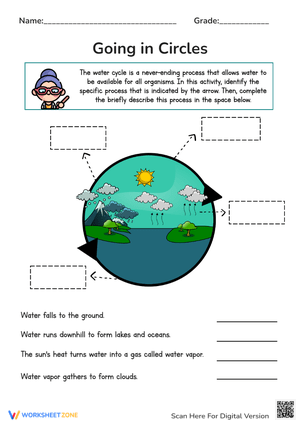
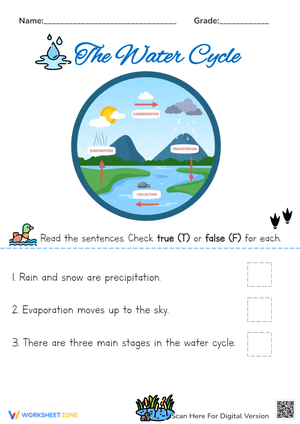
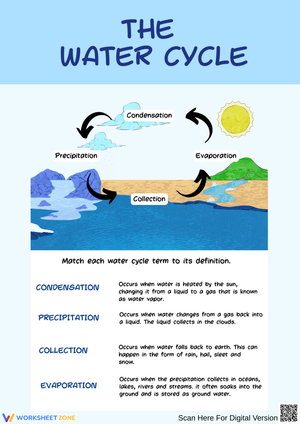
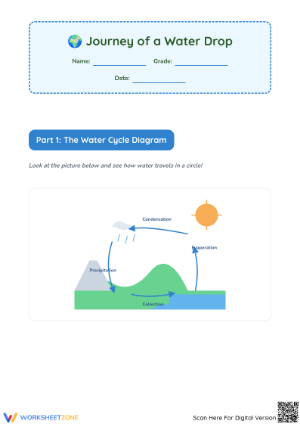
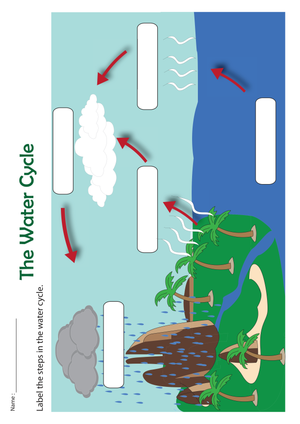
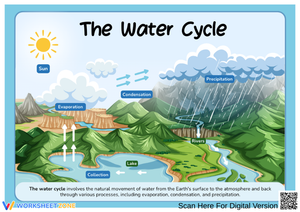
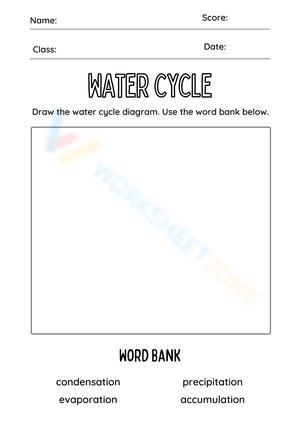
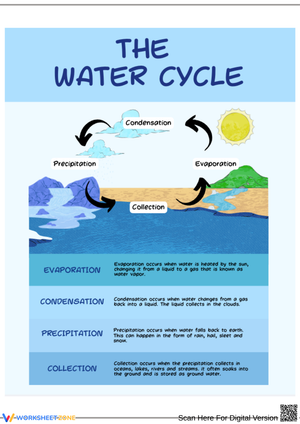
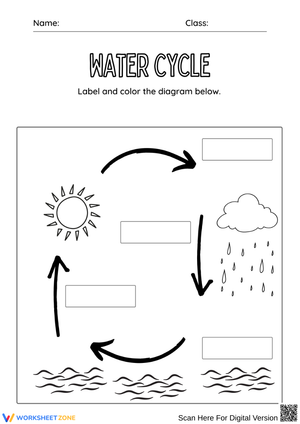
Each worksheet targets a distinct layer of water cycle understanding. The labeling worksheet gives students a clear cycle illustration with six to eight annotation points; students match terms to diagram locations rather than retrieve vocabulary from memory, which makes it a strong first-day practice after teacher modeling. The sequencing worksheet asks students to arrange the stages in order and then identify where the cycle restarts—that second step is where the real understanding lives, because students who see the cycle as linear will stop at precipitation and consider it complete.
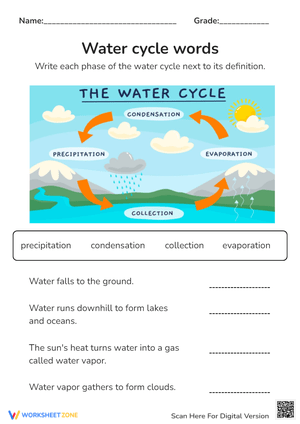
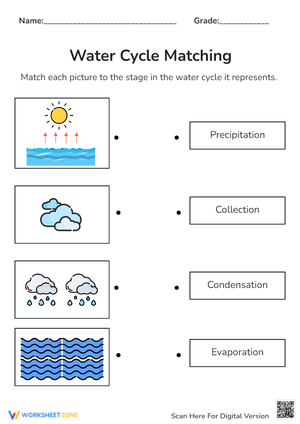
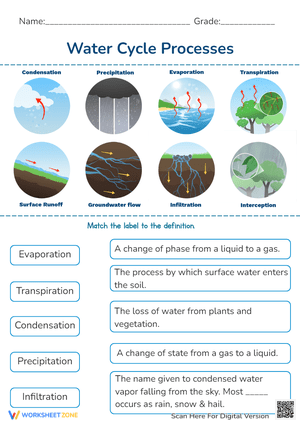
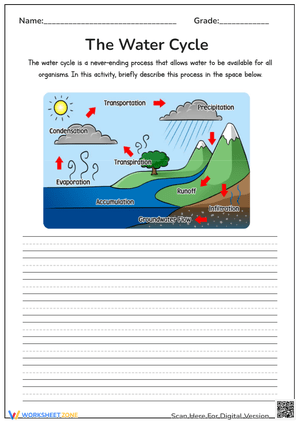
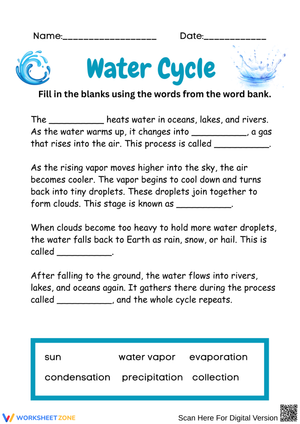
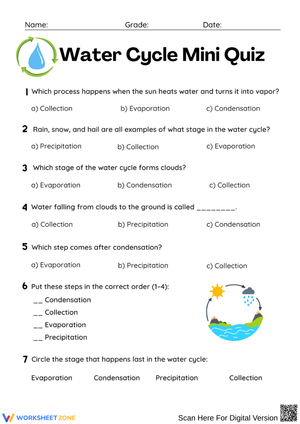
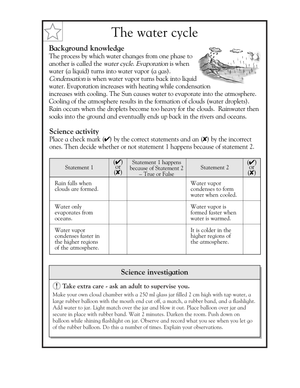
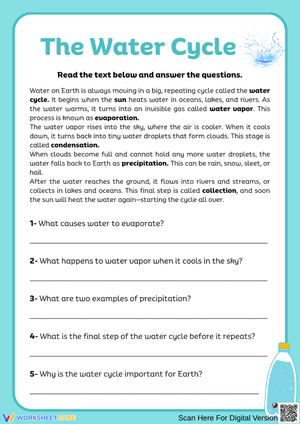
The cloze reading worksheet places evaporation, condensation, precipitation, and accumulation in context within a short passage, asking students to select the correct term based on meaning rather than recognition alone. Vocabulary matching is a quicker version of the same skill and works as a warm-up or exit task. The short-answer worksheet presents two or three observable prompts—why a puddle disappears after the sun comes out, what the droplets on a cold glass tell us about condensation—and asks students to explain using cycle vocabulary. Those written responses consistently reveal more about student understanding than any labeling or matching task does.
Where Student Understanding Breaks Down—and How to Catch It
The most stubborn misconception at this grade level is that the water cycle ends when precipitation reaches the ground. Students who can name all four stages will still describe rain as a final step rather than one point in a loop. The sequencing worksheet addresses this directly by asking students to draw an arrow showing where the cycle continues after collection. That specific task is worth a class discussion before students attempt it independently—leaving out the connection from collection back to evaporation is the single most common error in completed worksheets.
A second persistent problem is conflating condensation with precipitation. Students understand that clouds form and that rain falls, but they use the terms interchangeably or write that condensation is "when water falls from the sky." The cloze reading worksheet places both terms in the same passage, requiring students to distinguish them by context. The most effective classroom correction is a physical example: a cold glass of water left on a desk forms droplets on its outside surface—that is condensation, not precipitation. Students who have seen that demonstration write noticeably more accurate short-answer responses.
A third error is narrowing evaporation to situations where water is actively heated. Students write that evaporation only happens "when the sun shines on water" or "when it's really hot," overlooking that water evaporates from soil, wet clothing, and shaded puddles as well. Short-answer prompts asking where the water in a drying puddle goes push students past this narrow framing without requiring additional direct instruction.
Fitting These Worksheets Into the Teaching Week
Spacing the worksheet formats across three to four days produces better results than completing them in a single block. The labeling worksheet belongs on day one, used as guided practice while students are still building the visual model—they should be labeling with teacher support present. Vocabulary matching or the cloze reading fits day two as independent work: students have heard the terms, now they are sorting out meaning. Sequencing and short-answer worksheets are strongest on days three and four, once students have enough vocabulary to explain what they understand in writing rather than simply identify and match.
Science stations are another practical use. One station holds the labeling worksheet, another the cloze reading, a third the vocabulary matching. Because 4th grade water cycle pdf worksheets maintain consistent formatting across different printers, teachers can prepare a week of stations from a single print run and reuse the same materials with future classes. The ten minutes before a lab activity is also a natural slot for the matching or labeling worksheet—brief enough to complete without cutting into hands-on time, and useful enough to reinforce the vocabulary students are about to apply.
One classroom practice that consistently improves written response quality: before students begin any short-answer worksheet, ask them to name something they have seen outside that connects to the water cycle—a puddle shrinking over the day, fog on a cold morning, dark clouds before rain. That two-minute oral anchor gives students a concrete image to return to while they write, and their responses are noticeably more specific than those written without it.
Standard Alignment
NGSS places the most explicit water cycle standard at the middle school level: MS-ESS2-4 asks students to develop a model describing how water cycles through Earth's systems, driven by energy from the sun and the force of gravity. At the elementary level, related content appears in 2-ESS2-3 (where water is found on Earth and in what form) and 5-ESS2-1 (distribution of water across Earth's systems). Many state frameworks—including Virginia's SOL 4.4 and comparable benchmarks in Texas, Georgia, and other states—place the full water cycle as an explicit Grade 4 topic, bridging those two NGSS anchors. Teachers working within those state standards will find these worksheets match their unit targets directly. Across all contexts, the diagram labeling and sequencing worksheets support the NGSS crosscutting concept of Systems and System Models, while the short-answer prompts align to the science practice of Constructing Explanations.
Supporting Different Levels of Readiness Across the Same Set
The labeling worksheet is the most accessible starting point for students who need additional support. Providing a word bank converts it from a recall task to a recognition task—students are placing terms in the right locations rather than pulling vocabulary from memory. Reviewing the diagram orally before independent work also helps significantly; naming each labeled area together as a class means students spend their work time thinking about the science rather than decoding the illustration.
On-level students work through the cloze reading and sequencing worksheets without modification. For students ready for more challenge, the most effective adjustment is attaching a written extension to the sequencing worksheet: rather than ordering the stages, students explain what causes each transition—why evaporation leads to condensation, why precipitation leads to collection, what the sun's role is throughout. That level of explanation is harder to produce than a numbered list, and those responses typically reveal more nuanced understanding than any matching or labeling task can show. These 4th grade water cycle pdf worksheets vary enough in task type that teachers can assign different worksheets from the set based on readiness without making the differentiation conspicuous to students.
Frequently Asked Questions
Which worksheet works best as a quick formative check?
The vocabulary matching worksheet works as a fast exit task after a first lesson on water cycle terms. The short-answer worksheet serves as a stronger formative check near the end of a unit—it shows whether students can explain the cycle, not just identify its stages. For an end-of-unit quiz, combining the labeling section, a sequencing task, and one short-answer prompt gives a clear picture of three distinct levels of understanding in roughly twelve to fifteen minutes of student work time.
What is the best approach for homework assignments?
The labeling and vocabulary matching worksheets are the most suitable choices for homework. Both have clear visuals and limited writing demands, so students can complete them independently after classroom instruction. The cloze reading and short-answer worksheets are better used in class, where academic language questions can be addressed before they stall student progress.
In what order should I use these during the unit?
Start with the labeling worksheet as guided practice during the first lesson, then move to vocabulary matching or cloze reading for independent work on day two. Sequencing comes next, once students can reliably identify and name the stages. Save the short-answer worksheet for the final days of practice, when students have enough vocabulary and process knowledge to write explanations rather than just identify and match. That progression moves from recognition toward explanation, which reflects the way Grade 4 students actually consolidate new science content—they need the vocabulary stable before they can use it to reason in writing.
Are answer keys included with each worksheet?
Yes. Each worksheet includes a corresponding answer key. These 4th grade water cycle pdf worksheets are formatted so that answer keys can be shared with students for self-correction during review, which keeps grading fast and turns the check-your-work step into a brief instructional moment rather than a quiet administrative one.












 Interactive Worksheet Maker
 Quiz Maker
 Word Search Maker
 Crossword Puzzle Maker
 Word Scramble Generator
 Sentence Scramble Generator
 Handwriting Worksheet Generator
 Name Tracing Generator
 Fill In The Blank Generator