


























Views
Downloads

Essential Water Cycle Labeling Worksheet | Grade 3-4
Paste this activity's link or code into your existing LMS (Google Classroom, Canvas, Teams, Schoology, Moodle, etc.).
Students can open and work on the activity right away, with no student login required.
You'll still be able to track student progress and results from your teacher account.
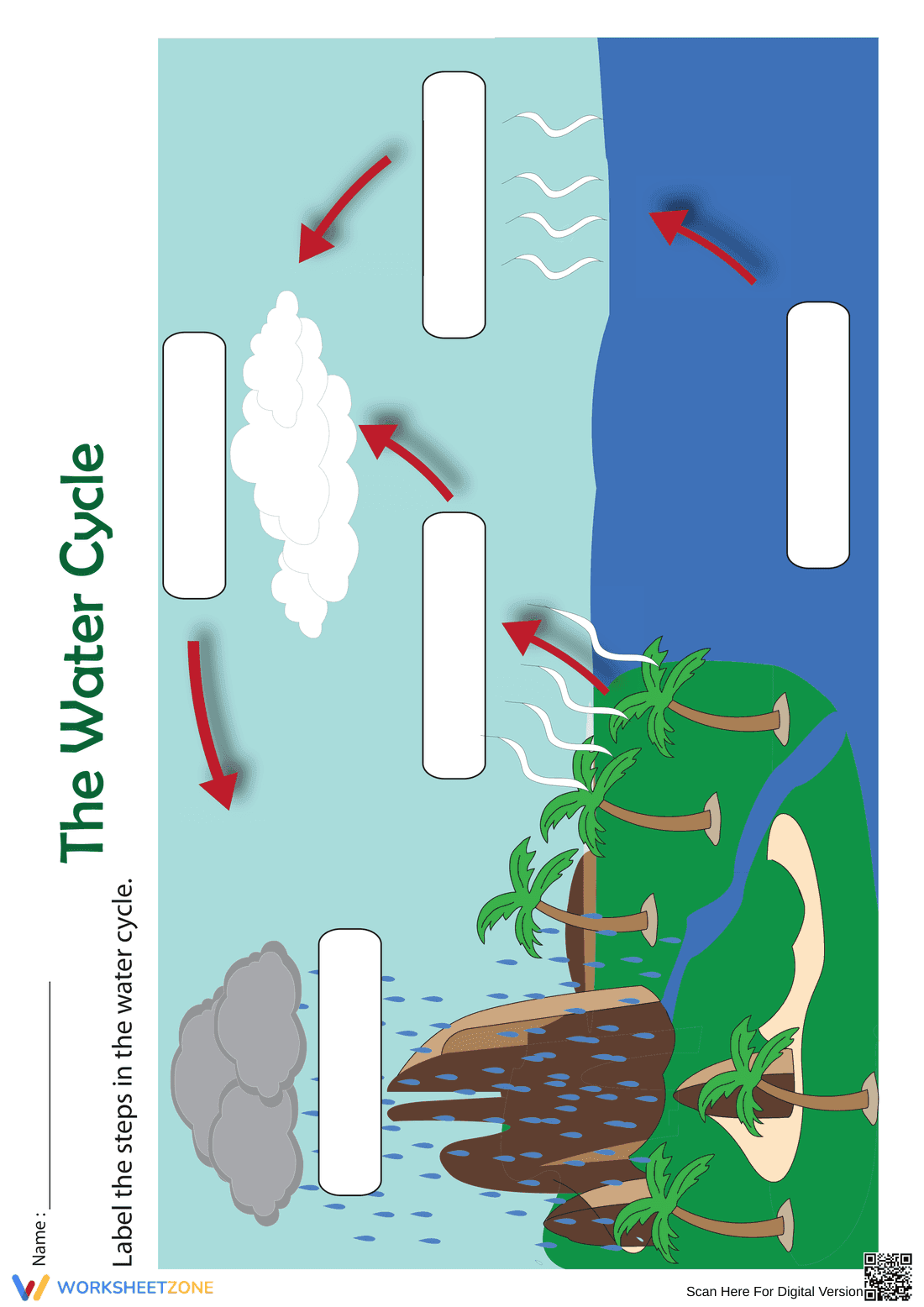
Students master the foundational processes of Earth's hydrosphere by identifying and labeling the five key stages of the water cycle. This worksheet provides a clear, visual representation of evaporation, transpiration, condensation, precipitation, and accumulation. It transforms abstract atmospheric concepts into a concrete, observable model, helping learners visualize how water moves through our environment continuously.
At a Glance
- Grade: 3–4 · Subject: Earth Science
- Standard:
3-ESS2-1— Represent weather data to describe climate patterns and Earth systems- Skill Focus: Water cycle process identification
- Format: 1 page · 5 problems · Answer key included · PDF
- Best For: Independent practice or quick formative assessment
- Time: 10–15 minutes
This resource features a high-quality, full-page illustration of a landscape including mountains, oceans, and clouds, clearly depicting the movement of water. The PDF includes one student worksheet with five strategically placed blank callout boxes and a corresponding teacher answer key. The diagram uses intuitive arrows to guide students through the cyclical nature of the system, ensuring they recognize the relationship between terrestrial and atmospheric stages.
Integrating this activity into your science block requires minimal effort. Simply print the single-page PDF (30 seconds), distribute it to your class (1 minute), and allow students to work through the diagram independently. The included answer key allows for a rapid 2-minute review or can be projected for self-correction, making it an ideal choice for emergency sub plans or morning work.
Aligned to `3-ESS2-1`, students represent Earth system interactions through a graphical display of the water cycle. This exercise supports the understanding that water changes state and location in a predictable pattern. Both standard codes can be copied directly into lesson plans, IEP goals, or district curriculum mapping tools.
Deploy this worksheet as a mid-lesson check-in during a unit on weather or Earth systems to gauge student understanding of vocabulary. It also serves as an excellent formative assessment tool; observe if students correctly distinguish between evaporation and transpiration. Expect most Grade 3 or 4 students to complete the labeling within 12 minutes of quiet work.
This diagram is designed for elementary students in Grades 3 and 4, particularly those benefiting from visual learning aids. The clear layout supports English Language Learners and students with IEPs by providing strong contextual cues. Pair this with a hands-on water cycle experiment or a reading passage for a comprehensive instructional experience.
According to RAND AIRS 2024, visual modeling in early science education significantly improves the retention of complex systemic interactions like the hydrologic cycle. By requiring students to label the processes of evaporation, condensation, and precipitation within a geographic context, this worksheet leverages dual-coding theory to bridge the gap between terminology and conceptual understanding. Research from EdReports 2024 highlights that high-quality, standards-aligned visual aids are critical for meeting the rigor of Earth Science benchmarks in Grades 3 through 5. This resource ensures that students not only memorize the 3-ESS2-1 standard's vocabulary but also understand the directional flow of matter through the atmosphere. This alignment with evidence-based instructional design provides a robust foundation for future studies in meteorology and environmental science, allowing educators to deploy the material with confidence in its pedagogical efficacy and curriculum relevance.


