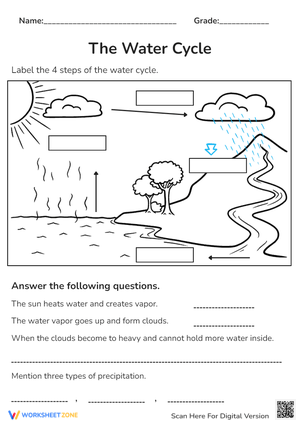
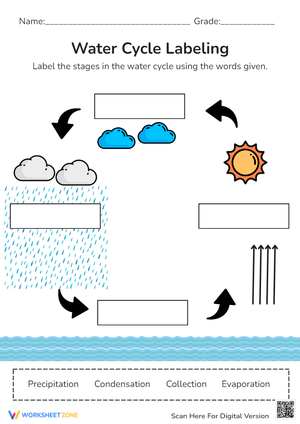
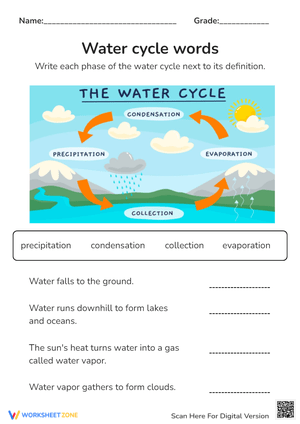
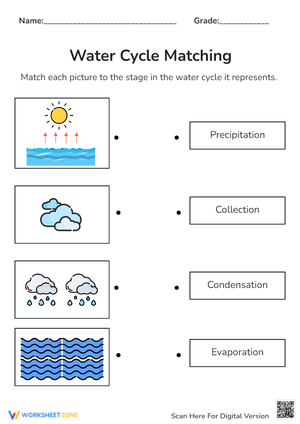
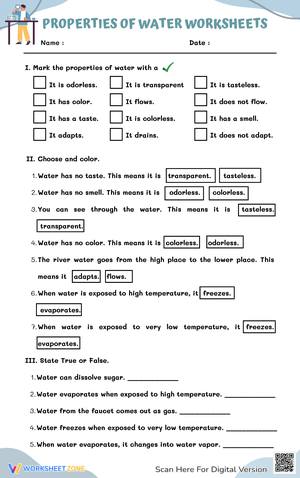
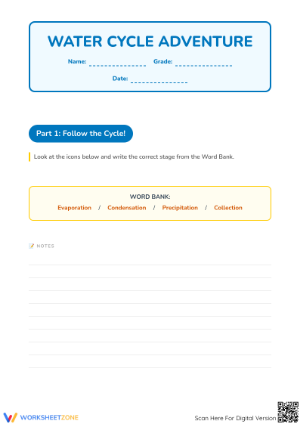
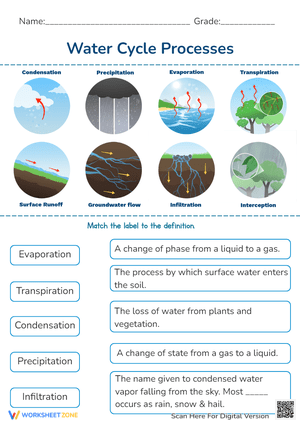
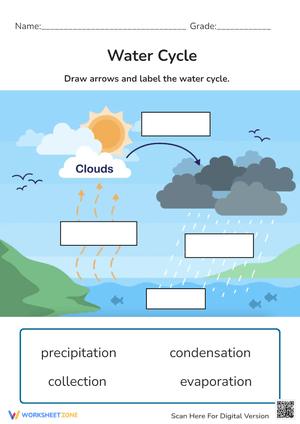
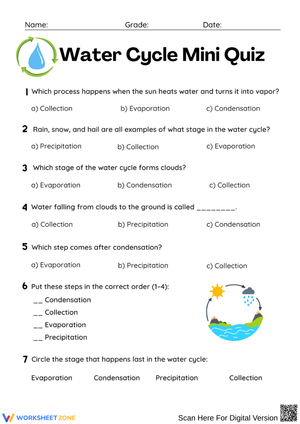
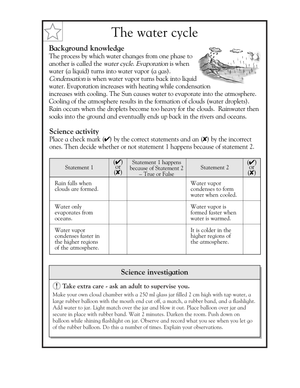
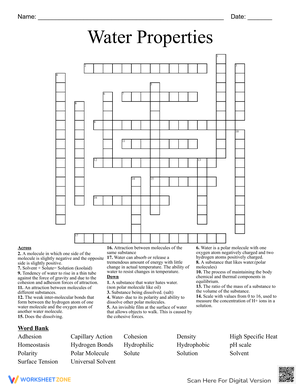
These 4th grade water printable worksheets give teachers ready-made practice across the water cycle, states of matter, and conservation — without extra planning beyond choosing the right worksheet for the day. The set covers enough ground for a focused short unit: labeling diagrams, ordering cycle stages, completing cloze passages, reading short informational text, and writing brief explanations using target vocabulary.
Concepts These Worksheets Build
Water sits at the intersection of several fourth-grade science strands — Earth systems, matter and its changes, and environmental stewardship — which makes it unusually easy to connect worksheets to ongoing instruction. Each worksheet targets a specific concept rather than the whole topic at once.
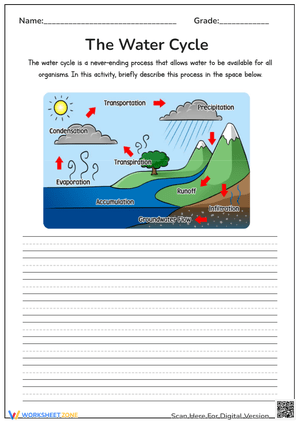
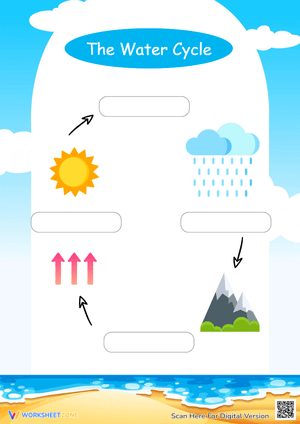
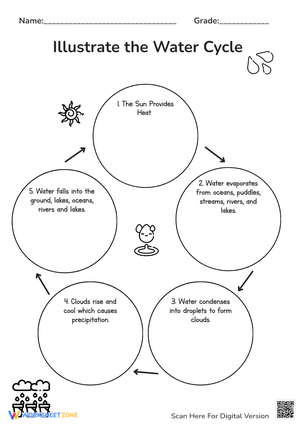
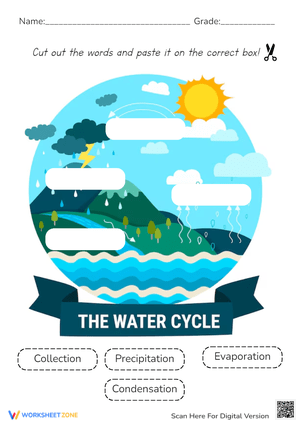
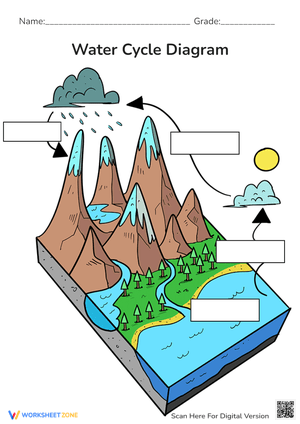
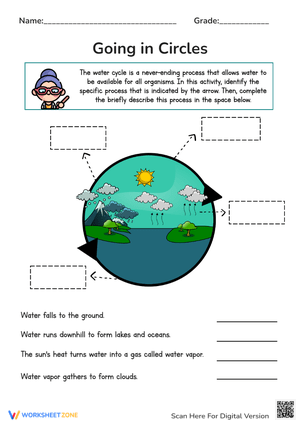
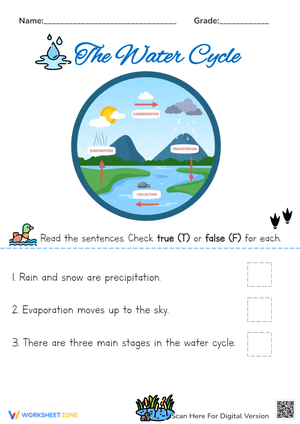
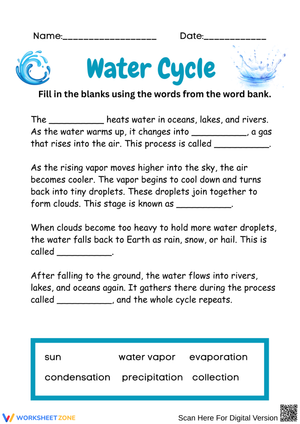
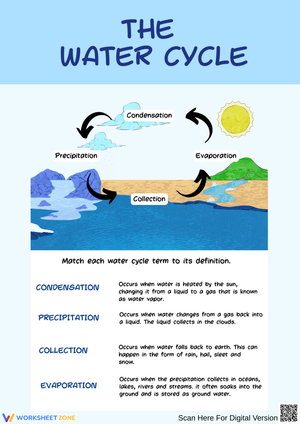
- Water cycle stages: Students identify evaporation, condensation, precipitation, and collection, then place each in sequence with a cause-and-effect explanation rather than just a label.
- Energy source: Students trace the sun's role in driving evaporation and keeping the cycle moving — a connection that often gets skipped when instruction focuses only on the diagram.
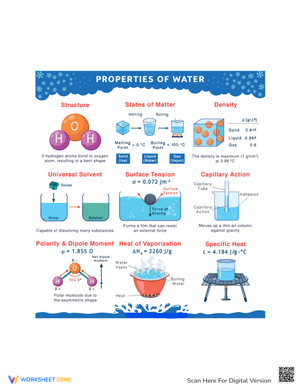
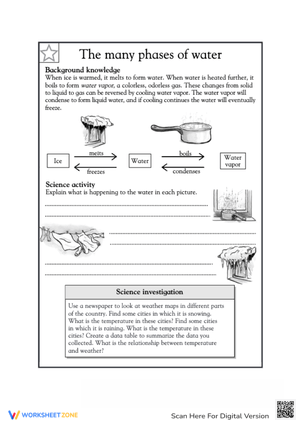
- States of matter: Students sort water into solid (ice), liquid, and gas (water vapor) and match each state to the corresponding cycle stage where it appears.
- Groundwater and collection: Students learn that water doesn't disappear after precipitation — it collects in rivers, lakes, and underground aquifers before the cycle begins again.
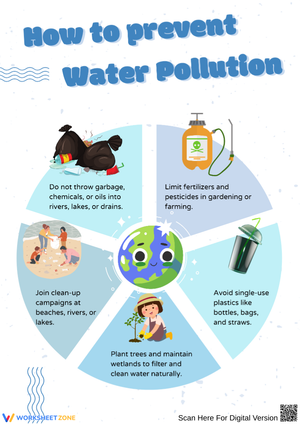
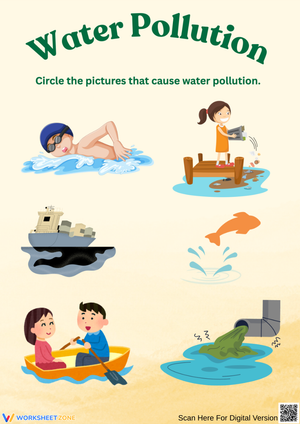
- Conservation reasoning: Students evaluate everyday water-use scenarios and explain choices using science vocabulary they've practiced in earlier worksheets.
Mistakes Students Make That These Worksheets Help You Catch
Evaporation and condensation are the two terms students mix up most reliably, and it happens in a specific way. On a labeled diagram completed during direct instruction, students usually place both terms correctly. Two days later on an independent worksheet, roughly a third of the class swaps them. The underlying problem is that students have memorized the word positions on that diagram rather than understood the process. A worksheet that asks students to describe what happens to water molecules during each stage — rather than just name the stage — surfaces this confusion before the unit assessment does.
Precipitation is another sticking point. Students who write "rain" as the only example miss winter scenarios entirely. Including a sequencing worksheet set in a mountain snowstorm, or one that lists sleet and hail as examples, forces students to apply the concept more broadly than the standard water cycle diagram allows.
A third pattern worth watching: students often draw the water cycle as a neat circle and can recite the four stages in order, but cannot explain why the cycle keeps moving. When asked "what would stop the water cycle?", a common fourth-grade answer is "if all the water runs out." Worksheets that build in one or two explanation prompts specifically about the sun's energy catch this gap before it shows up on an assessment.
How to Build These Worksheets Into Your Lesson Plans
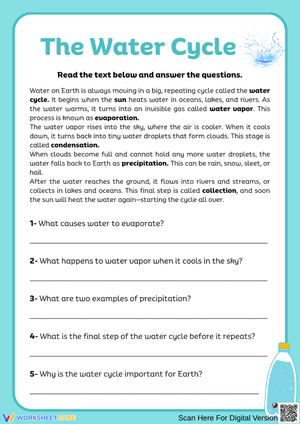
The most effective placement follows a consistent pattern across a water unit: one worksheet for introduction (label a diagram with new terms), one for guided practice mid-lesson (sequence and explain two cycle stages), and one for independent review the following day (read a short passage, answer comprehension questions, write a sentence using one target word). That three-part structure keeps vocabulary reinforcement spaced without requiring students to sit through the same content twice — a straightforward application of spaced retrieval that doesn't need a formal protocol to work.
The 4th grade water printable worksheets in this collection also work well for the last eight to ten minutes of a science block when a lesson has run slightly long. A vocabulary matching worksheet or a four-item sequencing activity requires no setup and gives students a concrete task rather than restless waiting. Teachers who use these as Monday warm-ups after a weekend report that the brief review keeps unit vocabulary active without eating into new instruction time.
For sub plans, water worksheets are among the most reliable options in fourth-grade science. The content is visual, the vocabulary is accessible to a non-specialist adult, and a worksheet with a diagram, short reading, and three or four response questions gives students enough to do without needing teacher explanation beyond what's printed on the sheet.
Standard Alignment
Fourth-grade water instruction connects directly to NGSS 4-ESS2-1, which addresses how water and wind shape Earth's surface through erosion and weathering. Worksheets that examine how flowing water moves sediment, cuts channels, or changes riverbanks align with this performance expectation at a foundational level. The water cycle itself is addressed most explicitly in NGSS 5-ESS2-1, which requires students to model interactions between Earth's systems — meaning the conceptual work students do in fourth grade on evaporation, condensation, and precipitation is direct preparation for fifth-grade proficiency on that standard. Treating the water cycle as fourth-grade preview rather than fourth-grade mastery also reduces the pressure on any single worksheet to do too much at once.
Reading-based worksheets in the set also align with CCSS ELA standards RI.4.1 (citing textual evidence) and RI.4.3 (explaining events and procedures in a scientific text), making water an efficient topic for reinforcing science literacy alongside content knowledge without adding a separate ELA lesson.
Adjusting the Worksheets for a Range of Learners
Students who struggle with reading-heavy worksheets can complete short passage questions orally before writing their answers. That approach preserves the comprehension task without turning the worksheet into a decoding exercise. Diagram-labeling worksheets are often the strongest starting point for students who need more language support, since the visual gives them a processing anchor before they encounter vocabulary in running text.
For students who finish early or need more challenge, the extension isn't to add more cycle stages — it's to push the explanation deeper. Ask them to respond to: "If the sun disappeared for a week, what would happen to the water cycle and why?" That prompt uses the same content but requires precise cause-and-effect reasoning rather than recall. The 4th grade water printable worksheets in this set include open-response prompts that can be assigned selectively rather than universally, which makes within-class adjustment straightforward without preparing a separate document.
Frequently Asked Questions
Do these worksheets require any special materials or prep?
No. The diagram-labeling worksheets include a pre-drawn water cycle illustration; students add the labels. The reading worksheets include the passage on the same sheet. Nothing needs to be cut, assembled, or prepared in advance beyond printing.
How long does a typical worksheet take in a fourth-grade class?
Most worksheets in the set run 10 to 15 minutes for students working at grade level. Vocabulary matching or labeling worksheets fall on the shorter end; reading-and-response worksheets take closer to 15 minutes. That timing makes them workable as bell-ringers, closure tasks, or center rotations without adjusting the rest of the lesson block.
Can these be used before the water cycle unit has started?
The labeling and diagram worksheets work best after at least a brief introduction to the vocabulary — students who encounter "evaporation" for the first time on a worksheet without any prior instruction tend to guess rather than reason through it. The 4th grade water printable worksheets used for introduction should follow at minimum one short direct-instruction moment, even if that's just a five-minute class discussion or a picture book read-aloud. The cloze and vocabulary worksheets include enough context clues that students can work through them with minimal prior knowledge, making them slightly more forgiving as a first contact.
Are the conservation worksheets rigorous enough for science credit, or are they more of a filler activity?
Conservation worksheets in this set require students to apply what they know about the water cycle to evaluate real choices — sorting water-use behaviors, explaining consequences, and writing evidence-based responses. That's a higher-order use of the same vocabulary and concepts from the core unit. Whether they belong in the main lesson sequence or function as an extension depends on available time, not on whether they're substantive.












 Interactive Worksheet Maker
 Quiz Maker
 Word Search Maker
 Crossword Puzzle Maker
 Word Scramble Generator
 Sentence Scramble Generator
 Handwriting Worksheet Generator
 Name Tracing Generator
 Fill In The Blank Generator