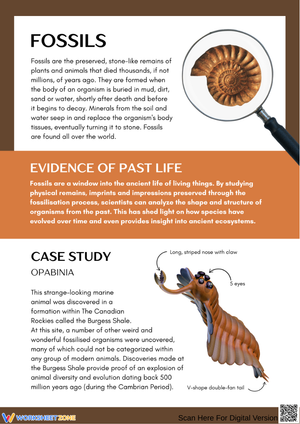
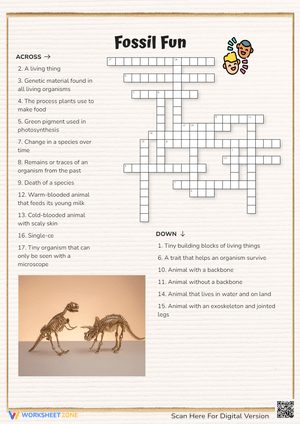
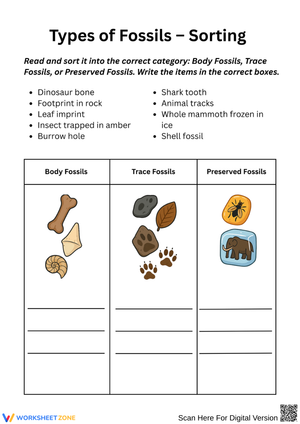
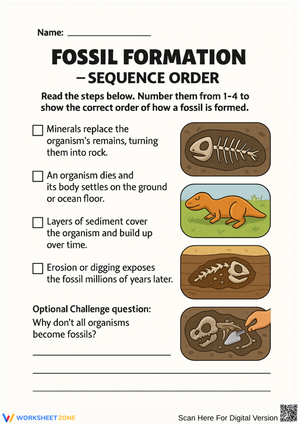
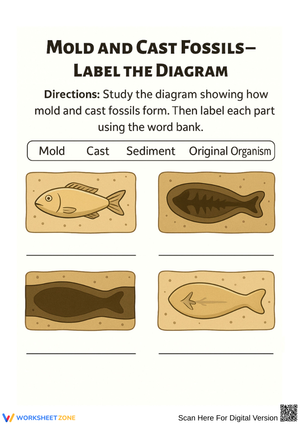
These fossils printable worksheets for 4th grade give teachers a targeted set of resources for building the three core skills at the heart of 4th grade Earth science: identifying fossil types, sequencing the fossilization process, and reading rock strata to reason about relative age. Each worksheet focuses on one piece of the conceptual picture, keeping cognitive load manageable while ideas accumulate across the unit.
What the Set Covers
The content centers on four fossil categories 4th graders are expected to distinguish: mold fossils, cast fossils, trace fossils, and true form fossils. Students often arrive thinking fossils are exclusively bones or teeth — the trace fossil worksheets address this directly by asking students to analyze dinosaur trackway diagrams and draw inferences about the animal's gait and direction of travel.
Beyond fossil type identification, each worksheet targets a specific skill:
- Sequencing activities that walk students through fossilization step by step, from organism death through sediment burial to mineral replacement
- Strata diagram work where students order fossils by relative age and explain the reasoning behind their placement
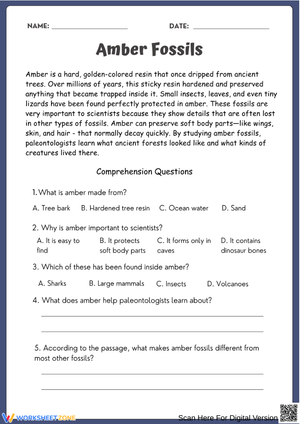
- Reading passages connected to fossil discovery cases, followed by evidence-based inference questions
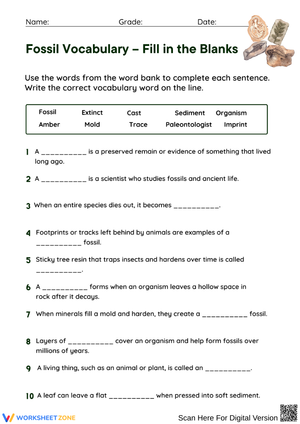
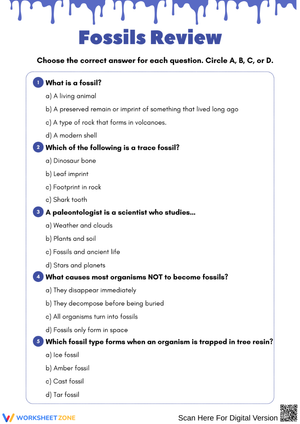
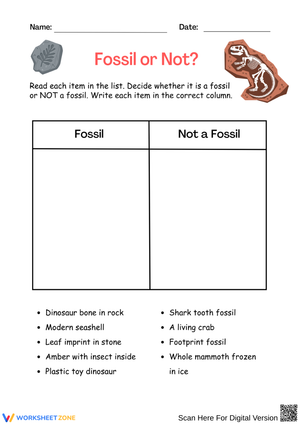
- Vocabulary and classification exercises that reinforce the distinctions between fossil categories
The strata work deserves a particular note. Students quickly learn to say "deeper is older," but applying that rule when a single rock layer holds two different fossil species — and then writing a sentence explaining what that tells us about when those organisms lived — is a different cognitive task entirely. These worksheets give students repeated low-stakes practice at that reasoning step before it shows up on an assessment.
How to Make the Most of These Worksheets in Daily Instruction
The mold-and-cast sequencing worksheet lands best the day after students have done something physical. Spend five minutes having students press a seashell into soft clay and lift it out — one lump of clay per student, one shell per table, minimal prep. That impression gives students a referent while they work through the diagram, turning an abstract multi-step sequence into something they made themselves. The physical step is short; its effect on comprehension during the worksheet task is not.
For the strata diagram worksheets, a station-based format works better than whole-class instruction. Rotate students through naming, inference-writing, and vocabulary review stations in 12-minute intervals, and position yourself at the inference-writing station — that is where students predictably stall, not the ordering tasks. Sitting there gives you a real-time diagnostic read on student reasoning that collected worksheets at the end of class cannot. When these fossils printable worksheets for 4th grade are used as Monday warm-ups, the reading passages fit naturally: students complete them in the first 8 minutes while attendance is handled, and the passage then anchors the day's opening discussion.
Student Errors Worth Anticipating Before You Teach This Unit
The most persistent confusion is between mold and cast fossils. Students will correctly learn that a mold is an impression and a cast fills that impression — and then reverse the definitions on a worksheet or assessment. This is almost always a sequencing failure rather than a vocabulary one: students who memorize the definitions independently do not hold the dependency that a mold must exist before a cast can form. Presenting both on the same worksheet with an arrow connecting them, and asking students to draw the relationship rather than just label it, addresses the underlying gap.
A second cluster of errors shows up in the strata work. Students who correctly order fossils from oldest to youngest will still write inference statements like "this dinosaur lived at the bottom of the ocean" rather than "this rock layer may have been a sea floor environment." Holding two time frames simultaneously — what the organism experienced versus what the rock layer indicates — is genuinely hard for 9- and 10-year-olds. The inference-writing portion of these worksheets functions as a diagnostic window: students who write about the organism instead of the evidence have not yet made the conceptual move that 4-ESS1-1 requires.
Watch also for students who dismiss trace fossils as "not real fossils" when they encounter a footprint diagram. This surfaces in class discussion nearly every time the concept is introduced. The trace fossil worksheets address it by leading with the definition before presenting examples, giving students an anchor before they encounter evidence that challenges their original mental model.
Standard Alignment
The fossils printable worksheets for 4th grade in this set target NGSS 4-ESS1-1 (Earth's Place in the Universe), which asks students to identify patterns in rock formations and fossils and use that evidence to explain how a landscape changed over time. In classroom terms, that standard has two distinct instructional demands: students need conceptual knowledge of fossil types and formation, and they need the reasoning skill to use fossil evidence as the basis for a scientific explanation. These are not the same skill, and teaching one does not automatically develop the other. The fossil type and sequencing worksheets handle the first demand; the strata and inference worksheets handle the second. Teachers familiar with this standard will recognize the gap: students who can name fossil types fluently still freeze when asked to treat a fossil as evidence for a claim.
Matching the Worksheets to Your Range of Learners
For students who need vocabulary support, the fossil type classification worksheet pairs well with a reference card — four definitions, one per fossil type, with a small sketch beside each. Students use the card while working through the classification activities without stopping to re-read a textbook. The worksheet itself does not need modification; the card handles the access issue.
Advanced students move through naming and sequencing tasks quickly and need something with more analytical weight. The strata worksheets extend naturally: instead of just ordering fossils by age, ask these students to write a paragraph-length scientific explanation of how the landscape changed over time based on the diagram's fossil evidence. A marine fossil positioned below a terrestrial one tells a specific story, and narrating that story in precise scientific language — distinguishing what the evidence shows from what it implies — is a genuine stretch task, not busywork.
Frequently Asked Questions
What fossil types do these worksheets cover?
The set addresses four categories: mold fossils, cast fossils, trace fossils, and true form fossils. Mold fossils are hollow impressions left in rock after an organism decays; cast fossils form when minerals fill those molds to produce a three-dimensional replica. Trace fossils preserve evidence of behavior — footprints, burrows, feeding marks — rather than body parts. True form fossils consist of actual preserved remains, typically trapped in amber, ice, or tar. Each category receives dedicated worksheet treatment, including formation diagrams and classification tasks.
How do these worksheets connect to NGSS 4-ESS1-1?
The standard requires students to use patterns in rock formations and fossils to explain changes in a landscape over time. The strata diagram worksheets give students practice reading a sedimentary column, ordering fossils by relative age, and writing an evidence-based inference about the environment in each period. Finding a marine fossil in a desert rock layer, for example, leads students to reason that the area was once underwater — which is exactly the kind of explanation 4-ESS1-1 targets.
How can I support students who struggle with the reading passages?
The diagram-based worksheets — fossil type sequencing, strata analysis, and footprint interpretation — require minimal reading and work well for students who struggle with text-heavy tasks. For worksheets that include reading passages, a partner-reading structure reduces the decoding demand without changing the analytical work. A printed vocabulary reference card covering the four fossil types handles most remaining access barriers without requiring separate modified worksheets.
What if my pacing only allows one or two class periods for fossils?
Prioritize the fossil type classification worksheet and one strata diagram worksheet — together, those two address the conceptual core and the evidence-based reasoning skill that 4-ESS1-1 actually measures. The fossils printable worksheets for 4th grade in this set are standalone, so teachers can select exactly what fits their pacing rather than working through the full set in sequence. The reading passages and inference activities work well as homework or early-finisher tasks when class time is limited.












 Interactive Worksheet Maker
 Quiz Maker
 Word Search Maker
 Crossword Puzzle Maker
 Word Scramble Generator
 Sentence Scramble Generator
 Handwriting Worksheet Generator
 Name Tracing Generator
 Fill In The Blank Generator