"
These 4th grade plant structure and function worksheets give teachers a structured, grade-appropriate way to move students from naming plant parts to explaining what those parts actually do. The set spans external anatomy, internal transport systems, photosynthesis, and adaptation — the full arc of what NGSS asks fourth graders to demonstrate before they leave this unit.
What's Inside the Set
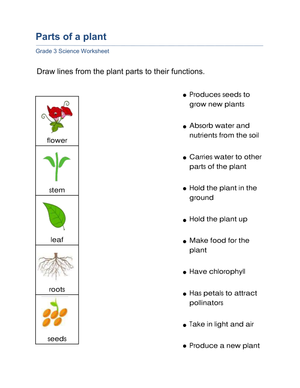
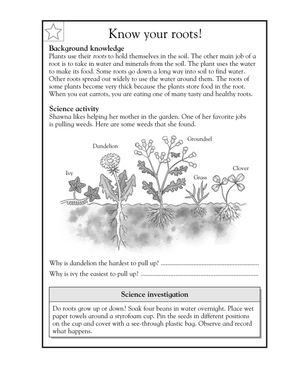
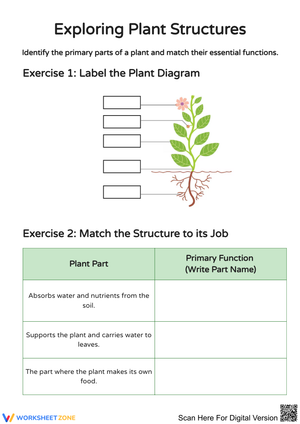
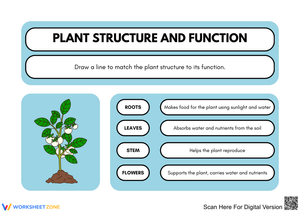
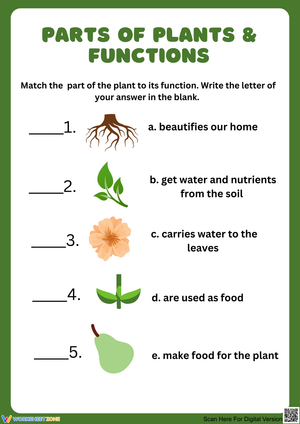
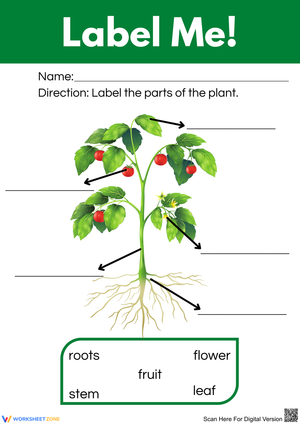
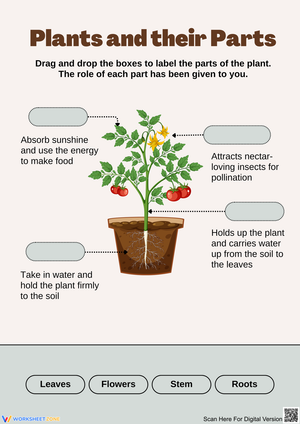
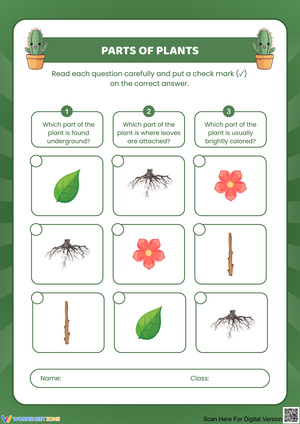
Each worksheet targets a distinct slice of plant biology rather than rehashing the same material in different formats. Students work with diagram-labeling exercises that cover both external structures (roots, stems, leaves, flowers) and internal cross-sections showing xylem and phloem pathways. Matching exercises ask students to connect specific structural features — a taproot, a waxy leaf cuticle, a hollow stem — to their survival function, which is a different cognitive move than simply naming a part. Comparative worksheets pair contrasting plants: the cactus with its water-storing stem, the lily pad with stomata positioned on the upper leaf surface rather than underneath. Photosynthesis flowcharts break the process into discrete steps so students can sequence inputs, outputs, and the role of chlorophyll without conflating them into one blurry reaction.
Standard Alignment
These worksheets align directly with NGSS 4-LS1-1 (Structure and Function), which asks students to construct an argument that plants have internal and external structures that support survival, growth, behavior, and reproduction. In instructional terms, that standard sits in the middle of a 4th grade life science unit — after students have explored organisms broadly but before they move toward ecosystems and interdependence. The function-explanation prompts on each worksheet are written to support the evidence-based argument structure the standard requires, not just vocabulary recall. Teachers using the NSTA frameworks for plant life cycles will find the sequencing of these worksheets consistent with recommended instructional progression.
Why This Format Works at Fourth Grade
Fourth grade is when students shift from ""plants have roots"" to ""roots absorb water and anchor the plant, and here is evidence."" NGSS 4-LS1-1 is explicit about this: students need to construct an argument connecting physical structures to survival, growth, and reproduction — not simply recall vocabulary. Labeling diagrams alone does not get students there. The worksheets pair identification tasks with function prompts, so a student who correctly labels the phloem also has to write where the sugars it carries come from and where they go. That pairing reflects the standard's actual performance expectation rather than just its vocabulary list.
The cross-section diagrams address a genuine developmental challenge at this grade: most fourth graders have never thought about the inside of a stem. Without a concrete visual anchor, xylem and phloem remain abstract terms that disappear after the test. Diagram work that asks students to trace a water molecule's path from soil to leaf — marking each tissue it passes through — builds a mental model that holds.
Lesson-Planning Ideas to Get the Most From These Worksheets
The diagram-labeling worksheets work well at the front of a lesson as a pre-assessment or at the close of direct instruction as a quick check. Five minutes at the end of class, students label what they can from memory before flipping their notes over — that retrieval attempt, even an incomplete one, strengthens retention more than rereading their notes would.
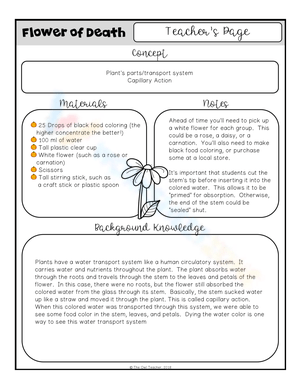
For the internal transport worksheets, pair them with the celery-and-food-coloring demonstration. Before students mark up the xylem on their cross-section worksheet, have them physically trace the colored water line up the celery stalk with a finger. The kinesthetic experience makes the diagram feel like a record of something real rather than an abstract schema. The matching worksheets make a reliable Monday warm-up after a weekend gap — a low-stakes way to recover vocabulary before building on it. Flowchart worksheets, because they require sequencing, work better mid-unit than at the start; students need enough prior knowledge to recognize when a step is out of order.
Common Student Mistakes Teachers Should Anticipate and Address
The most persistent confusion at this level involves the direction of transport in the two vascular tissues. Students routinely assign phloem the job of moving water upward, conflating it with xylem. On worksheet responses, this shows up as sentences like ""the phloem carries water from the roots to the leaves so they can make food."" The confusion is understandable — both tissues are in the same location and both are involved in the photosynthesis story — but the error matters because it unravels the whole system. A targeted follow-up prompt (""what does the phloem carry, and which direction does it travel?"") surfaces this faster than a multiple-choice item would.
A second error pattern appears on the adaptation comparison worksheets: students often describe structural differences accurately but cannot explain the survival logic. They write ""the cactus has a thick stem and the lily pad has a thin stem"" without connecting stem thickness to water storage in an arid environment. The worksheets are designed to push past description with an explicit function prompt, but students who are used to being rewarded for correct labels will skip the explanation unless a teacher explicitly holds the line on that portion of the task.
Adjusting the Worksheets for a Range of Learners
For students who struggle with the blank diagram format, partially completed versions — with one or two labels already filled in and a word bank provided — reduce cognitive load without eliminating the thinking. The goal is for every student to practice connecting structure to function; the scaffolding just changes how much retrieval support they get. Word banks work especially well for the internal anatomy worksheets, where xylem and phloem are genuinely unfamiliar words that can block a student who knows the concept from demonstrating it.
Students who finish quickly and accurately benefit most from the open-ended extension built into the comparative worksheets: design a hypothetical plant for an extreme environment and explain how each structural choice supports survival. This task requires applying the same structure-function logic the standard asks for, but without a diagram to copy from — students have to generate the reasoning independently. One honest caveat: the open-ended format frustrates students who rely on matching a visible answer to a provided term. For those students, the extension works better as a discussion prompt than a written task.
Frequently Asked Questions
Do these worksheets cover both internal and external plant structures, or just the visible parts?
Both. The set includes external anatomy worksheets focused on roots, stems, leaves, and flowers, as well as cross-section diagrams that address the vascular system — specifically xylem and phloem. Internal structures are a genuine focus of NGSS 4-LS1-1, and the worksheets treat them as such rather than as bonus content.
Where do these worksheets fit in a typical 4th grade science unit sequence?
The labeling worksheets work at the start of a plant unit, when students are building vocabulary. The function-matching and flowchart worksheets fit better mid-unit, after students have enough context to reason about why a structure does what it does. The comparative adaptation worksheets are strongest near the end of the unit, when students can draw on the full set of structures they have studied.
Are these worksheets appropriate for students who are reading below grade level?
The diagrams and matching formats are accessible to students reading below grade level because they rely on visual recognition and short-answer responses rather than extended reading passages. The flowchart and explanation-based worksheets include more text, and teachers may want to read those aloud or pair students strategically for those tasks. The word-bank option on the scaffolded versions also reduces reading demand without changing the science content being assessed.
"












 Interactive Worksheet Maker
 Quiz Maker
 Word Search Maker
 Crossword Puzzle Maker
 Word Scramble Generator
 Sentence Scramble Generator
 Handwriting Worksheet Generator
 Name Tracing Generator
 Fill In The Blank Generator