These 4th grade partial products printable worksheets give teachers a ready sequence of multiplication practice that moves from place-value decomposition through full multi-digit problems — without requiring extra prep time between the guided lesson and independent work. Each worksheet targets a specific step in the partial products strategy, so you can assign by readiness rather than guessing which worksheet will push students forward and which will lose them.
What's Inside the Set
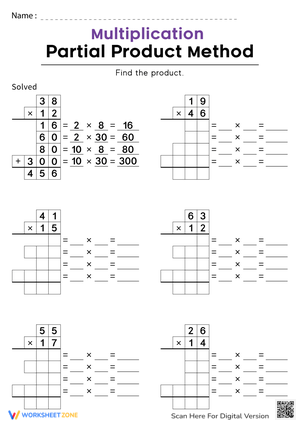
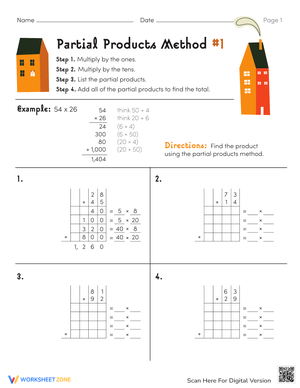
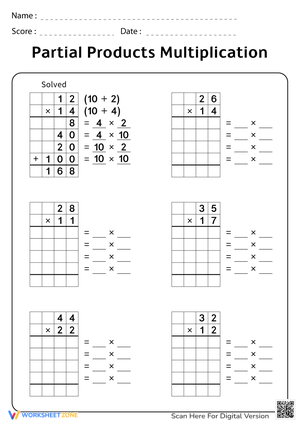
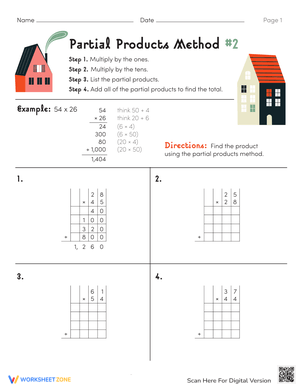
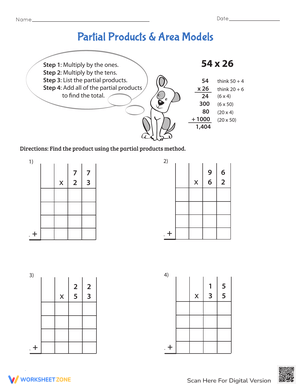
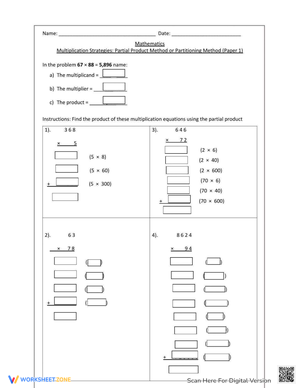
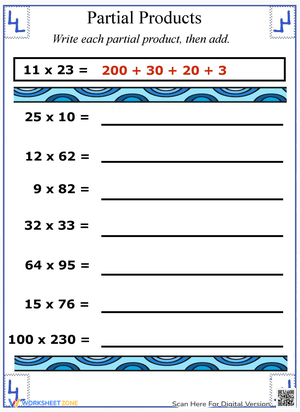
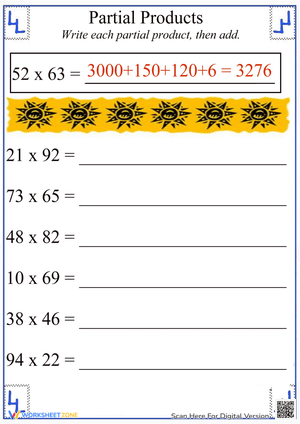
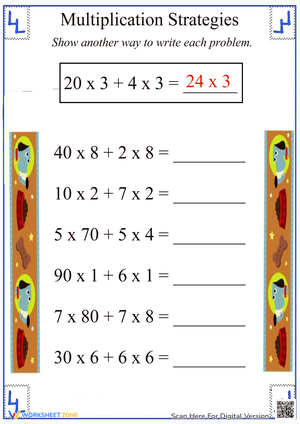
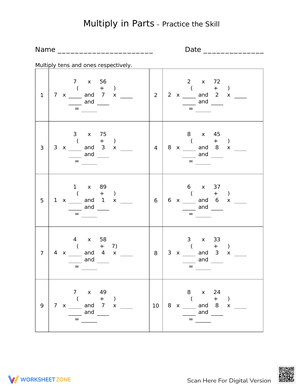
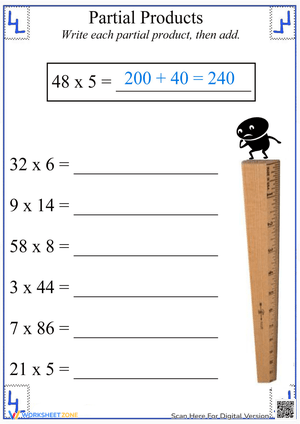
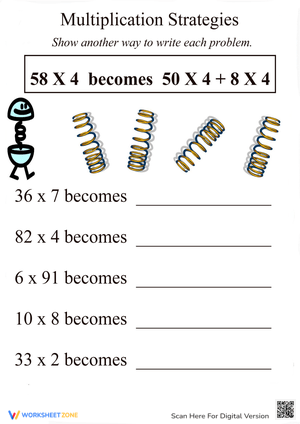
The worksheets progress from simpler to more demanding problems in a deliberate order. Early worksheets have students break a two-digit factor into expanded form — 47 becomes 40 plus 7 — before multiplying each part by a one-digit number and recording two separate products. Later worksheets remove the expanded-form prompt and ask students to identify the place-value parts themselves. The final worksheets in the set address two-digit by two-digit multiplication, where students write four partial products and add them to find the total.
- Expanded-form worksheets with labeled boxes for tens and ones products
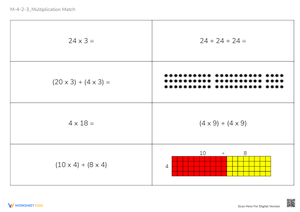
- Area-model connection worksheets that link a visual rectangle to the written partial products format
- Two-digit by one-digit practice with open working space for each step
- Two-digit by two-digit problems with enough room to organize four partial products clearly
- Error-analysis tasks where students examine flawed work, identify the mistake, and correct it in writing
- Mixed-review worksheets that combine partial products with basic fact checks and place-value questions
Answer keys accompany every worksheet, which matters most during intervention blocks and center rotations when you need to redirect students quickly without stopping to recalculate by hand.
Mistakes Students Make That These Worksheets Help You Catch
Partial products is one of the best strategies for making student thinking visible — which means it also surfaces errors that a compact algorithm would hide entirely. The most consistent mistake in early Grade 4 work: a student correctly identifies 30 and 4 in the number 34, multiplies 4 × 6 accurately, then writes 18 instead of 180 for 30 × 6. The place-value connection breaks during multiplication even when it held during decomposition. That specific error appears reliably in the first week of partial products instruction, and worksheets with open space for each partial product let you spot it in thirty seconds during a quick classroom scan.
A second pattern appears when students move to two-digit by two-digit problems. Students who handle 24 × 3 correctly will still treat the "1" in 13 as a ones value — computing 24 × 1 instead of 24 × 10 and recording 24 as a partial product where 240 belongs. That is not a fact error; it is a place-value error wearing the costume of a multiplication error. Worksheets that require students to write out the full value they are multiplying — not just the digit — catch this before it becomes a habitual wrong answer.
Building These Worksheets Into Your Weekly Lesson Plans
The most practical way to use a set of 4th grade partial products printable worksheets is to vary the purpose of each worksheet across the week rather than treating every session as standard practice. One worksheet works well as a Monday bell ringer when students have been away from multiplication for two days — three or four short problems to restart place-value thinking before the lesson. A more open-format worksheet fits the twenty minutes after direct instruction when students are ready to try problems independently but still need the organizational structure on the page to keep their partial products sorted. Exit tickets work best with one fresh problem and one error-analysis item: students solve their own problem and then examine and correct a sample of flawed student work.
A concrete move during modeling: print the same worksheet at full size for display under a document camera, then distribute standard-size copies to students. When the layout students see during the lesson matches what they work on at their desks, they direct attention to the math rather than to decoding a new format. That transfer cost is real — especially in the first few days with any new strategy — and matching the layout removes it.
Standard Alignment
These worksheets address CCSS 4.NBT.B.5, which requires students to multiply a whole number of up to four digits by a one-digit whole number and multiply two two-digit numbers using strategies based on place value and properties of operations. Partial products is one of the named strategy types this standard points toward. Instructionally, this standard arrives mid-year in most Grade 4 sequences — after students have solidified place-value understanding through the 4.NBT.A standards and before they are expected to reach fluency with the standard algorithm in Grade 5. Positioning partial products practice here, between conceptual place-value work and procedural fluency, reflects exactly what 4.NBT.B.5 calls for.
Differentiating the Worksheets Across Student Readiness Levels
Students who are still uncertain about place-value position benefit most from worksheets that include labeled boxes for tens and ones products. Those boxes act as a built-in organizational structure rather than an add-on, so students who need additional support can use the same worksheet as the rest of the class without requiring a separate version. For students who have the decomposition step secure, cover or remove those labeled sections and ask them to organize their partial products in the open working space below. The shift from prompted to unprompted work is where most of Grade 4 needs to arrive by the end of the unit — and these worksheets give you a concrete way to move students through that transition incrementally.
Extension is handled through the error-analysis and word-problem worksheets. When students explain in writing why a classmate's partial product is wrong and what the correct value should be, that demands a level of precision in place-value reasoning that calculation alone does not require. Written explanations also give you something genuinely useful for assessment: they reveal whether a student who gets the right answer actually understands the strategy, or has found a shortcut that will not hold when numbers get larger.
Frequently Asked Questions
What multiplication problems appear across the set?
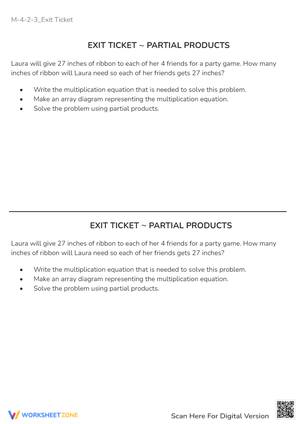
The worksheets move from two-digit by one-digit problems — such as 43 × 7 — through two-digit by two-digit problems — such as 36 × 24 — with intentional progression between those levels. Problems use values that produce realistic partial products so students can check their addition without a calculator. Some of the 4th grade partial products printable worksheets in the set also include multi-step word problems that require students to set up and solve the multiplication before answering a contextual question.
Can these worksheets be used for homework?
Yes, and families follow along more easily with partial products than with the standard algorithm because the written steps show exactly what the student is doing. Keep homework assignments to worksheets with a clear, familiar format and manageable problem sizes. The full two-digit by two-digit worksheets are better reserved for classroom time, where you can address questions during the work period.
How do these worksheets connect to area models?
Several worksheets pair a drawn area model with the partial products written format so students see both representations of the same problem side by side. That connection reinforces why the strategy works rather than asking students to follow steps on faith. Once students no longer need the visual, they move to worksheets that present the written strategy on its own — and having worked with the area model previously gives them a mental reference point when a partial product doesn't look right.
Are these worksheets appropriate for students who have already learned the standard algorithm?
Students who have memorized the standard algorithm sometimes resist partial products because it feels slower. The error-analysis worksheets are the right fit for that group — they demand precise place-value reasoning rather than procedural speed, and they address conceptual gaps that often surface later in algebra. These 4th grade partial products printable worksheets are worth assigning to advanced students as a reasoning check, not a computation drill.













 Interactive Worksheet Maker
 Quiz Maker
 Word Search Maker
 Crossword Puzzle Maker
 Word Scramble Generator
 Sentence Scramble Generator
 Handwriting Worksheet Generator
 Name Tracing Generator
 Fill In The Blank Generator