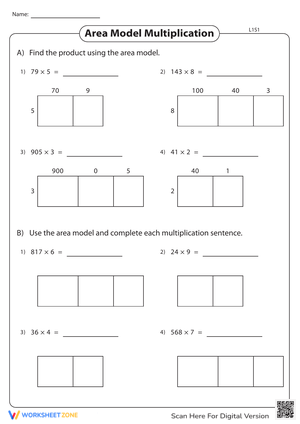
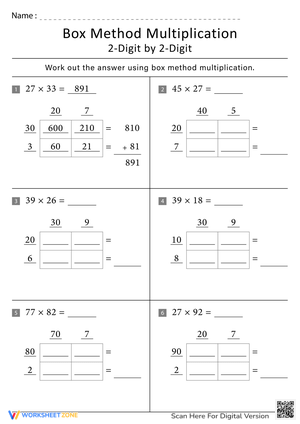
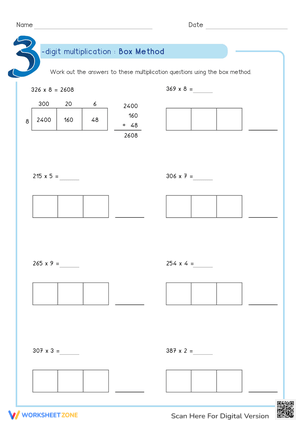
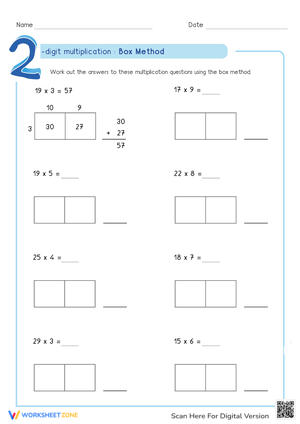
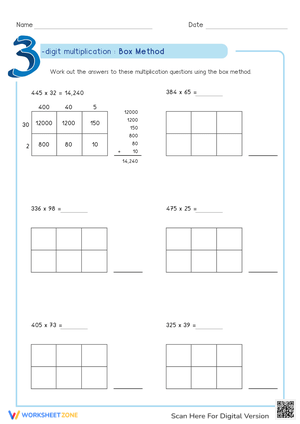
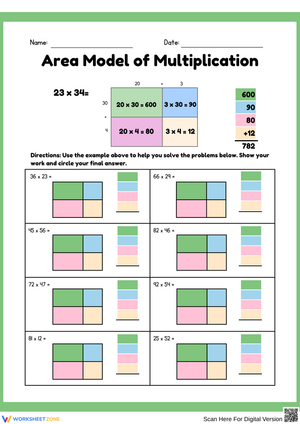
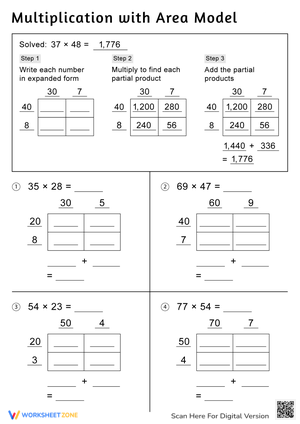
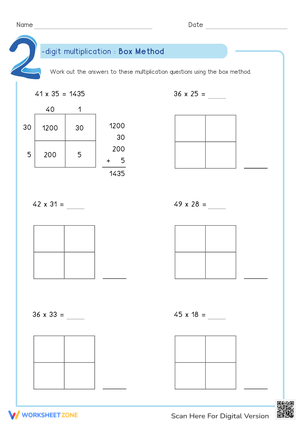
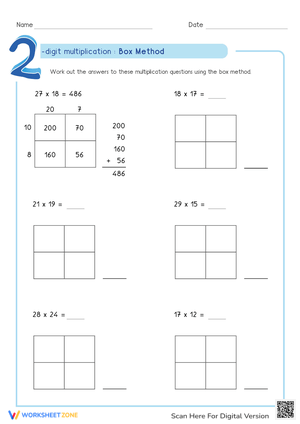
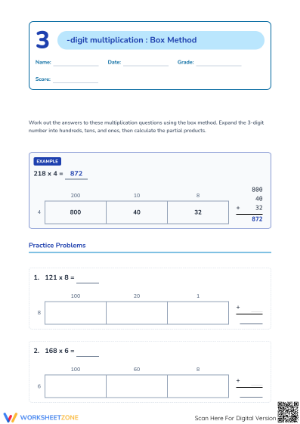
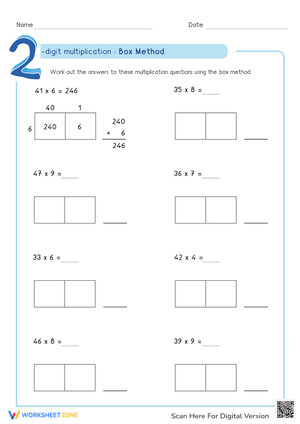
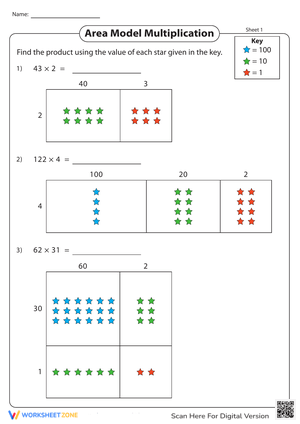
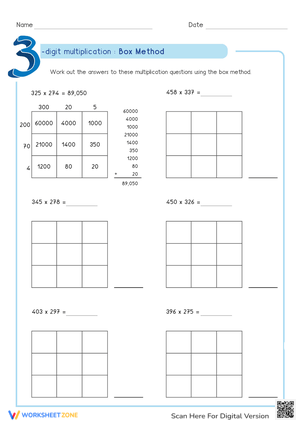
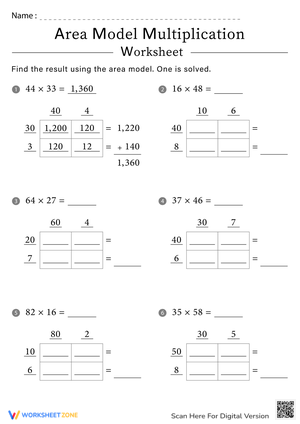
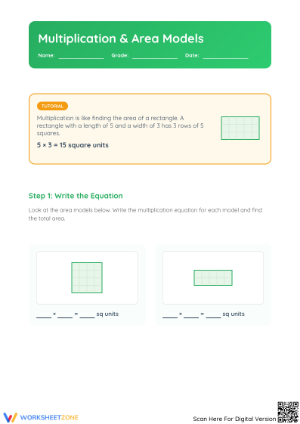
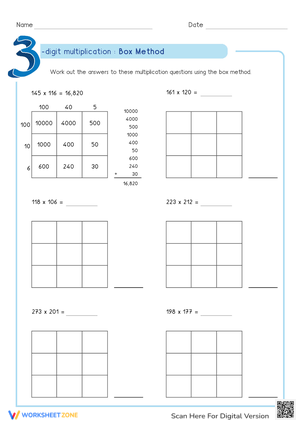
These 4th grade area models worksheets resources give teachers a direct path from place-value instruction into multi-digit multiplication without shortcutting the visual reasoning step Grade 4 students genuinely need. Each worksheet asks students to decompose factors into tens and ones, populate a divided rectangle with partial products, and combine those parts into a final answer — a sequence that keeps the structure of multiplication visible rather than procedural. The set works equally well during initial instruction, small-group review, and targeted follow-up with students who stall when transitioning to the standard algorithm.
Skills These Worksheets Build
The central task is decomposition. Students split a factor like 47 into 40 and 7, label each section of the rectangle accordingly, and calculate the partial product for each box before adding. Grade 4 is the first time most students encounter multiplication where the place value of each digit significantly shifts the size of the partial product — 40 × 6 and 4 × 6 are not interchangeable, and the model keeps that distinction in plain view throughout every problem.
Across the set, students practice these specific skills:
- Labeling rectangle dimensions with decomposed factor values
- Calculating the partial product for each section independently
- Adding partial products correctly to find the full product
- Extending from one-digit by two-digit problems into two-digit by two-digit multiplication
- Writing partial products as a numerical equation alongside a completed model
Mistakes Students Make That These Worksheets Surface
The most common error in area model work is writing 4 instead of 40 when labeling the tens section of a rectangle for a factor like 46. The student has drawn the rectangle and divided it correctly — but records the digit rather than its value. That single mistake turns up on a high percentage of first-attempt worksheets and almost always signals a place-value gap rather than a multiplication error. It calls for different follow-up than the student who labels both dimensions correctly but drops one partial product when adding — that student needs work on computation, not concept.
Sorting finished worksheets by error type rather than by score makes intervention planning significantly more targeted. These 4th grade area models worksheets resources allow that kind of diagnostic sorting because they show student thinking at every step — labeling, multiplication, and addition — rather than reporting only a final answer. A student who decomposed both factors incorrectly needs different instruction than one who decomposed correctly but combined the partial products wrong.
Where These Worksheets Fit Best in the Math Block
During direct instruction, a partially completed model works well as a class think-aloud. Project one worksheet, fill in a single section together while explaining the reasoning aloud, then ask students to complete the remaining boxes independently. The format makes it easy to pause mid-problem and discuss what belongs in each section before anyone writes on their own.
In small groups, use worksheets at different complexity levels simultaneously. One group works through one-digit by two-digit models where the factor decomposition is already provided; another group handles two-digit by two-digit problems without that support. Both groups are practicing the same strategy — the teacher is not running separate lessons. For exit checks near the close of a lesson, one quick area model problem tells you clearly whether students can find and add all partial products without prompting, which is more informative than checking a single numerical answer.
Homework deserves a note here. Area model worksheets are among the better homework choices for Grade 4 multiplication because the rectangle makes the strategy legible to parents who didn't learn this way. When the visual layout shows each step explicitly, the kitchen-table conversation about an unfamiliar method becomes much shorter.
From the Rectangle to the Standard Algorithm
Teachers use area models not only because they're visual but because the thinking inside each box is identical to the thinking that drives the standard multiplication algorithm. When a student multiplies 34 × 27 using the model, the rectangle produces four partial products: 30 × 20, 30 × 7, 4 × 20, and 4 × 7. Those are the same four calculations the standard algorithm executes — just recorded more compactly. Students who practice the model thoroughly before moving to the compact method tend to place digits correctly in the algorithm because they understand what each step represents, not just where to write the numbers.
Students who skip directly to the algorithm often treat it as a sequence of steps with no underlying logic. When something goes wrong, they have no way to check their reasoning because they never built the structure. That's why a set of 4th grade area models worksheets resources fits best in the middle of a multiplication unit rather than as a brief visual introduction at the start. Two or three days of practice is usually not enough time for the model to build the conceptual layer students will carry into the algorithm.
Adjusting the Set for Different Levels of Student Readiness
For students who still place tens and ones inconsistently, use worksheets where the factor decomposition is already printed beside the rectangle. Removing that step means students concentrate entirely on the multiplication and addition without also managing the breakdown. That's not an easier version of the task — it's a more focused version that prevents students from guessing at decomposition and practicing the wrong thing.
For students working above grade level, assign worksheets that extend to three-digit by one-digit multiplication or include space to record all partial products as a vertical numerical equation alongside the model. A written reasoning prompt asking students why one partial product in a one-digit by two-digit problem is always a multiple of ten pushes place-value understanding further than the model alone. The rectangle format handles both ends of the range because the visual structure stays constant while the number complexity adjusts.
Standard Alignment
CCSS 4.NBT.B.5 requires students to multiply multi-digit whole numbers using strategies based on place value and properties of operations, with an expectation that students illustrate and explain their calculations. In most Grade 4 classrooms, that standard lands mid-year — after students have worked on place-value relationships and before the standard algorithm becomes the expected method. 4th grade area models worksheets resources belong squarely in that instructional window, not as a supplement to the algorithm but as the conceptual groundwork that gives the algorithm meaning when students eventually reach it.
Frequently Asked Questions
What is the difference between an area model and partial products?
They represent the same multiplication in different formats. An area model shows each partial product as a section of a rectangle — students can see the space occupied by 40 × 6 versus 7 × 6 before they calculate either one. Partial products recorded vertically show the same math without the visual. Many teachers use the rectangle first because it forces students to treat each partial product as a distinct calculation before combining, which makes the transition to a numerical partial products format feel like a natural step rather than a new procedure.
When should Grade 4 students stop drawing area models?
There is no firm cutoff. Most students transition away from drawing full rectangles once they can reliably record partial products numerically and connect those steps to the standard algorithm. That might happen late in the Grade 4 multiplication unit or carry into Grade 5 review. Some students keep the model as a checking method long after they've internalized the algorithm — that's worth encouraging rather than correcting. Using a visual check is a mathematical habit, not a sign of weakness.
Do these worksheets address two-digit by two-digit multiplication?
Yes, and that extension is where the area model becomes most important. Two-digit by two-digit multiplication produces four partial products, and without a clear visual layout, students routinely miss one or combine two incorrectly. The rectangle requires students to account for all four sections before they sum. Most sets include separate worksheets for this problem type, introduced after students have worked through one-digit by two-digit models and can label dimensions accurately on their own.
How do I use these worksheets with students who already know the standard algorithm?
Have them complete an area model and a standard algorithm calculation for the same problem side by side, then ask them to identify which partial product in the algorithm corresponds to which box in the rectangle. That task is more demanding than it sounds. Students who genuinely understand the algorithm can make the connection without difficulty. Students who have memorized the steps without understanding them usually cannot — and the comparison makes that gap visible to both the teacher and, usefully, to the student.













 Interactive Worksheet Maker
 Quiz Maker
 Word Search Maker
 Crossword Puzzle Maker
 Word Scramble Generator
 Sentence Scramble Generator
 Handwriting Worksheet Generator
 Name Tracing Generator
 Fill In The Blank Generator