4th Grade Number Line Multiplication Worksheets
These 4th grade number line multiplication worksheets give students a way to see multiplication as movement — equal jumps along a scale — rather than a memorized fact disconnected from meaning. Each worksheet targets a specific stage of that progression, from drawing single-digit jumps to translating word problems into a linear model. What teachers get is a ready-to-use set that fits naturally into the conceptual work Grade 4 demands before multi-digit algorithms take over.
The Specific Skills Targeted
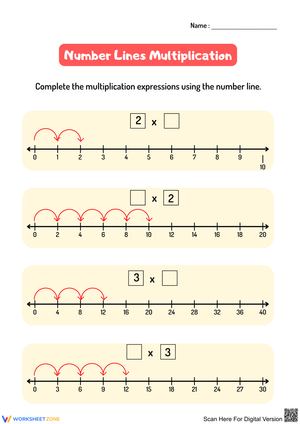
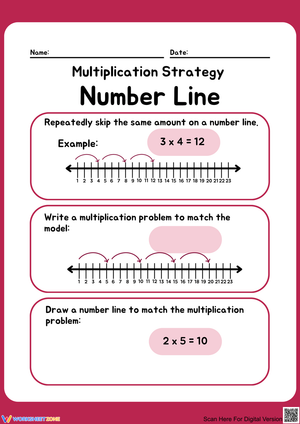
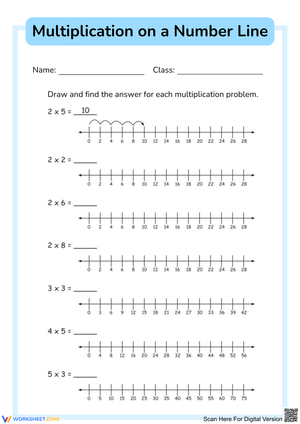
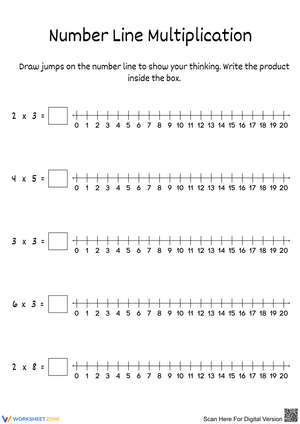
The set opens with jump-drawing exercises built around single-digit factors. Students start at zero, draw equal arcs, and label each landing point — a physical act that makes the repeated-addition interpretation of multiplication visible rather than assumed. Once that foundation is solid, a second group of worksheets shifts to multiples of ten. Problems like 3 × 20 or 4 × 50 use wider intervals, which trains students to scale their number line thinking rather than defaulting to unit counting. This is the mechanical prerequisite for mental math with larger numbers.
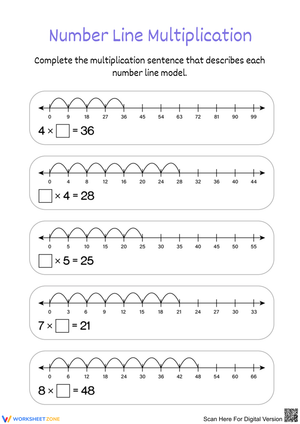
Missing-factor problems flip the direction. The jumps are already drawn; students write the equation those jumps represent. This reversal demands genuine comprehension — a student who has been mechanically copying the teacher's model is exposed here because the scaffold is gone. The final worksheet type moves into word-problem mapping: students read a short scenario, identify the equal groups, and construct the number line themselves before writing the equation. That sequence — context to model to symbol — mirrors the gradual release most Grade 4 teachers use during the multiplication unit.
Standard Alignment
These worksheets align most directly to CCSS 4.NBT.B.5, which asks students to multiply a whole number of up to four digits by a one-digit whole number using strategies based on place value and properties of operations. The number line model is one of the visual strategies that standard explicitly invites. They also support 4.OA.A.1, the standard that asks students to interpret multiplication equations as comparisons — an interpretation the number line makes concrete because students can literally see that 4 × 6 lands four times as far from zero as 6 alone does.
In classroom sequence, these worksheets fit best during the introductory and consolidation phases of the multiplication unit, before students are expected to work with the standard algorithm. Once procedural fluency with the algorithm is the goal, number line work shifts to a checking and sense-making tool rather than the primary method.
Mistakes Students Make That These Worksheets Help You Catch
The single most consistent error is starting the first jump at 1 instead of 0. It seems minor until you realize the student lands on 13 instead of 12 for every problem, and when they check their answer against a times table and find a mismatch, they often conclude the number line "doesn't work" rather than spotting their own starting-point error. Watching for this in the first two worksheets saves a lot of confusion downstream.
A subtler problem appears when students mix up the number of jumps with the size of each jump. A student solving 4 × 6 might draw six jumps of four instead — landing on 24 either way, which masks the confusion entirely until a non-commutative situation reveals it. The missing-factor worksheets tend to surface this: because the jumps are pre-drawn at a fixed size, students who have been swapping factors without realizing it suddenly find that their equation doesn't match the visual. That's a productive moment worth a brief whole-class discussion rather than a quiet correction.
Unequal jump sizing is the third pattern worth flagging. Students who are uncertain about their skip-counting will draw jumps that drift — a "four" jump that visually spans five spaces. This is less a multiplication misunderstanding than a signal that skip-counting fluency needs attention before the student can use the number line reliably as a check on their arithmetic.
Building These Worksheets Into Your Week
The jump-drawing worksheets work well as Monday warm-ups after the weekend gap — five minutes of drawing 3 × 7 and 4 × 6 before morning meeting ends re-engages the spatial memory students built the previous week without requiring any new instruction. The missing-factor worksheets, because they require more independent reasoning, fit better mid-week when students are past the re-entry phase but haven't hit end-of-week fatigue.
For small-group pullout, these worksheets give you something concrete to sit with alongside two or three students. Rather than reteaching from scratch, you can ask a student to talk through why they placed a jump where they did — that narration surfaces the actual misunderstanding faster than another round of the same problem done silently. The word-problem mapping worksheets double as informal formative data: a student who draws the correct number of jumps but at the wrong size has a different gap than a student who draws the right size but the wrong count, and a quick scan of the completed worksheets before your next lesson tells you which of those two problems you're actually solving.
One transition worth building in before students touch the paper: if you have floor tape or painters' tape, walking a physical number line for ten minutes — with students taking actual steps of equal length — transfers to the worksheet representation in a way that a projected image alone does not. Students who have physically jumped "four times, five spaces each" rarely make the starting-at-one error afterward.
Adjusting the Worksheets Across Ability Levels
Students who are still building skip-counting fluency need the worksheets where the number line is pre-labeled at regular intervals. Asking them to both determine the interval scale and draw jumps simultaneously is too much at once; pre-labeling keeps the focus on the multiplication structure itself. For these students, pairing the worksheet with a hundreds chart visible on the desk removes skip-counting as a barrier without removing the multiplication reasoning.
Students working above grade level benefit most from the open number line versions, where no intervals are marked and they must choose a reasonable scale before drawing. This demands the kind of proportional thinking that previews ratio work in Grade 6. You can extend further by asking them to represent the same problem at two different scales on the same worksheet — 4 × 6 on a 0–30 line and again on a 0–100 line — which builds a sense of relative magnitude that number line work is particularly well-suited to develop.
Frequently Asked Questions
Do these worksheets cover multi-digit multiplication, or only single-digit problems?
The set focuses on single-digit factors and multiples of ten — the range where number lines are genuinely useful as a primary model. Problems like 4 × 30 or 6 × 50 appear because they build place-value reasoning alongside multiplication. For full multi-digit problems like 34 × 27, an open number line can support a partial-products approach, but that's an extension beyond what these worksheets address directly.
How long does a typical worksheet take in class?
Jump-drawing worksheets with single-digit factors run about eight to ten minutes for most Grade 4 students working independently. Missing-factor and word-problem worksheets take closer to twelve to fifteen minutes because the reasoning demand is higher. That timing makes the simpler worksheets workable as warm-up activities and the more complex ones better suited to a dedicated practice block.
My students already know their times tables. Is the number line work still useful?
Yes — fact fluency and conceptual understanding are separate, and students who can recite 7 × 8 without hesitation often cannot explain why that answer is 56 or estimate whether a product is reasonable. The number line builds the second kind of understanding. It also previews the scaling logic students need when they encounter multiplying by fractions or decimals, where recalled facts no longer get them to the answer.
Clear All