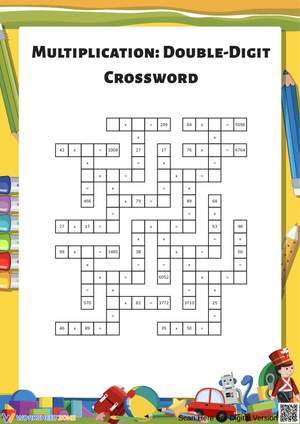
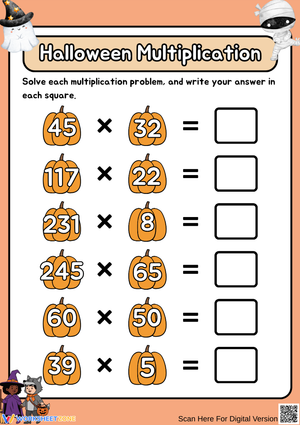
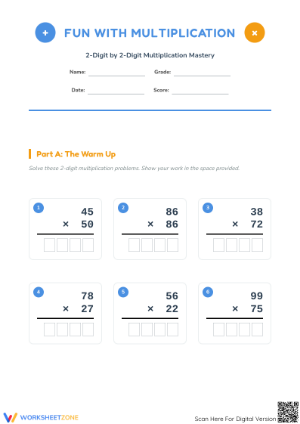
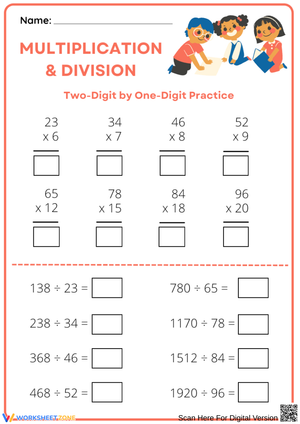
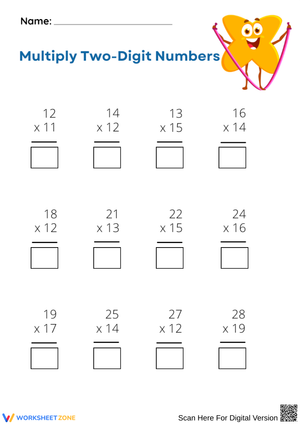
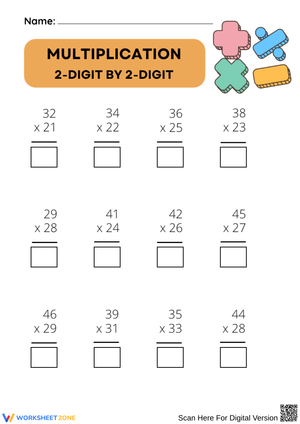
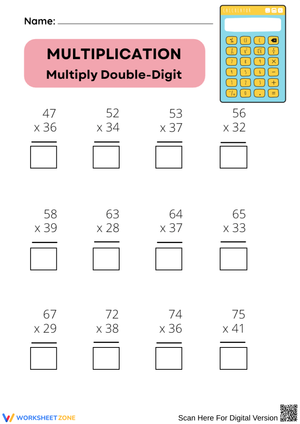
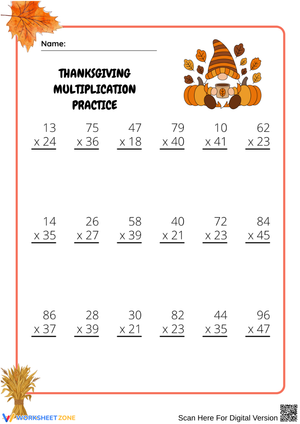
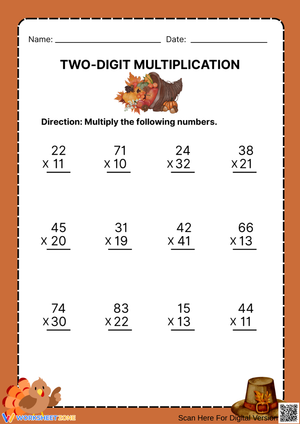
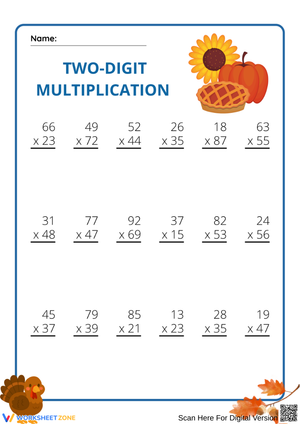
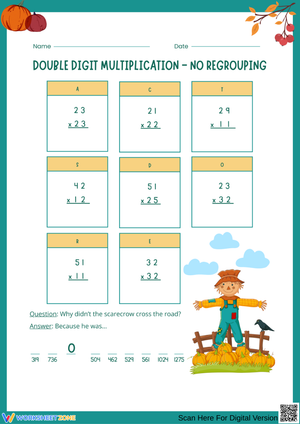
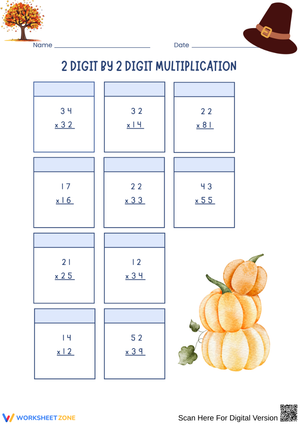
These 4th grade 2 digit 2 by 2 worksheets give teachers a ready sequence of practice materials that move students through the three main multiplication strategies used in fourth grade — the area model, partial products, and the standard algorithm — without requiring teachers to build problem sets from scratch. Each worksheet focuses on a specific strategy at a specific stage, which matters more than it might seem: mixing all three methods on a single task before students are secure in any one of them produces confusion rather than fluency. The workspace format — how much room is provided, whether place value columns are marked, how densely problems are packed — directly affects whether students can show clean work or end up with arithmetic they cannot check.
Concepts in Each Worksheet
The set covers the full instructional arc for 2-digit by 2-digit multiplication. Area model worksheets ask students to draw and label the four inner rectangles that make up the full product — for 34 × 27, that means four separate cells: 30 × 20, 30 × 7, 4 × 20, and 4 × 7 — making visible what the standard algorithm later compresses into a few written lines. Partial products worksheets present the same four calculations vertically and require students to write out each one before summing. These 4th grade 2 digit 2 by 2 worksheets also include estimation prompts, asking students to round each factor to the nearest ten before solving — a step that builds a self-checking habit and catches magnitude errors students would otherwise miss entirely.
Standard algorithm worksheets occupy the third tier and include generous workspace for regrouping marks and a clearly indicated position for the placeholder zero. The progression is intentional: a student who has built area models for two weeks and listed partial products after that understands why the placeholder belongs where it does. Without that conceptual foundation, the algorithm's steps feel arbitrary, and students who meet an unfamiliar variation have nothing to reason from.
The Errors That Show Up Most in Student Work
The most persistent error in 2-by-2 multiplication is place value collapse, not a forgotten fact. A student working through 34 × 27 who multiplies 2 × 3 and records 6 has treated both digits as single-unit numbers rather than as 20 and 30 — the correct partial product is 600. Partial products worksheets surface this quickly because students must write 30 × 20 explicitly rather than bypassing that conceptual step entirely.
Column misalignment causes a separate category of errors. When students write the second partial product without shifting one column to the left, they add hundreds digits to tens digits and produce answers that are off by a factor of ten. Worksheets with a faint grid background reduce this significantly — not because the grid thinks for the student, but because it removes the visual ambiguity that allows digits to drift. A third recurring problem is dropped carry marks: students note the regrouped digit but skip over it later, especially after any pause in their work. Error analysis tasks — where students receive a completed worksheet with planted mistakes and must identify exactly which step failed — address all three error types more efficiently than additional computation repetition alone, because they require students to articulate the reasoning behind each step rather than just produce answers.
Fitting These Worksheets Into Your Lesson Sequence
Area model worksheets work best as in-class guided practice on the day of introduction — not as homework. At that stage, students still need to be close enough to ask a question when they stall on how to partition the factors. Once that worksheet can be completed accurately without support, partial products worksheets work well as a Monday warm-up after morning meeting or as a five-minute opener before new content. Standard algorithm worksheets should wait until students can explain in their own words why the placeholder zero occupies that position. Assigning the algorithm before that reasoning is in place means students practice a sequence they don't understand, and the skill breaks down on assessments as soon as the numbers change. For exit tickets, a short worksheet from the set takes about eight minutes — long enough to assess strategy use clearly and still fit before afternoon pickup or a specials rotation.
Standard Alignment
These worksheets address CCSS 4.NBT.B.5, which requires students to multiply two two-digit numbers using strategies based on place value and the properties of operations, and to illustrate and explain their work using equations, rectangular arrays, or area models. This standard typically enters the curriculum in the second or third quarter of fourth grade, after students have worked with single-digit multiplication and multi-digit addition. It appears on state assessments in both computation and applied formats, which is why worksheets that pair bare calculations with word problems give students practice recognizing when to multiply — not only how.
Matching Each Worksheet to Where Students Actually Are
For students who are not yet secure with the area model, 4th grade 2 digit 2 by 2 worksheets that include a pre-drawn grid with labeled rows and columns reduce how much students must hold in working memory at one time. They fill in the four multiplication cells rather than constructing the entire structure, which lets them focus on computing each partial product correctly. A basic multiplication fact chart alongside these worksheets helps students who haven't yet consolidated single-digit facts — removing that barrier lets them work on the multi-digit process, which is the actual target of the standard.
Advanced students benefit from a different kind of challenge than additional repetitions. Missing-digit problems — where one or two digits in the factors are hidden and students must reason backward from a given product — require genuine mathematical thinking rather than faster computation. Real-world contexts add another layer: calculating the total number of seats in an auditorium with 34 rows of 27 seats, or figuring out how many minutes are in 15 weeks, keeps the arithmetic embedded in reasoning and gives strong students something to actually think through rather than simply execute.
Frequently Asked Questions
Are these worksheets appropriate for homework?
Each worksheet sent home needs a worked example of the specific strategy being practiced printed directly on it. Without a reference, students who get stuck have no recovery path, and parents who learned a different method may introduce steps that conflict with current classroom instruction. In-class use works at any stage of the sequence. Homework is most reliable once students can complete that particular strategy independently during the school day.
How many problems should appear on a fourth-grade multiplication worksheet?
Ten to twelve problems is a practical upper limit for a focused session. That count gives students enough room to show full work — partial products listed vertically, regrouping marks written clearly — without cramming digits into margins. Including two or three word problems within that count matters: students who compute correctly but cannot identify when to multiply are not yet fully meeting the standard.
Why teach the area model before the standard algorithm?
The area model makes the four partial products visible as separate quantities rather than embedded steps in a memorized procedure. When a student fills in the cell for 30 × 20 and writes 600, they are doing something conceptually different from placing a 6 in a column during the standard algorithm. Students who skip the area model stage and go straight to the algorithm often lose the thread when they encounter a slight variation — a three-digit factor, or a word problem that doesn't directly signal multiplication.
How can I use these worksheets to assess student understanding?
A three-problem exit ticket pulled from the set takes about eight minutes and immediately reveals whether errors are coming from fact recall, column alignment, or conceptual confusion about place value — three different diagnoses that call for three different instructional responses the following day. Looking at a handful of completed 4th grade 2 digit 2 by 2 worksheets after class almost always surfaces a consistent error pattern across the group, which is more instructionally useful than a simple correct-versus-incorrect count.













 Interactive Worksheet Maker
 Quiz Maker
 Word Search Maker
 Crossword Puzzle Maker
 Word Scramble Generator
 Sentence Scramble Generator
 Handwriting Worksheet Generator
 Name Tracing Generator
 Fill In The Blank Generator