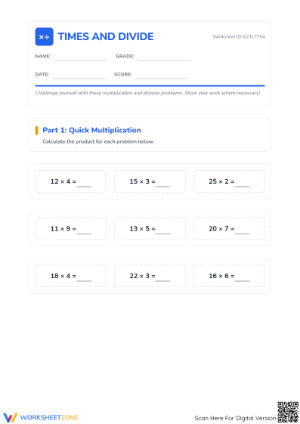
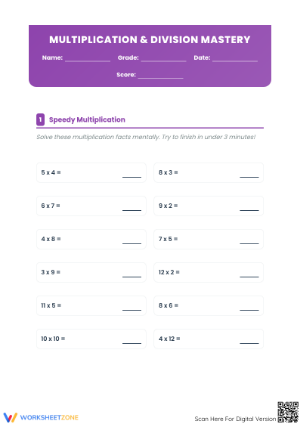
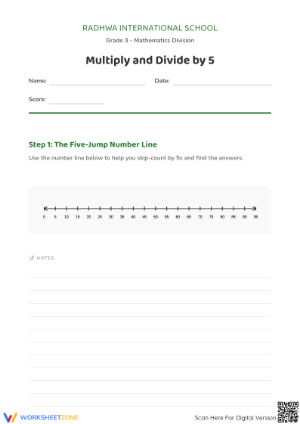
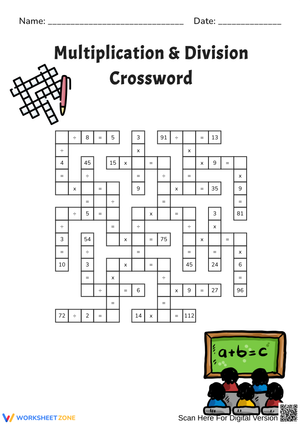
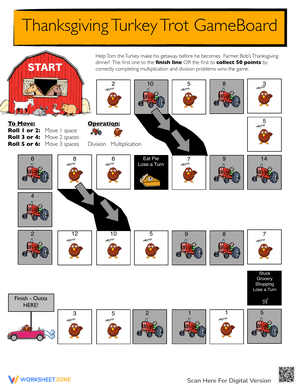
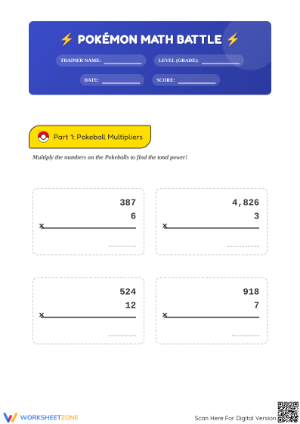
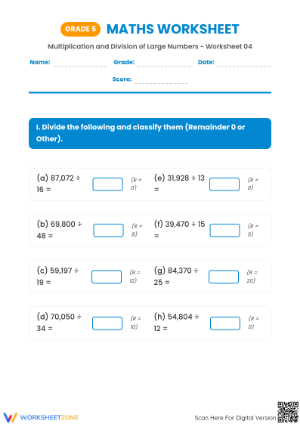
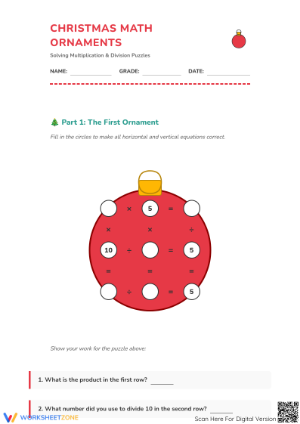
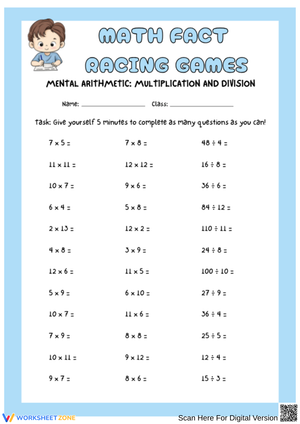
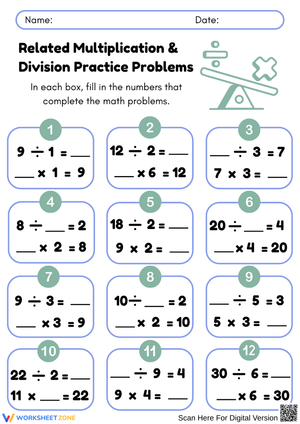
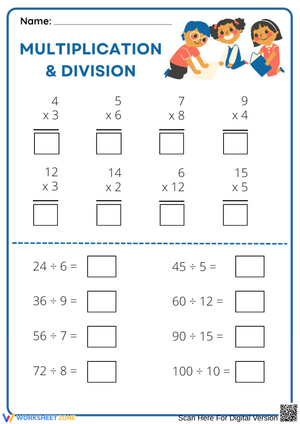
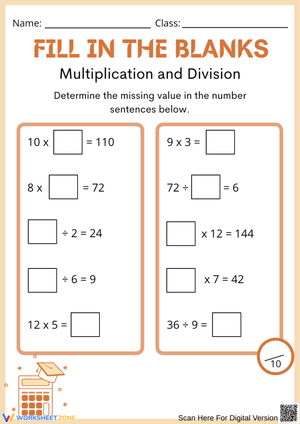
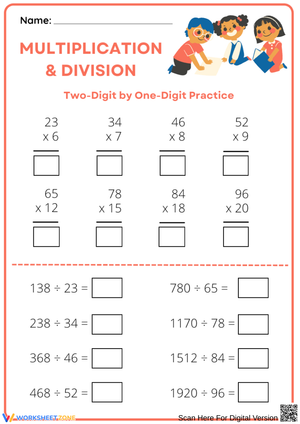
These multiplication division printable worksheets for 4th grade give teachers a ready supply of computation and problem-solving practice that holds up across the entire year — warm-ups, centers, quick checks, and intervention groups alike. The set covers basic fact fluency through multi-digit work, division with remainders, and word problems that ask students to decide which operation the situation calls for, rather than follow a repeated pattern.
Skills Each Worksheet Builds
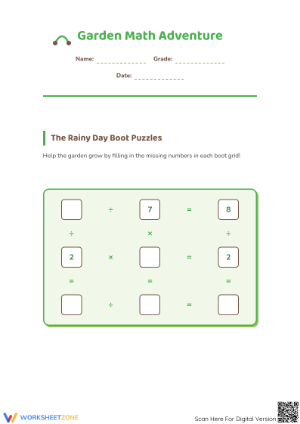
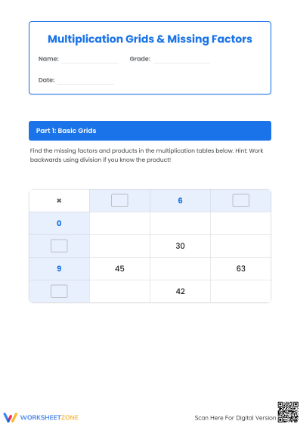
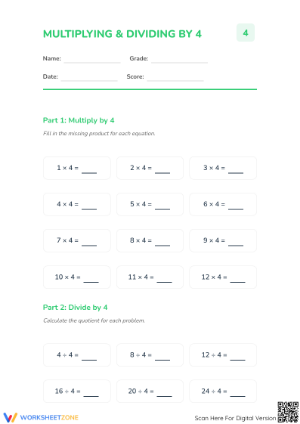
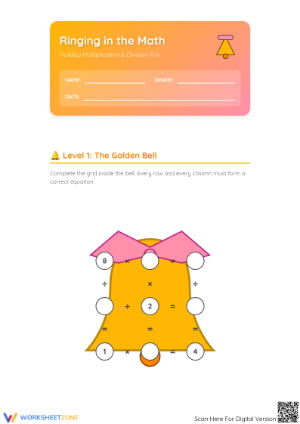
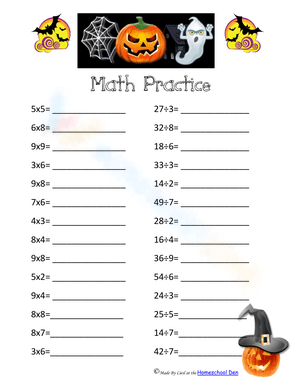
The worksheets cover the full range of Grade 4 multiplication and division work, from fact recall through applied reasoning. Students practice basic single-digit facts and their corresponding division pairs, multi-digit multiplication using two-digit by one-digit and two-digit by two-digit structures, and division with remainders where students record the quotient and remainder as two distinct values — not a single digit that discards what's left over. Missing-number equations like ___ × 7 = 56 or 63 ÷ ___ = 9 appear throughout, requiring inverse operation reasoning rather than matching a memorized sequence. Fact family worksheets tie multiplication and division together explicitly. Word problems close out the harder worksheets, asking students to read a situation and choose the correct operation before computing anything.
Answer keys are included with every worksheet. When checking takes three minutes instead of fifteen, practice actually generates usable feedback — which is the whole point of running it daily.
Mistakes Students Make That These Worksheets Help You Catch
The most reliable error in 4th grade division is remainder inconsistency. A student who correctly writes 7 R3 on a standalone equation will often write only "7" on a word problem asking how many complete groups can be formed from 45 items separated into groups of 6. The remainder disappears because the question format changed, not because the student lacks the underlying skill. Each worksheet that mixes equation-style division with brief word problems surfaces this inconsistency within a single sitting — far easier to address during a debrief than if it shows up in two separate assignments weeks apart.
Missing-number problems reveal a different issue. Many 4th graders learn to multiply as a top-down sequence of steps — following a procedure rather than reasoning about relationships. When an equation appears as ___ × 8 = 72 instead of 9 × 8 = ___, they treat it as something unfamiliar even though the mathematical fact is identical. That pattern shows up reliably in student work and points to a gap in inverse operation thinking, not memory. The fix is explicit: connect the missing-number item to the division sentence 72 ÷ 8 = ___ and the relationship becomes visible.
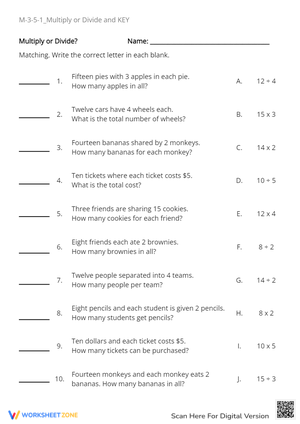
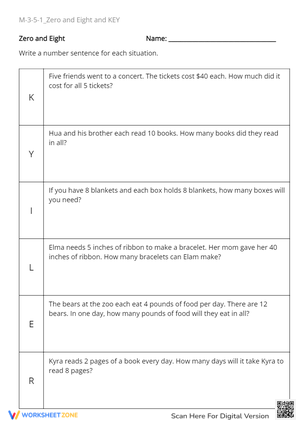
In word problems, students frequently select the operation based on the size of the numbers rather than the structure of the situation. They see a two-digit number alongside a one-digit number and reach for division because it looks right, even when the problem is asking for a total. That operation-selection error only appears under mixed conditions — it's invisible on any worksheet where every problem uses the same operation. Mixed-operation word problems are the only format that catches it.
How to Build These Worksheets Into Your Lesson Plans
The structure that works most consistently across Grade 4 classrooms is rotating the worksheet type by the week's instructional purpose rather than following a fixed sequence. On Monday, a short fact fluency worksheet run at the start of math class — 3 to 4 minutes, untimed or lightly timed — reactivates what students practiced the previous week through spaced retrieval at low stakes. Tuesday and Wednesday suit focused skill practice: one worksheet on multi-digit multiplication, one on division with remainders. By Thursday, a mixed-operation worksheet earns its place; students must decide which operation each problem calls for, which is where the real cognitive work happens. Friday works well for word problems used as either an exit assessment or a partner discussion task.
For small-group work, these multiplication division printable worksheets for 4th grade offer enough skill-specific options — division with remainders, missing-factor problems, fact family sets — to fuel a focused 10-minute pull-out session without any preparation. The answer key lets a paraprofessional run the check independently while the classroom teacher stays with the rest of the class. On a compressed schedule where a group gets handed off at the last minute, that matters.
One instructional move that reveals a lot: give the same mixed-operation worksheet twice — first as an ungraded strategy session where students talk through their reasoning aloud, then two or three weeks later as a short timed check using only the computation problems. Comparing the two results tells you whether a student's hesitation is a concept gap or a pacing issue. That distinction directly improves grouping decisions for intervention.
Standard Alignment
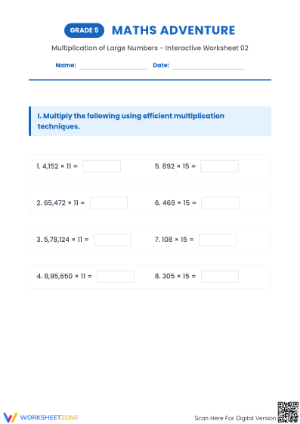
This set addresses four Common Core State Standards for Grade 4 mathematics. 4.OA.A.2 covers multiplicative comparison problems and one-step word problems involving both operations, mapping directly to the word problem worksheets and the mixed-operation decision-making practice. 4.NBT.B.5 targets multiplication of whole numbers up to four digits by a one-digit number and multiplication of two two-digit numbers — the scope of the multi-digit multiplication worksheets. 4.NBT.B.6 covers division with up to four-digit dividends and one-digit divisors, with explicit attention to quotient-and-remainder notation, and aligns with the division worksheets that push beyond basic fact recall. 4.OA.B.4 addresses factor pairs and the relationship between multiplication and division, connecting to the fact family and missing-number worksheets.
In most Grade 4 scope-and-sequence maps, 4.NBT.B.5 and 4.NBT.B.6 anchor the third or fourth unit of the year. The 4.OA standards appear earlier, during the transition from additive to multiplicative thinking. The mixed-operation worksheets serve both phases — fact-based decision-making in the fall, larger-number application in the winter and spring.
Adapting Each Worksheet Across Ability Levels
Students who need more support work best with worksheets that isolate one problem type and give room to think. A division worksheet with 12 problems and generous spacing serves a struggling learner better than a 24-problem mixed worksheet. Covering the bottom portion of a worksheet with a folded strip of paper and assigning only the top section keeps the skill target intact while reducing the volume that triggers avoidance. For students who lose track of vocabulary mid-task, a brief handwritten note at the top of their copy — "Remainder = what's left over after equal groups" — takes ten seconds to write and cuts the number of mid-task interruptions noticeably.
On-level students handle mixed-operation worksheets well once they have completed focused practice on each operation separately. Those worksheets push them to make decisions rather than execute a memorized routine. For students ready for more challenge, the missing-number and multi-step word problem worksheets ask them to explain which operation they chose and why — adding a written justification requirement changes the cognitive demand without requiring entirely different materials.
These multiplication division printable worksheets for 4th grade support that kind of tiered adjustment because the skill focus stays constant across difficulty levels. The teacher changes the entry point; the mathematical goal stays fixed.
Frequently Asked Questions
Do these worksheets work for intervention groups, or mainly whole-class practice?
Both. For intervention, worksheets focused on a single skill — division with remainders or missing-factor equations — give students a contained task that fits in 8 to 10 minutes without feeling overwhelming. Whole-class use works best with the mixed-operation and word problem worksheets, where all students work through shared material and teacher-led discussion can follow immediately after.
Should Grade 4 division practice always include remainders?
Yes. A student who only divides when numbers split evenly hasn't fully internalized what division does with quantities that aren't perfectly partitioned. Beyond the conceptual point, 4.NBT.B.6 explicitly requires students to find whole-number quotients and remainders, so remainder work isn't optional when teaching to grade-level standards.
How are these different from basic fact drill sheets?
Fact drill focuses narrowly on speed and recall. These multiplication division printable worksheets for 4th grade include fact fluency practice, but they also ask students to apply those facts in multi-digit computation, interpret remainders in context, read word problems, and distinguish between operations across mixed sets. That range reflects actual 4th grade instructional targets, not just automaticity training.
Can these worksheets be used without a textbook or curriculum program?
They work well as a standalone practice layer alongside direct instruction, but they don't replace conceptual teaching. The reasoning and initial exploration that builds understanding still needs to happen through instruction — these worksheets take over once students are ready to practice, apply, and consolidate what they've been taught.













 Interactive Worksheet Maker
 Quiz Maker
 Word Search Maker
 Crossword Puzzle Maker
 Word Scramble Generator
 Sentence Scramble Generator
 Handwriting Worksheet Generator
 Name Tracing Generator
 Fill In The Blank Generator