4th Grade Area Of Compound Shapes Worksheets: Geometry Review
Precision in spatial reasoning separates students who simply memorize formulas from those who can apply them independently. These 4th grade area of compound shapes worksheets place students in exactly that position, requiring them to analyze irregular figures, identify the rectangular or square components within each shape, and compute the total area with accuracy. Each PDF follows a structured progression from guided scaffolding to fully independent problem sets, making it straightforward to measure where each student stands at any given point in the unit.
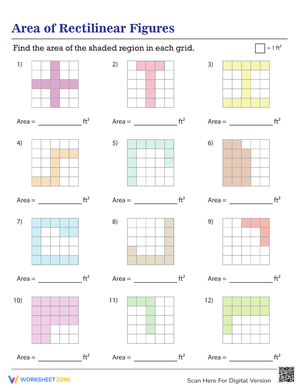
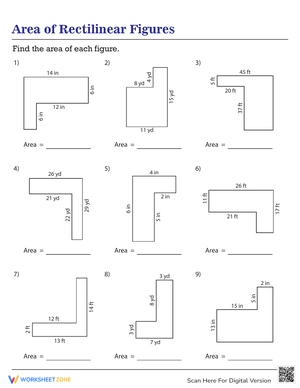
The collection is organized around a clear skill ladder. Early exercises present L-shaped figures made of two non-overlapping rectangles, with labeled dimensions and answer verification built into the layout. Intermediate sheets introduce T-shapes and U-shapes without pre-drawn partition lines, requiring students to decide where to decompose the figure on their own. Advanced pages combine multiple irregular configurations that demand a deliberate multi-step approach, mirroring the reasoning demands of fourth-grade geometry assessments.
Teachers can deploy these materials across several instructional formats. Assign one page as a targeted warm-up at the start of the geometry unit, use a pair of sheets for station rotation centers, or distribute an entire set for a performance-based assessment. The clean, ink-efficient black-and-white layout works equally well printed in bulk for classroom sets or saved as a PDF for individual digital submission. Educators tracking mastery data will appreciate that every sheet records the number of problems completed, simplifying progress documentation.
Parents supporting fourth graders at home will also find the format transparent and easy to follow. Each worksheet labels the learning objective clearly at the top, so there is no guesswork about which concept is being reinforced. The answer key included with each set allows a parent to check work quickly without needing to recalculate every problem independently. For students who want to explore related geometry skills, Worksheetzone also provides resources on area and perimeter practice to build a broader spatial measurement foundation.
Worksheetzone designs each set of 4th grade area of compound shapes worksheets to meet the specific reasoning demands of the fourth-grade geometry standard. The emphasis on decomposition as a calculation strategy - not just a vocabulary term - ensures students develop a transferable skill they will use again in fifth grade and beyond. For background reading on related concepts, teachers can also reference the guide on how to find the area of a circle, which reinforces the broader context of area measurement across different figure types.
Frequently Asked Questions
Question 1: What skills do students develop by working through compound shapes area problems?
Students develop the ability to decompose irregular figures into simpler rectangles or squares, calculate the area of each part separately, and add the results to find the total area. This process builds spatial reasoning, multi-step problem solving, and the disciplined application of the area formula across different figure configurations.
Question 2: What grade level and curriculum standard do these worksheets align with?
These worksheets are designed for fourth-grade students and align with geometry standards that require students to apply area formulas for rectangles to solve problems involving composite figures. The difficulty range within each set supports differentiated instruction for students working at, below, or above the fourth-grade benchmark.
Question 3: How are these worksheets best used in a classroom math rotation?
Each worksheet functions effectively as an independent center task during station rotations. Teachers can assign one page per rotation cycle, use the included answer key for self-checking, and track completion data at the end of the session. The structured layout minimizes the need for verbal instruction, allowing students to work independently while the teacher meets with small groups.
Question 4: How do I select the right difficulty level for different students?
Start with sheets featuring two-part L-shaped figures for students who are new to compound area practice. Transition to T-shapes and U-shapes once students can decompose independently without guide lines. For advanced learners, select pages with three or more components that require a planned multi-step 4th grade area of compound shapes worksheets strategy before any computation begins.
Clear All