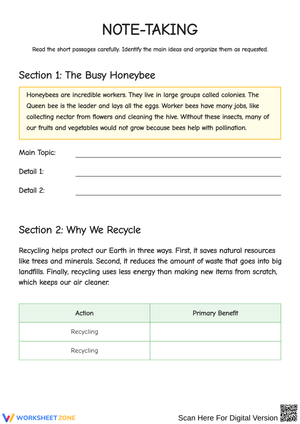
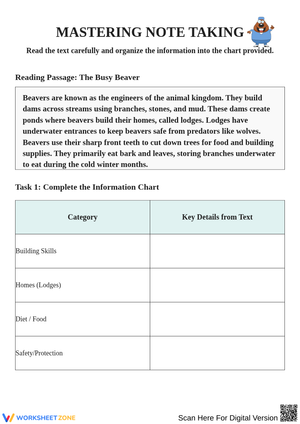
4th Grade Note Taking printable worksheets
These 4th grade note taking printable worksheets resources arrive at a critical transition point — the year students shift from reading as a decoding exercise to reading as a way of gathering and organizing information. The set spans five worksheet types: T-charts, KWL organizers, two-column note formats, mind maps, and guided paraphrasing practice. Each worksheet targets a distinct step in the research and synthesis process.
The Specific Skills Each Worksheet Targets
When fourth graders sit down with an informational text and a blank piece of paper, most of them copy sentences wholesale. Not because they're lazy — they genuinely don't know what else to do. These worksheets interrupt that pattern by giving students specific decisions to make: What's the main idea? Which details actually support it? How do I write this fact in fewer words without losing the meaning?
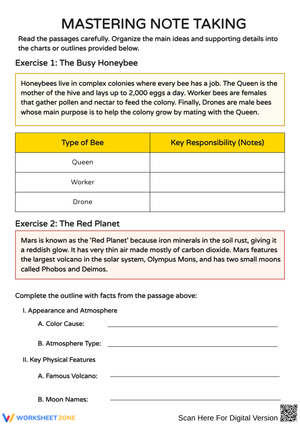
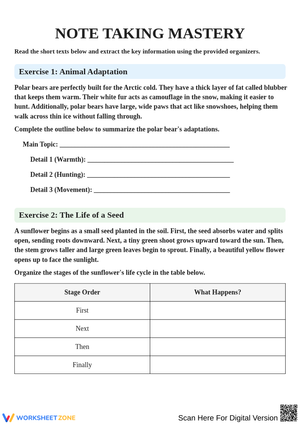
- T-Charts ask students to separate a topic from its supporting evidence. One column holds the main idea or category; the other holds the specific facts. The act of physically sorting forces students to read with a question in mind rather than just moving their eyes across the text.
- KWL Organizers activate prior knowledge before reading and give students a structured place to record questions mid-text. The final column — what they learned — functions as a first-draft summary when the worksheet is complete.
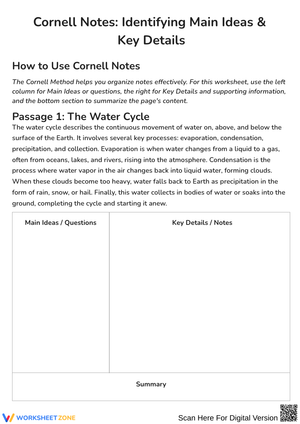
- Two-Column Notes use a narrow left column for key terms or questions and a wider right column for brief notes, with a summary box at the bottom. This format introduces fourth graders to a structure they'll use through high school without presenting them with anything unfamiliar.
- Mind Maps place the central topic in the middle with branches for each subtopic. Students who think spatially often take their first genuinely organized notes on a mind map worksheet because the visual layout tells them where each piece of information belongs.
- Paraphrasing Practice Worksheets give students a short source paragraph and a structured prompt to rewrite the core idea in their own words. A source citation line at the top requires students to record where the passage came from before they even begin reading it.
Fitting These Worksheets Into Your Instructional Week
The most reliable entry point is a whole-class think-aloud. Project a short nonfiction passage — a paragraph from a social studies textbook works well — and fill out one of these worksheets on the board while narrating your decisions. "I'm going to skip this sentence about what giraffes eat because my research question is about habitat, not diet." That kind of visible decision-making is what students need to see before they can do it independently. The first few times, expect the worksheet to occupy an entire 30-minute block. That's not inefficiency — it's instruction.
After two or three modeled sessions, these worksheets work as the starting point for independent reading in science or social studies. Fourth graders who have seen a T-chart used during ELA don't need re-explaining when it shows up during an ecosystems unit — they recognize the format and get to work. That transfer across subjects is one of the clearest signs that students are internalizing the skill rather than just completing an assignment. The 4th grade note taking printable worksheets set is built to be format-consistent enough that students recognize each template on sight, regardless of which class period they're in.
Mistakes Students Make That These Worksheets Help You Catch
The most persistent error in fourth-grade note-taking is wholesale transcription — students copy a sentence from the source, change one word, and believe that constitutes a note. The paraphrasing worksheets address this directly by including a pre-writing step: students underline three keywords from the source sentence, close the passage, and then write their note using only those keywords as anchors. This forces reconstruction rather than transcription. It's a small procedural change that produces noticeably different results within two or three practice sessions.
A second error is relevance blindness. Students fill a T-chart with accurate facts that have nothing to do with their actual research question because interesting details feel like good notes. If a student researching the water cycle writes down that cumulus clouds are the tallest type of cloud, that's accurate information — and completely off-topic. Checking a completed T-chart in the first five minutes of independent work catches this before the student has recorded ten more off-topic facts. The worksheet itself creates the opportunity for that quick formative check.
A third error is treating the source citation line as decoration. Students skip it unless there's a consistent expectation attached to it. Building a simple classroom rule — no citation filled in, no full credit — from the very first research lesson makes the habit automatic within a few weeks rather than something you're still correcting in May.
Standard Alignment
These worksheets address CCSS.ELA-LITERACY.W.4.8, which requires fourth graders to gather relevant information from print and digital sources, take brief notes, sort evidence into provided categories, and list sources. That standard is typically introduced when the first formal research unit begins — often mid-year — but the skills it demands are better built earlier. Starting T-chart and KWL practice in September with low-stakes informational read-alouds means students arrive at the research unit with a working process already in place, rather than learning both the format and the content simultaneously. That separation of skill-building from content-learning reduces the cognitive load when the actual research assignment begins.
Adjusting the Worksheets for a Range of Learners
For students who are overwhelmed by grade-level source texts, the two-column note worksheet is the most forgiving format. Pair it with a pre-highlighted passage — mark the relevant sentences before the student receives the text — and the task shifts from "find the important parts and record them" to simply "record them." That's a more achievable starting point. The 4th grade note taking printable worksheets set lends itself to this kind of teacher preparation without requiring a fully separate modified version of each worksheet.
Students who are ready for more challenge can use the paraphrasing worksheet with multi-paragraph passages instead of single paragraphs and can be asked to combine notes from two different sources onto a single T-chart before they begin writing. This mirrors the actual demands of a research report and gives those students a preview of what fifth-grade units will require. Mind maps work particularly well for students who have strong ideas but disorganized thinking — the branching structure imposes order without requiring them to sequence their thoughts before they've finished gathering them.
Frequently Asked Questions
How do I get students to stop copying sentences directly from the text?
Limit the writing space. When a note box is three lines deep, students physically cannot fit a copied sentence and know they need to shorten it. Pair that constraint with a keyword-first strategy: before writing any note, students identify two or three words that carry the main meaning, then close the text and write using only those words as a starting point. Practice this as a class with very short passages — a two-sentence paragraph is enough — before asking students to apply it independently on a full worksheet.
Can these worksheets be used in science and social studies, not just ELA?
That's where they tend to be most effective. The research skills in CCSS W.4.8 don't develop from ELA practice alone — students need repeated encounters with the same process across different content areas. Using these 4th grade note taking printable worksheets resources during a science unit on ecosystems or a social studies unit on regional geography gives students more total practice time and reinforces that note-taking is a general academic tool, not something that only happens during the reading block.
How long does it realistically take for students to become independent with these worksheets?
For most fourth graders, genuine independence — reading a passage and completing a worksheet with minimal prompting — takes four to six weeks of consistent guided practice. The first two weeks should be almost entirely teacher-directed. Weeks three and four work well as partner practice, which gives students a low-stakes way to externalize the thinking the teacher modeled. By weeks five and six, most students can work independently on shorter passages; complex multi-paragraph texts may still need check-ins through the end of the year, and that's appropriate for the grade level.
Clear All