Author's Purpose in Nonfiction printable worksheets for 4th Grade
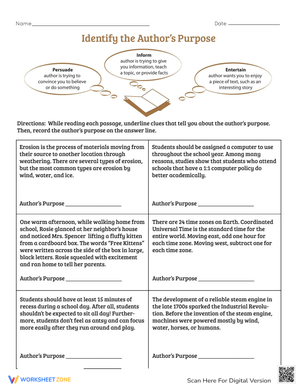
These author's purpose in nonfiction printable worksheets for 4th grade give teachers a focused set of resources for moving students past PIE-acronym labeling and into evidence-based reading analysis. Each worksheet pairs a short nonfiction passage with structured tasks: students identify the dominant purpose, underline the signal words that support that reading, and write a brief explanation citing specific text. The set covers the four purposes students encounter most in Grade 4 — inform, persuade, explain, and describe — across nonfiction topics drawn from science, social studies, and current events.
What Students Practice Across the Set
Each worksheet targets a specific combination of analytical skills rather than cycling through the same format repeatedly. Across the set, students work on:
- Distinguishing between inform and explain — two purposes that use similar vocabulary but serve different goals
- Identifying persuasive intent in texts that blend opinion with factual evidence
- Annotating signal words and connecting each one to the purpose it signals
- Reading text features — headings, captions, diagrams — as supporting evidence of authorial intent
- Writing a one-sentence purpose statement that cites a specific word, phrase, or sentence from the passage
The skill that transfers most reliably to other reading contexts is the annotation habit. Students who underline first and label second make more accurate purpose calls than students who read once and guess. Working through varied passages builds that habit without students noticing they are practicing a procedure — they are just reading and marking.
Student Errors Worth Anticipating Before the Lesson
The most persistent error is defaulting to "inform" for any science-related nonfiction. A passage about the water cycle, an article on animal adaptations, a short profile of a biologist — students call them all "inform" without distinguishing whether the writer is stating facts or walking readers step-by-step through a process. That distinction lives in verb choice: a text that uses occurs, consists of, and includes is doing something different from one that uses first, this causes, and as a result. Fourth graders rarely notice verbs unless taught to look there specifically.
The second pattern is confusing what a text makes a student feel with what the author intended. A passage about endangered species that creates concern in a reader will sometimes get labeled "persuade," even when the text is a clean informational account with no opinion language anywhere. Asking students to circle the specific word that proves their purpose claim — before writing the answer — catches this error while it is happening rather than after.
A third issue surfaces in passages where two purposes are genuinely present. A biography of Rosa Parks informs readers about her life and simultaneously frames her as admirable. Students who feel they need a single definitive answer sometimes freeze and write nothing. Teaching them to identify the dominant purpose and note the secondary one resolves this, but it requires direct instruction — additional practice alone will not fix it.
How to Build These Worksheets Into Your Lesson Plans
The most reliable sequence is gradual release within a single lesson period. Model the first paragraph of the passage aloud — identify one signal word, explain what it suggests about intent, record it — then release students to finish the worksheet independently. The teacher-led portion typically takes about 12 minutes, leaving enough time for completion and a brief share-out before the next transition.
For literacy centers, these work as post-lesson consolidation. Students who have just heard a whole-group lesson on how persuasive nonfiction uses emotional language and one-sided evidence rotate to a center and apply that same lens to a new passage. The change in text keeps the analysis honest — students cannot rely on prior discussion; they must read what is actually in front of them.
Author's purpose in nonfiction printable worksheets for 4th grade also function well as a three-minute exit task. After any reading lesson, hand students a fresh passage with a single question: what is the author's main purpose, and what is one word or phrase that shows you? The responses tell you immediately which students have internalized the concept and which are still guessing — and they take almost no time to review.
One underused approach is reverse engineering: give students a specific purpose and ask them to write three to four sentences to achieve it. A student assigned to persuade a classmate to try a new food, who then compares their own writing to a mentor worksheet, recognizes persuasive signal words in published text far faster than a student who has only read and labeled. Writer's perspective solidifies reader analysis.
Standard Alignment
CCSS RI.4.8 requires students to explain how an author uses reasons and evidence to support particular points in a text. Purpose identification is the necessary first step — students cannot evaluate how an argument is constructed until they have recognized that persuasion is the goal. Each worksheet in this set builds toward RI.4.8 through a two-step response structure: name the purpose, then cite the textual evidence that confirms it. That sequence matches exactly what the standard requires.
Author's purpose in nonfiction printable worksheets for 4th grade that include text structure questions extend practice into RI.4.5 at the same time. A problem-solution structure almost always signals an explanatory or persuasive purpose; a chronological structure tends to signal narrative nonfiction or a sequential informational account. Students who learn to read structure alongside signal words are working two standards within one focused task — no artificial separation needed.
Grade 4 is the deliberate placement point for RI.4.8 in the Common Core sequence. Students at this level are moving from narrative-dominant reading toward informational texts in science, social studies, and research contexts — textbook chapters, news articles, and explanatory essays that carry rhetorical intent. They need a framework for understanding not just what a text says but why it was written that way, and this standard provides it.
Adjusting the Set Across Ability Levels
For students still building fluency with the basic purpose categories, the most effective support is narrowing the decision. Present two options rather than four, ask for a single signal word rather than a full explanation, and use passages on topics students already know something about — animal facts, sports records, weather events. A student spending working memory on an unfamiliar subject has little cognitive capacity left for analysis. Familiar topics let the analytical task be the actual challenge rather than the vocabulary.
Advanced students benefit from evaluation rather than identification. Instead of asking what the purpose is, ask whether the author achieved it: Did the persuasive text provide enough evidence to be genuinely convincing? Were the informational facts specific enough to leave a reader truly informed? That shift from labeling to assessing turns author's purpose in nonfiction printable worksheets for 4th grade into a launching point for written response work — and it mirrors the critical reading expectations students will face in fifth and sixth grade ELA.
Frequently Asked Questions
What should students do when a passage seems to have more than one purpose?
Most nonfiction texts carry more than one purpose, and Grade 4 students benefit from knowing this upfront rather than discovering it mid-task and freezing. Teach students to identify the dominant purpose — the one most of the text is doing — and note the secondary one alongside it. A useful internal question: "If I described this text in one sentence to someone who had not read it, would I say it was telling facts, making an argument, walking through a process, or painting a picture?" That question usually surfaces the dominant purpose quickly, even in complex texts where both inform and persuade are operating.
What signal words, organized by purpose, should students learn first?
For persuasion: should, must, believe, best, agree. For explanation: first, next, because, as a result, this causes. For information: dates, statistics, and domain-specific vocabulary presented without emotional charge. For description: adjectives, sensory comparisons, and language that builds a mental image rather than moves an argument forward. Students who can sort these words quickly have a consistent entry point into any nonfiction passage — in ELA, in science, and in social studies reading.
How does identifying author's purpose in Grade 4 connect to later reading demands?
Fifth grade introduces paired-text tasks that require students to compare how two authors address the same topic with different purposes. Sixth grade adds source evaluation — students assess whether a source is reliable and what perspective the author brings. Both skills depend on the foundational habit these worksheets build: read for intent before evaluating content. A student who has consistently practiced identifying why a writer made specific word choices in Grade 4 is better positioned to evaluate source credibility and argument quality two years later.
Clear All