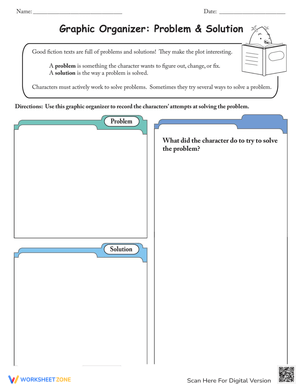
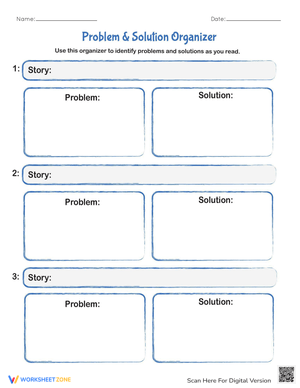
These 4th grade problem and solution in fiction printable worksheets give teachers a focused tool for the moment when narrative analysis gets genuinely hard — when stories are long enough that the central conflict hides under subplots, minor setbacks, and secondary characters all pursuing their own smaller struggles. The set targets the specific reading behaviors that separate students who can retell a story from students who can analyze one.
The Specific Skills Targeted
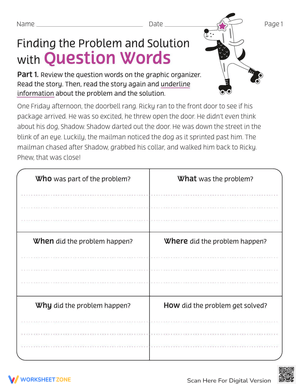
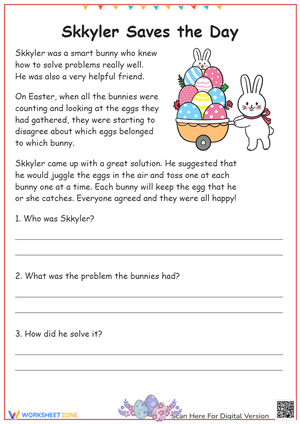
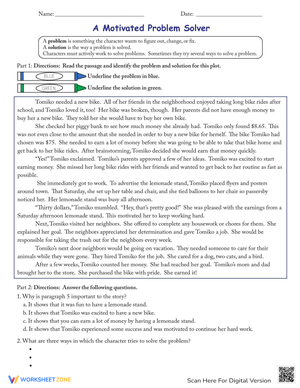
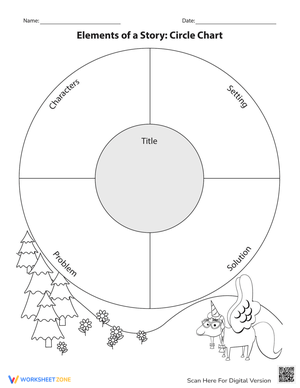
Each worksheet moves students through a sequence of connected analytical tasks. Rather than a single "name the problem" prompt, the work asks for:
- Identifying exactly when in the text the central problem is introduced
- Distinguishing the main conflict from smaller obstacles that arise during the plot
- Labeling the conflict type — internal (a character wrestling with a decision, a fear, or a value) versus external (a threat from another character, from nature, or from circumstances beyond the character's control)
- Tracing the character's attempts to resolve the problem before the final resolution is reached
- Explaining what changed — in the situation and in the character — once the conflict was settled
That last task is where problem-solution analysis connects to theme, which is the real analytical destination at this grade level. Students who can explain what the character learned or how they changed through the resolution are a step away from making a defensible theme statement.
Student Mistakes That Surface Repeatedly With This Skill
The most persistent error is conflating the climax with the solution. Students mark the most exciting paragraph — the moment of highest tension — and label it "the solution." But the climax is where the problem peaks, not where it ends. The solution is the specific action or decision that resolves the conflict, and it usually arrives shortly after the peak. Asking students to name the exact choice a character made that caused the problem to disappear, rather than asking where the story got exciting, redirects this error reliably.
A second pattern: students identify a minor obstacle as the main conflict. In a story where a character spends several chapters trying to win a science fair while also managing a falling-out with a friend, many fourth graders will name whichever conflict appeared first or got the most dramatic scenes. The main problem is the one driving the character's primary goal across most of the plot, and recognizing that distinction requires practice with texts complex enough to force the choice.
Surface-level problem naming is a third issue worth intercepting early. "The problem was that Marcus was nervous" is technically defensible but analytically thin. Pushing students to specify — nervous about what, when, and with what consequence for the plot — is where the text-evidence prompts in each worksheet do their heaviest work. A response that thin rarely earns credit under RL.4.3 rubrics, which gives teachers a practical reason to address it before assessment.
Standard Alignment
CCSS.ELA-LITERACY.RL.4.3 requires students to describe a character, setting, or event in depth, drawing on specific details from the text. Problem-solution analysis sits directly at the center of that standard because how a character faces and resolves conflict is the clearest window into who that character is. A character who solves a problem through deception reveals different traits than one who reaches a resolution through persistence or collaboration. Each worksheet pushes students to connect their conflict analysis to character description — naming not just what the problem was, but what it reveals about the character, and not just what the solution was, but what it cost or changed.
Using 4th grade problem and solution in fiction printable worksheets alongside direct RL.4.3 instruction gives teachers a ready evidence artifact for standards-based grading: the student's written explanation of how a character's specific choice resolved the central conflict is a direct performance indicator for the standard.
Getting the Most From These Worksheets in Your Reading Block
The most reliable placement is during small-group guided reading, where you can intervene when a student is about to label a subplot as the main conflict. In that setting, 4th grade problem and solution in fiction printable worksheets function as a structured conversation tool — the prompts keep students on task while you listen for the misconceptions worth addressing before they solidify. A five-minute debrief at the end of each session, where students share their conflict labels and justify them from the text, surfaces more errors than written feedback alone.
For whole-class work, one worksheet used immediately after a read-aloud — before any discussion — makes an efficient formative check. Give students eight minutes to respond independently, then collect. What comes back tells you which students are still naming surface-level problems and which ones are ready for theme work. That information shapes the next day's small-group assignments more precisely than a comprehension quiz can.
Literacy centers are a third natural fit. Pair one worksheet with a short fiction passage and let partners work through it together. Negotiating "is this the real problem or just an obstacle?" out loud produces the kind of peer explanation that cements the skill faster than a completed graphic organizer sitting in a folder.
Tailoring the Worksheets to Your Range of Readers
The most effective lever for differentiation is the complexity of the conflict in the accompanying text, not the structure of the worksheet itself. For students still building fluency with narrative structure, pair the worksheet with a story that has a single visible external conflict — a character working toward a concrete goal that a clear antagonist is blocking. The problem and solution are findable without much inference. For students working above grade level, pair the same worksheet with a text where the central conflict is internal — a character deciding whether to tell a hard truth, or grappling with a personal bias — because internal conflicts require inferential reading to identify and rarely resolve in one clean action.
4th grade problem and solution in fiction printable worksheets support tiered text complexity without requiring teachers to build separate versions of the activity. The worksheet structure holds across reading levels; the variable is the passage you attach to it. That makes the set practical to manage in a classroom where preparing three distinct activity formats for one skill isn't realistic on a Wednesday afternoon.
Frequently Asked Questions
How do I help students distinguish the main problem from the smaller obstacles in a story?
Have students apply two tests to each conflict they identify: Does it affect the main character's primary goal? And is it still unresolved near the end of the story? Minor obstacles tend to clear up within a scene or two. The central problem persists — shaping the character's decisions and the plot's direction — right up to the climax. A conflict that passes both tests is almost always the main problem.
At what point in a fiction unit should these worksheets come in?
After direct instruction on plot structure but before students move into theme work. Problem-solution analysis is the bridge between the two: students who can describe the central conflict and its resolution with textual specificity are already holding the evidence they need to build a defensible theme statement. Introducing the worksheets before any think-aloud modeling tends to produce surface responses; after one strong model lesson, the depth of written analysis improves noticeably.
How does analyzing problem and solution connect to what students write in their own fiction?
Fourth graders who understand that fictional resolutions follow from character choices — not from plot convenience — write more purposeful stories. When students analyze why a character's particular decision ended the conflict rather than assuming the problem just "went away," they apply that same thinking to their own drafts. The worksheet prompt asking students to name the exact choice that resolved the conflict is one teachers can use verbatim in a writing conference.












 Interactive Worksheet Maker
 Quiz Maker
 Word Search Maker
 Crossword Puzzle Maker
 Word Scramble Generator
 Sentence Scramble Generator
 Handwriting Worksheet Generator
 Name Tracing Generator
 Fill In The Blank Generator