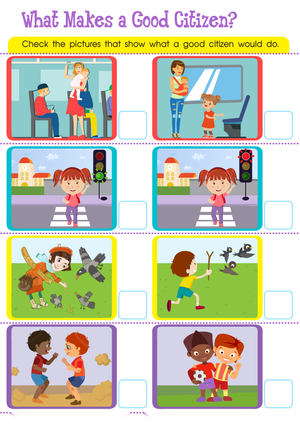
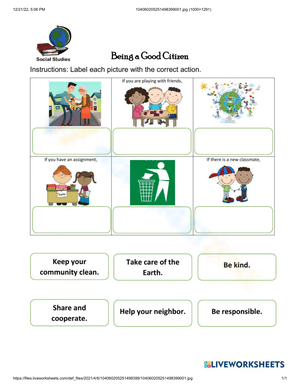
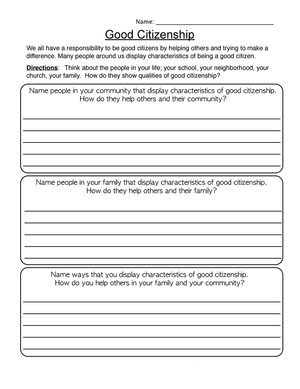
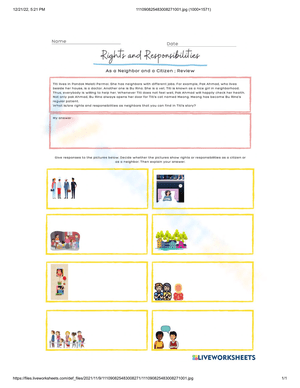
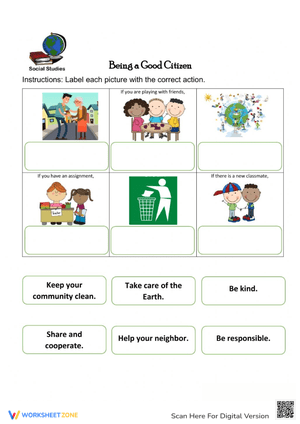
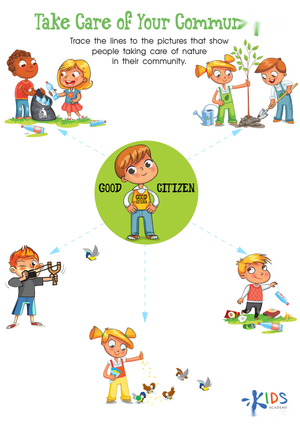
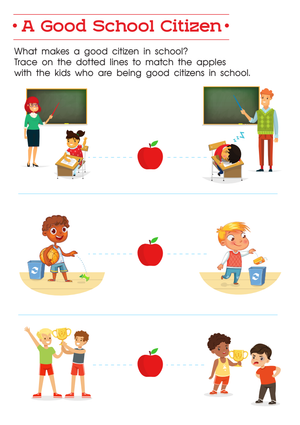
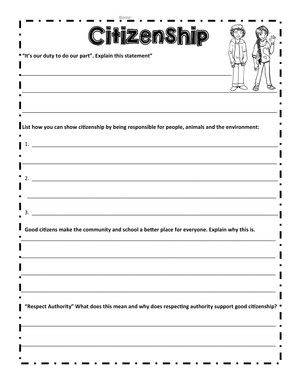
These 3rd grade citizen in the community worksheets printable resources put the abstract work of civic understanding into a format students can actually sit with — sorting rights from responsibilities, evaluating short scenarios, and building the vocabulary that makes classroom discussion possible. Grade 3 is often the first year curricula formally ask students to think past classroom rules and consider why communities have laws, who keeps public spaces running, and what everyday participation looks like for an eight- or nine-year-old. The set gives teachers structured tasks for that developmental shift.
Skills Each Worksheet Builds
The core of the set targets six interconnected areas that Grade 3 social studies teachers return to across a citizenship unit.
- Rights and responsibilities: Students read paired examples and mark which item describes something they're entitled to and which describes something they owe to others. The distinction is harder than it looks at this age.
- Rules versus laws: Students compare a school rule with a town ordinance — stopping at crosswalks, keeping the cafeteria clean — and explain why both protect people.
- Community helpers and civic roles: Students match services to the people who provide them, then push further by explaining how using those services responsibly is itself a form of citizenship.
- Responsible decision-making in familiar scenarios: Students read three- to four-sentence situations set in parks, libraries, and neighborhoods and choose — and justify — the action a good citizen would take.
- The common good: Students identify whether an action helps only one person or benefits the larger group, a concept that forms the backbone of civic reasoning at this level.
- Short written response: Students write two to four sentences explaining what they personally do — or could do — to contribute to their school or community.
Most Grade 3 teachers cover this content over two to three weeks, so having each worksheet address one focused skill keeps pacing manageable and lets teachers pinpoint exactly where understanding breaks down.
Where Students Stumble in Citizenship Lessons
Rights and responsibilities are where confusion runs deepest. Students at this age often write that having a right means having no obligations attached to it. A student who correctly says, "I have the right to use the school library," will also write that returning books on time is optional — not part of citizenship. When that pattern shows up in student work, it's worth returning to the idea that rights exist within a shared community, and that exercising a right responsibly is itself a responsibility.
The second persistent error involves the scope of who counts as a good citizen. After a lesson on community helpers, many students write that a good citizen is a firefighter, a teacher, or a librarian — essentially a person with an official role. They leave themselves out of the picture entirely. Scenario worksheets that place students in the action — You see someone drop their lunch on the way to the cafeteria — push back against that framing and help students recognize that citizenship is about everyday choices, not job titles.
A third problem appears on scenario worksheets: students circle the right answer but can't explain why it's right in community terms. They'll mark "pick up the litter" as the correct choice, but when asked to justify it, they write "because it's nice" rather than "because shared spaces stay clean when everyone does their part." Building a brief justification line into each worksheet — even just one sentence — surfaces this gap and makes it addressable before the unit ends.
Getting the Most From These Worksheets Across the Week
The most effective placement for 3rd grade citizen in the community worksheets printable sets is inside a brief instructional frame, not as standalone seatwork. A five-minute setup makes a real difference: ask a quick anchor question ("What's one rule in our school, and who does it protect?"), model how to approach the first item on each worksheet, then release students to work. Even two minutes of modeled thinking beforehand reduces off-task behavior and produces richer written responses.
Within the school week, these worksheets fit several practical slots:
- Monday morning warm-up: A rights-versus-responsibilities sort brings students back into the unit's vocabulary after the weekend without requiring a full lesson launch.
- After a class conflict: When a recess dispute just happened, a scenario worksheet about fair use of shared spaces lands with immediate relevance — students are already thinking about exactly the topic on the page.
- Social studies center rotation: Pair a scenario worksheet with a brief discussion prompt card. Students complete the worksheet, then compare answers with a partner before rotating.
- Sub plans: The directions are self-contained and the tasks don't require background knowledge a substitute won't have.
- End-of-unit review: A community helper matching worksheet or a rights-and-responsibilities checklist works as a low-stakes formative check before a culminating discussion or assessment.
One instructional move that consistently strengthens outcomes: after students identify a poor community action on a worksheet, ask them to rewrite it as a responsible one. If a worksheet includes the prompt Someone leaves trash on the park bench, have students revise it — A citizen picks up the trash and helps keep the park clean for everyone. That shift from judging behavior to planning better action is where the civic reasoning actually develops, and it takes only two minutes of additional time.
Standard Alignment
These worksheets align directly to D2.Civ.7.3-5 of the C3 Framework for Social Studies State Standards, which asks students to apply civic virtues and democratic principles in school and community settings. In practical classroom terms, that means students aren't just defining citizenship — they're practicing it through the decisions they make on scenario and written-response worksheets. The set also supports D2.Civ.4.3-5, which addresses how groups create rules to establish responsibilities and protect individual and collective freedoms. Most state Grade 3 social studies standards map directly to both codes, so teachers in states that have adopted or adapted the C3 Framework will find strong alignment across the full set.
Tailoring the Set for Students at Different Readiness Levels
Students who are still building reading fluency do best with worksheets that rely on short sentences, familiar vocabulary, and visual anchors — a simple icon next to each community role, or a two-word label to sort rather than a full sentence to read. For those students, the matching and sorting formats carry most of the cognitive weight and stay accessible without losing the content focus.
On-level students typically handle scenario worksheets well, especially when a sentence frame is available for their written response: A good citizen would _____ because _____. That structure holds the thinking without removing the challenge of supplying the actual reasoning.
For students who need more depth, the most productive extension is revision work. Rather than assigning more 3rd grade citizen in the community worksheets printable resources at the same level, have those students take a simple scenario — a neighbor not shoveling a shared walkway, a classmate dominating a shared game — and write a short explanation of the situation from two perspectives: the individual and the community. That task introduces the concept of competing interests without requiring new materials or extra prep time.
Frequently Asked Questions
How do these worksheets fit into a broader Grade 3 social studies unit?
They work best as the practice layer inside a unit that also includes read-alouds, class discussion, and some connection to the local community. Each worksheet handles one focused concept — rights, responsibilities, community roles, decision-making — so teachers can pull individual worksheets to match exactly where the class is in the unit rather than working through the full set in order.
Can teachers use these worksheets for informal assessment?
Yes, especially the scenario response and short-writing worksheets. A student's written justification — not just the answer they circle — tells you whether they understand the reasoning behind civic behavior or are only pattern-matching to what they think the teacher wants. Quickly scanning the justification lines after independent work gives a clear read of where the class stands before moving to the next concept.
Are these worksheets better used in class or sent home as homework?
Both work, but the scenario and writing-response worksheets have the most value in class where you can circulate, ask follow-up questions, and turn a student's written answer into a brief discussion. A number of teachers use the 3rd grade citizen in the community worksheets printable matching and sorting formats for homework — those tasks travel well because the directions are clear and students don't need to ask follow-up questions to complete them — and reserve the written-response worksheets for in-class time.












 Interactive Worksheet Maker
 Quiz Maker
 Word Search Maker
 Crossword Puzzle Maker
 Word Scramble Generator
 Sentence Scramble Generator
 Handwriting Worksheet Generator
 Name Tracing Generator
 Fill In The Blank Generator