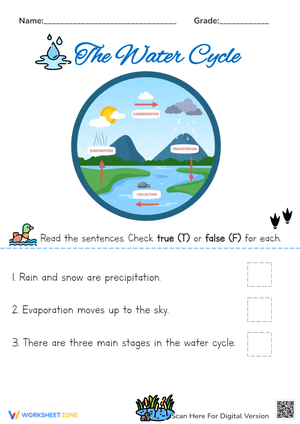
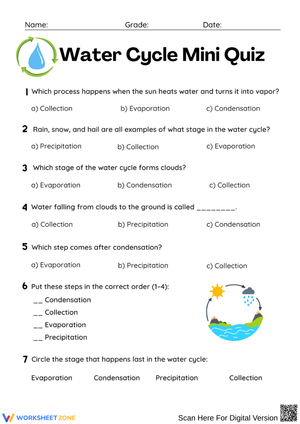
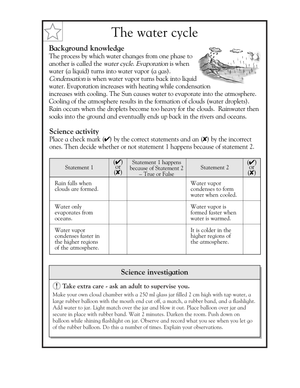
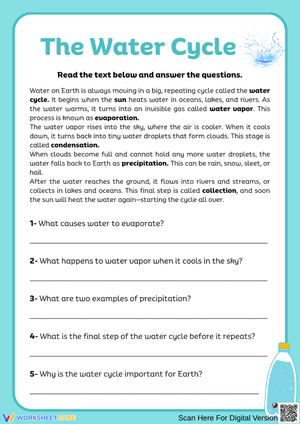
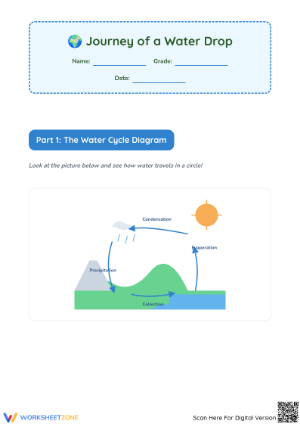
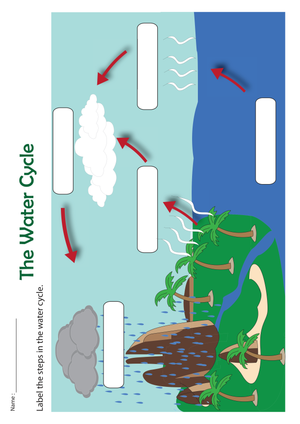
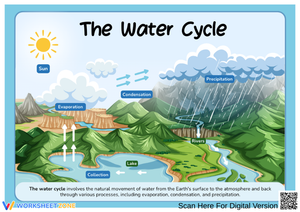
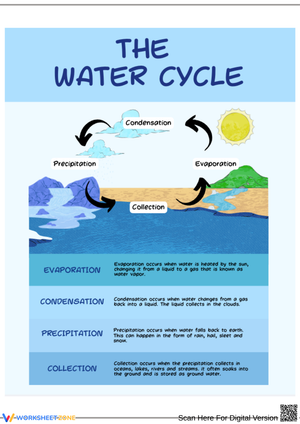
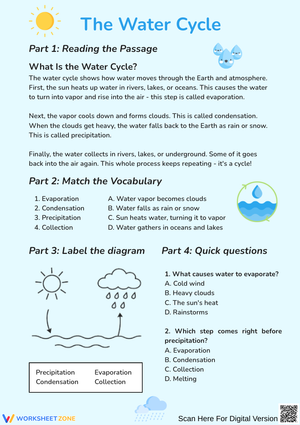
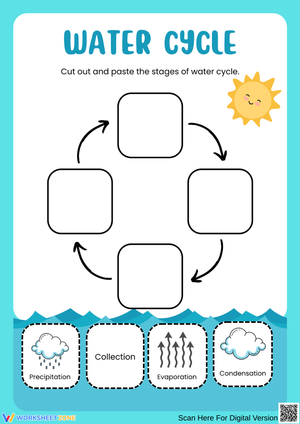
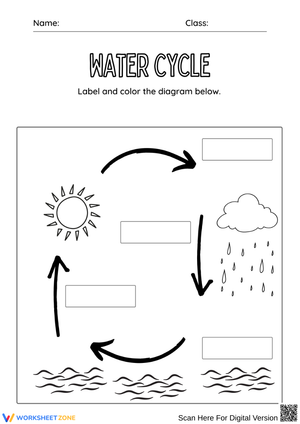
These 3rd grade water cycle worksheets give teachers a direct path from the concept diagram to what students need to demonstrate on paper — labeling, defining, sequencing, and connecting stages to states of matter. The set is built around the four-stage model most state science standards expect at grade 3: evaporation, condensation, precipitation, and collection. Each worksheet targets a specific skill so you can drop the right one into a lesson without reconfiguring your plan.
What Each Worksheet Asks Students to Do
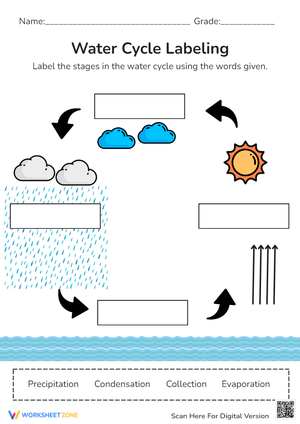
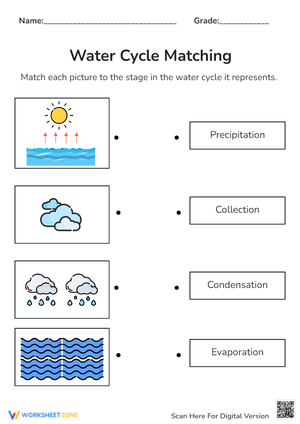
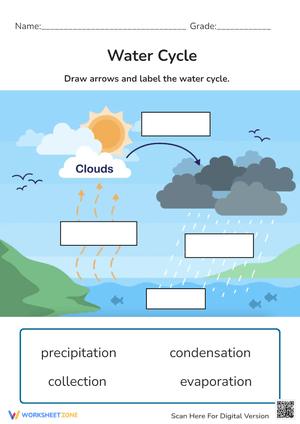
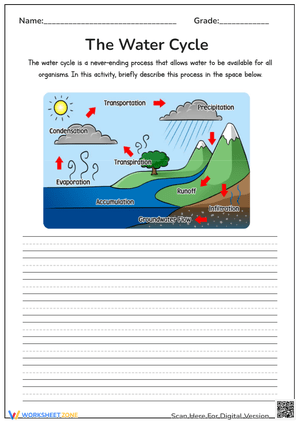
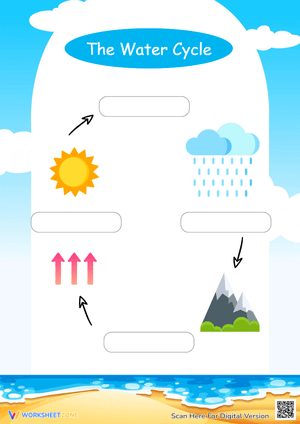
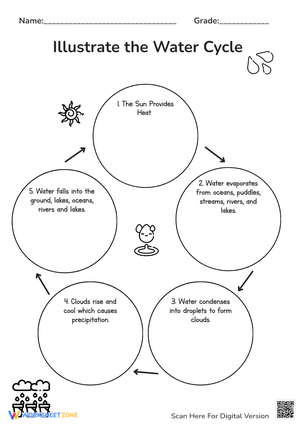
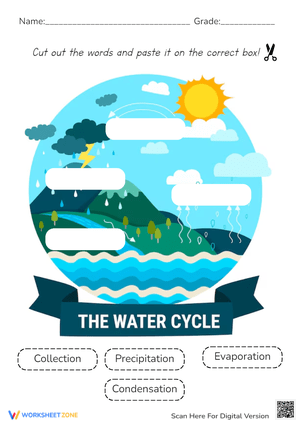
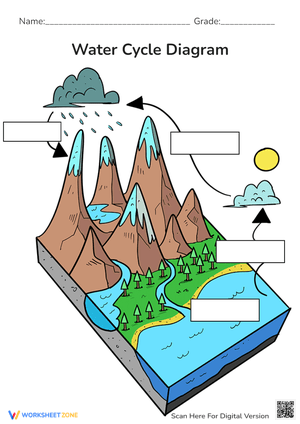
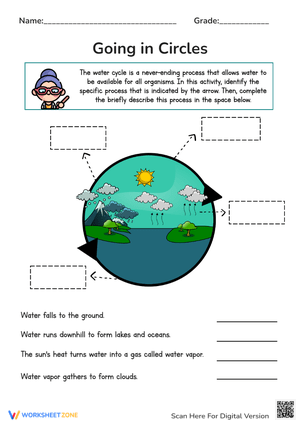
The skills across the set move from recognition to production. Students start with labeling tasks — filling in a blank cycle diagram with the four stage names and the sun's position. From there, worksheets move into definition work, where students write what each stage means in their own words rather than copying a glossary entry. That distinction matters: copying a definition is a memory task; writing in your own words requires actual understanding of the process.
Other worksheets in the set ask students to:
- Sequence the four stages in correct order and explain the transition between each
- Identify the state of matter — solid, liquid, or gas — that water is in at each stage
- Match precipitation types (rain, snow, sleet, hail) to the temperature conditions that produce them
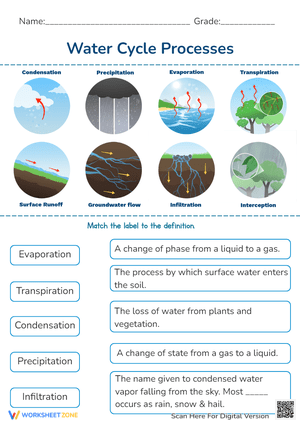
- Distinguish between runoff and groundwater infiltration during the collection stage
- Recognize transpiration as a secondary water input to the atmosphere beyond surface evaporation
The states-of-matter angle is worth emphasizing. Third grade is typically when students first connect physical science vocabulary to Earth science phenomena, and the water cycle is the clearest real-world example of matter changing state. Worksheets that ask students to annotate each stage with its state of matter reinforce that cross-disciplinary link directly rather than leaving it implicit.
Mistakes Students Make That These Worksheets Help You Catch
The most persistent error at this level is treating evaporation as disappearance. When a bowl of water dries out on the windowsill, students routinely write that the water "went away" or "dried up." They understand the water is gone from the bowl; they do not understand it is now in the air above the bowl as invisible vapor. This reflects a genuine conceptual gap around conservation of matter, not just a vocabulary problem. Worksheets that ask students to draw an arrow from the water surface to the sky and label what travels along that arrow surface this confusion faster than any quiz question.
A second common error is collapsing condensation and precipitation into one event. In students' everyday experience, clouds and rain both mean "water somewhere above them in the sky," so the distinction between vapor forming clouds and clouds releasing rain feels abstract. Watch for students who draw a single arrow from the sun directly to a cloud dropping rain — they are skipping the evaporation-to-vapor step entirely. Labeling worksheets with a word bank visible during work often reveal exactly who has the sequence straight and who is guessing by position on the diagram.
The term "collection" creates its own confusion. Students interpret it as an active verb — someone or something collects the water — rather than a description of where water naturally accumulates. Brief class discussion before the worksheet helps, but the more reliable move is choosing a worksheet that uses the word alongside a short contextual explanation, so students encounter the term in meaning rather than as an isolated label to drop into a blank.
Fitting These Worksheets Into Your Science Block
The labeling worksheet works well as an exit ticket after the initial direct instruction lesson — five minutes at the end of a 45-minute period, or right before the transition to specials. It tells you quickly whether students can recall stage names and their order without the diagram in front of them. Use that data to decide whether the class needs a reteach on sequence before you move into states-of-matter work.
The definition and explanation worksheets fit naturally into the second or third lesson, after students have done the "Water Cycle in a Bag" experiment — a sealed plastic bag with a small amount of water taped to a sunny window, observed over three days. By the time students return to a written worksheet, they are connecting labels to something they watched happen rather than to a static image they studied. The sequence matters. A 3rd grade water cycle worksheets used before that hands-on observation tends to produce surface-level responses; the same worksheet used after it gets more specific, experience-grounded language from students.
For Friday review or the day before a unit assessment, the sequencing and states-of-matter worksheet functions as a self-check. Students who can accurately identify that water is a gas during evaporation and a liquid during condensation — without prompting — have internalized the concept at the level the standard requires. Students who cannot are easy to identify before the assessment rather than after.
Adjusting the Set for Different Learners
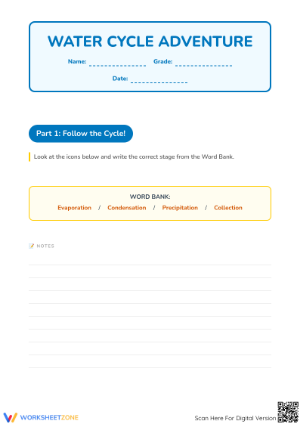
For students who need more support, the labeling worksheet works better when paired with a word bank that includes all four stage names plus one or two distractors. The distractors matter more than they seem — they force students to evaluate each term rather than filling in blanks by process of elimination. Students who cannot yet work from memory at all can complete the worksheet using a fully labeled model diagram as a reference, which at minimum builds visual familiarity with the cycle layout and the directional flow of each stage.
For students who move through the standard worksheets quickly, extend the collection stage into a deeper investigation. Ask them to sketch two pathways water takes after precipitation — runoff into a river versus infiltration into soil — and explain which pathway makes the water available for evaporation soonest. That question has no single right answer, which is exactly the point: it requires reasoning rather than recall. Transpiration also opens into a strong extension task, because students who research it independently discover that plants are active participants in the water cycle, not just passive recipients of rain.
Standard Alignment
These worksheets align with the NGSS Disciplinary Core Idea ESS2.C (The Roles of Water in Earth's Surface Processes) as developed across the K–5 grade band. At third grade, state standards in most U.S. school systems expect students to describe the water cycle, identify the sun as its energy source, and explain how water changes state at each stage. The states-of-matter component also connects directly to the NGSS physical science DCI PS1.A (Structure and Properties of Matter) — specifically, that matter changes from one state to another when energy is added or removed. That cross-DCI connection is one reason water cycle instruction at grade 3 benefits from explicit vocabulary work alongside diagram practice: students are doing two standards' worth of conceptual work in the same unit, and the worksheets that surface both simultaneously give teachers the most instructional return.
Frequently Asked Questions
Do these worksheets include answer keys?
Yes. Each worksheet includes a corresponding answer key with correct labels, model responses for definition tasks, and the correct sequencing order. For open-response items, the key notes which elements should appear in a full-credit answer rather than requiring one exact phrasing.
What grade level are these worksheets built for?
The set targets third grade, but the diagram-labeling and vocabulary worksheets also work at second grade for enrichment or fourth grade for review. The states-of-matter and extended-vocabulary worksheets assume some prior exposure to the terms liquid, solid, and gas, which most third graders have carried forward from second-grade science.
Can I use one of these as a formative assessment?
The labeling worksheet and the sequencing worksheet are both used regularly as formative checks. The labeling worksheet in particular works as a pre-assessment before instruction begins — it shows which students have residual knowledge from prior grades and which are starting from zero. A 3rd grade water cycle worksheets formatted for labeling gives you a fast, scorable snapshot of where the class stands before you plan the first lesson.
Are these worksheets accessible for English language learners?
The diagram-based worksheets rely more on visual recognition than on dense reading, which makes them more accessible for students still building academic English vocabulary. Pairing the written definition worksheets with a bilingual glossary or sentence frame helps ELL students produce responses without the task collapsing into a language barrier rather than a science assessment. A 3rd grade water cycle worksheets with a strong visual diagram component lets ELL students demonstrate understanding of the cycle itself while language support handles the vocabulary gap separately.












 Interactive Worksheet Maker
 Quiz Maker
 Word Search Maker
 Crossword Puzzle Maker
 Word Scramble Generator
 Sentence Scramble Generator
 Handwriting Worksheet Generator
 Name Tracing Generator
 Fill In The Blank Generator