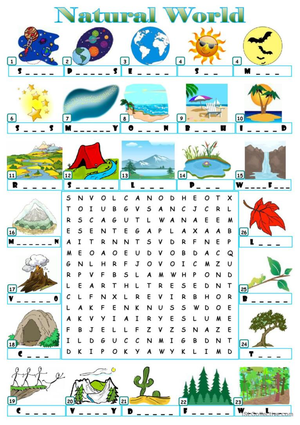
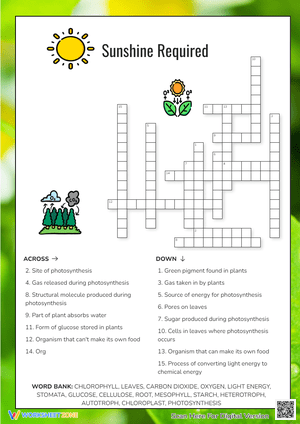
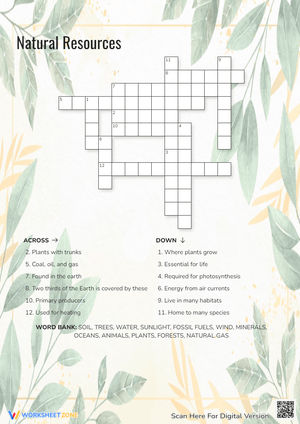
These 3rd grade natural resources printable worksheets give third-grade teachers a targeted set of standalone activities for building Earth science literacy at the exact moment the curriculum shifts from simple observation to reasoning about cause and effect. Each worksheet addresses a distinct concept — vocabulary introduction, renewable versus nonrenewable classification, raw-material-to-product tracing, and conservation reflection — so teachers can slot individual pieces into an existing unit or pull them as needed across multiple weeks.
Skills These Worksheets Build
The set moves students through a clear progression: naming and defining natural resources, sorting them by type, connecting raw materials to the finished goods they produce, and applying conservation reasoning to everyday choices. Specific skills across the worksheets include:
- Reading short informational passages and completing vocabulary work with terms like renewable, nonrenewable, conservation, and fossil fuel, using a word bank for support
- Sorting resources through cut-and-paste diagrams that separate renewable sources — sunlight, wind, trees, water — from nonrenewable ones like coal, oil, natural gas, and minerals
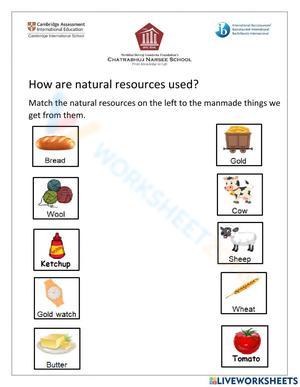
- Matching raw natural materials to the consumer products they become: sand to glass, trees to paper, petroleum to plastic goods
- Analyzing illustrated scenes to distinguish natural resources from manufactured objects within the same image
- Writing structured conservation responses where students name specific resources they use daily and identify concrete ways to reduce that use
Where Third Graders Reliably Go Wrong on Resource Classification
The most persistent error in this unit is the conflation of "natural" with "renewable." Students who understand that coal and oil come from the Earth — they're natural, in the plain sense of the word — will drop them into the renewable column without hesitation. The concept they're missing is timescale: fossil fuels took hundreds of millions of years to form under heat and geological pressure, which puts replenishment entirely outside any frame a third grader can hold. The sorting worksheet forces direct confrontation with this. When a student places petroleum in the renewable column and then reads the passage on formation time, the resulting correction tends to stick in a way that a lecture explanation alone doesn't produce.
A second pattern worth watching: students consistently classify processed materials as man-made rather than resource-derived. They know glass comes from a factory, so they stop the origin story there. The matching worksheet breaks this habit by making the full chain visible — from sand quarry to glass pane — rather than letting students start at the manufacturing step and work no further back.
Where These Worksheets Fit in Your Science Block
The vocabulary worksheet belongs at the start of the unit. Students read a short passage and complete a fill-in-the-blank activity with a word bank — it builds the working language they need before any classification or analysis task makes sense. The sorting worksheet lands best the following day, after that vocabulary is in place. Cut-and-paste classification at this grade level benefits from a five-minute whole-class debrief immediately after students finish: discussing which items caused disagreement reveals more about student thinking than an exit ticket will.
The resource-to-product matching worksheet runs well as a science center activity once the unit is underway, since students can move through it independently. The conservation writing prompt works as a formative check at the unit's end — it shows whether students can transfer classification knowledge into applied reasoning, and it doubles as a low-stakes writing-across-curriculum task if the science block shares time with ELA goals.
Teachers running the 3rd grade natural resources printable worksheets across a full week often follow this arc: vocabulary on Monday, sorting on Tuesday, material tracing on Wednesday, scene analysis on Thursday, and conservation writing on Friday. Because none of the worksheets depend on the others being completed first, that sequence bends easily around pacing gaps, assembly days, or substitute coverage without losing coherence.
The Pencil Box as a Teaching Move
Before students open the nonrenewable resources worksheet, have them quietly audit what's inside their own pencil boxes. Every plastic ruler, marker cap, eraser casing, and glue bottle cap is made from petroleum — a nonrenewable fossil fuel extracted from deep underground over millions of years of geological pressure. Walking through that origin chain takes about eight minutes and produces a visible shift in engagement. When students understand that tossing a half-used plastic tool is not just creating trash but permanently consuming a finite Earth material, the abstract classification concept becomes personal and concrete. This audit pairs particularly well with the matching worksheet that connects raw resources to manufactured goods, which students approach with noticeably more investment after completing it.
Standard Alignment
These worksheets support NGSS 3-ESS3-1: Earth and Human Activity, which asks third graders to understand how humans affect Earth's systems and evaluate solutions that reduce that impact. In instructional terms, the standard expects students to move beyond identifying what resources are and begin analyzing consequence: what happens when a nonrenewable material is overused, and what choices reduce that pressure. The vocabulary and sorting worksheets build the conceptual foundation the performance expectation requires, while the conservation writing prompt asks students to do exactly what the standard calls for — apply their understanding of resource limits to concrete human decisions.
Adjusting the Set for a Range of Learners
Students who need additional support on vocabulary work can complete the fill-in-the-blank passage with a printed reference card listing key terms and short definitions nearby. This reduces the working memory demand of the task without lowering its intellectual target. For the sorting worksheet, adding a small visual anchor — a sun icon labeled "renewable" and an oil barrel labeled "nonrenewable" at the top of the page — helps students who know the concepts but lose their footing when a novel example appears mid-activity.
Students who move through classification quickly find more challenge in the matching and scene-analysis worksheets, since both require reasoning backward from a finished product to its origin rather than simply applying a label to a named resource. A useful extension: ask these students to identify one object in the scene that could be made from a renewable resource instead of the nonrenewable material currently used, and write one sentence defending the switch. That addition moves the task from recall into applied argumentation with almost no additional preparation required. Teachers using the 3rd grade natural resources printable worksheets in mixed-ability groups find that pairing the sorting activity with the scene analysis keeps the full class occupied at different cognitive levels without requiring separate materials for different groups.
Frequently Asked Questions
Do these worksheets work if I'm only teaching part of a natural resources unit rather than a full week?
Each worksheet addresses a self-contained skill and stands alone without the others. Teachers frequently use just the sorting worksheet for a single classification lesson, or pull the conservation writing prompt as a standalone closing activity. The set also works well as review material mid-unit when students need reinforcement on a specific concept before moving forward.
How do I explain why fossil fuels are nonrenewable when students point out that they come from the Earth, which makes them "natural"?
Anchor the distinction on timescale, not origin. Both renewable and nonrenewable resources come from the Earth — "natural" doesn't tell students which category something belongs to. A more useful frame: some resources refill within a human lifetime (trees, water, sunlight), while others took longer to form than all of recorded human history (coal, oil, natural gas). That contrast gives students a meaningful dividing line, and the sorting worksheet reinforces it through repeated practice with specific examples rather than asking students to hold the definition abstractly.
Which worksheets in the set are suitable for independent work, and which need teacher support?
The vocabulary fill-in-the-blank and sorting activities work best with a brief whole-class introduction first — students who encounter nonrenewable or fossil fuel cold tend to stall. The matching and scene-analysis worksheets are more accessible for independent or partner work once the foundational vocabulary is in place. The conservation writing prompt assumes students have already done the classification work, so it functions well as independent work near the end of the unit. Teachers using the 3rd grade natural resources printable worksheets for homework assignments most often send home the sorting or matching activities, since those have clear answer structures that don't require on-the-spot teacher facilitation.
Are there differentiation options for students who are still developing reading fluency?
The cut-and-paste sorting worksheet and the scene-analysis activity carry the lightest reading load and are the most accessible for students with developing fluency. The vocabulary passage can be read aloud by the teacher or played as a recorded audio version without changing the task. For students who need it, completing the matching worksheet with a partner — one student reading aloud while the other traces the connections — preserves the academic rigor while removing the independent decoding barrier.












 Interactive Worksheet Maker
 Quiz Maker
 Word Search Maker
 Crossword Puzzle Maker
 Word Scramble Generator
 Sentence Scramble Generator
 Handwriting Worksheet Generator
 Name Tracing Generator
 Fill In The Blank Generator