What 3rd Grade Place Value Worksheets Cover
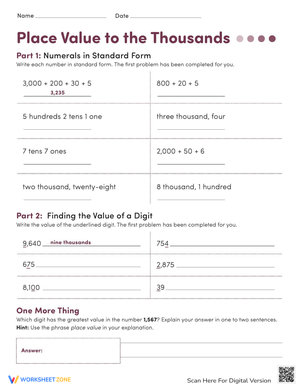
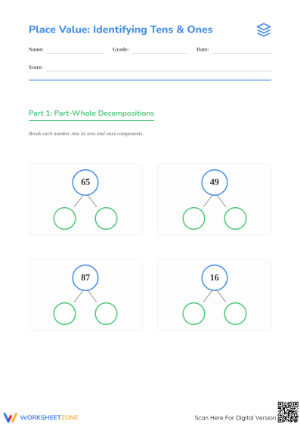
Place value is the hinge that holds together almost every number skill your 3rd graders will use this year. These 3rd grade place value worksheets focus on 3-digit numbers, so students name the hundreds, tens, and ones in a number like 486, break it into 400 + 80 + 6, and rebuild it in standard form. That work up to 1,000 is exactly what sets up the rounding, addition, subtraction, and early multiplication you'll teach later in the year.
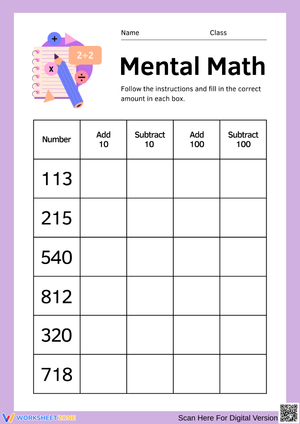
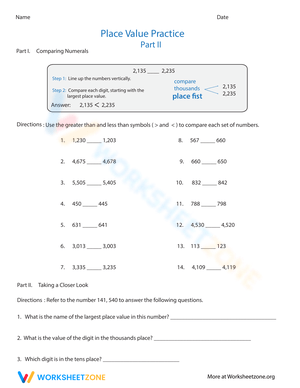
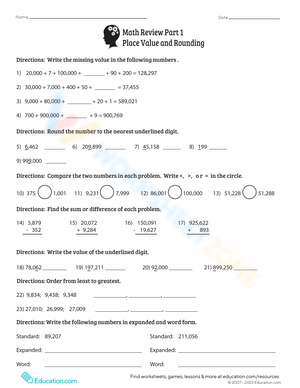
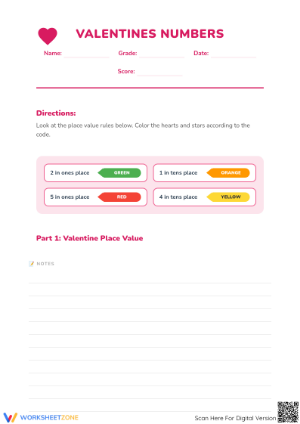
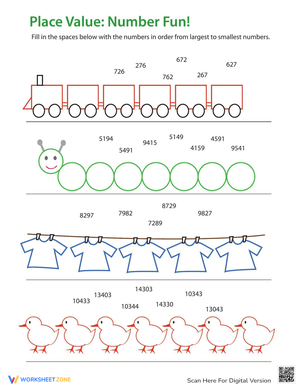
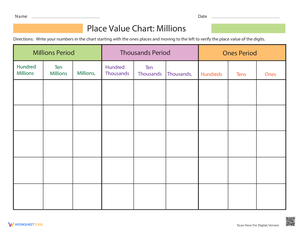
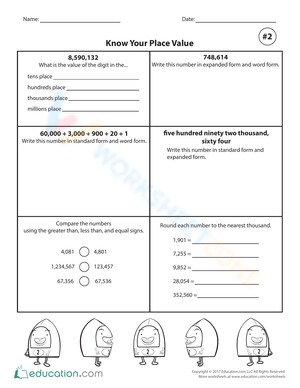
Most sheets move through a predictable arc: identify the value of a digit, match base-ten pictures to numbers, write numbers in expanded form, compare two 3-digit numbers, and round to the nearest 10 or 100. Because the format stays consistent, you can hand them out as warm-ups, homework, or small-group intervention without re-teaching the directions every time. The goal isn't just a right answer; it's students who can explain that the 4 in 486 means four hundreds, not four.
How These Worksheets Align to the 3.NBT.A Standards
The place value block in Grade 3 lives in the Number and Operations in Base Ten domain, and three standards drive it. CCSS 3.NBT.A.1 asks students to use place value understanding to round whole numbers to the nearest 10 or 100. CCSS 3.NBT.A.2 asks them to add and subtract fluently within 1,000 using strategies based on place value and the properties of operations. CCSS 3.NBT.A.3 asks them to multiply one-digit numbers by multiples of 10, from 10 to 90.
The Common Core State Standards Initiative sets a clear Grade 3 benchmark: standard 3.NBT.A.1 requires students to use place value understanding to round whole numbers to the nearest 10 or 100. That means every 3rd grader should round within 1,000 accurately, and these worksheets build the digit-by-digit reasoning that makes that expectation reachable.
When you pick worksheets, look for a mix that touches all three standards. A page that only asks for expanded form builds naming skills but never pushes students toward rounding or multi-digit fluency. Balanced practice keeps place value connected to the arithmetic it supports.
From Base-Ten Blocks to Expanded and Standard Form
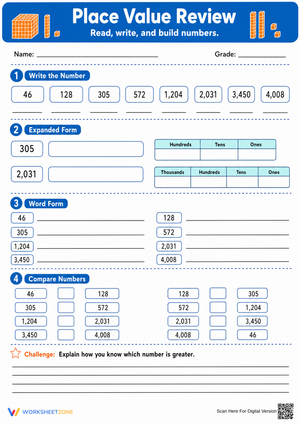
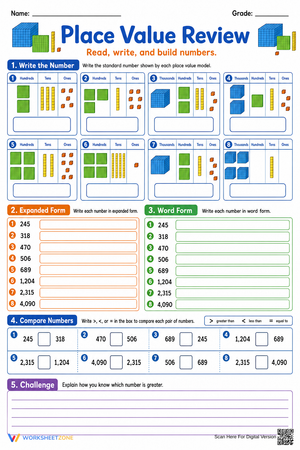
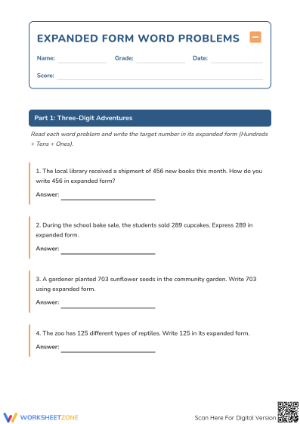
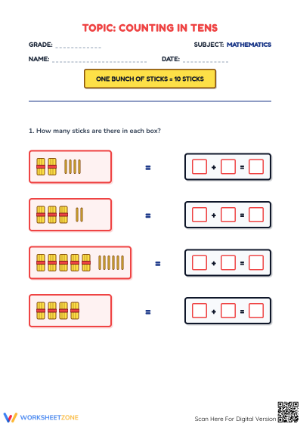
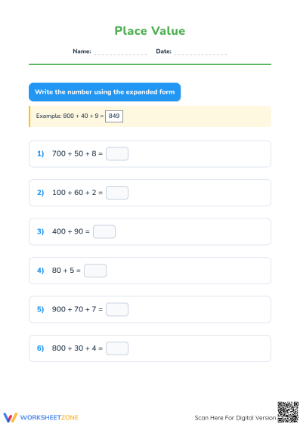
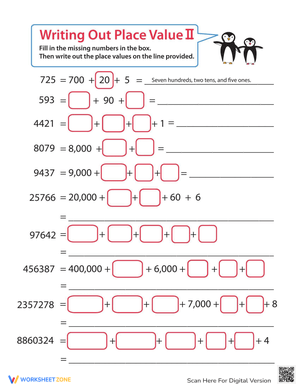
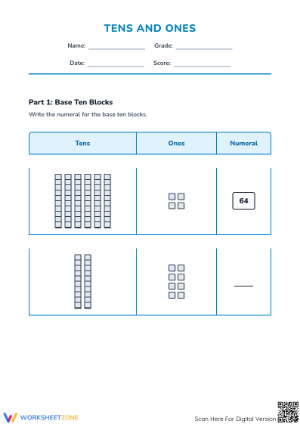
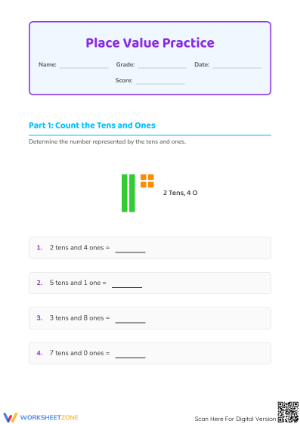
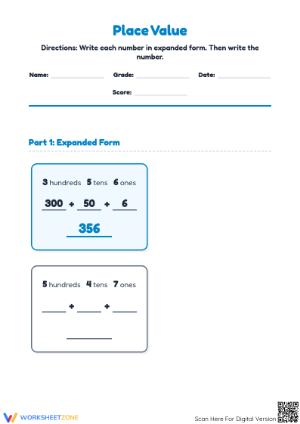
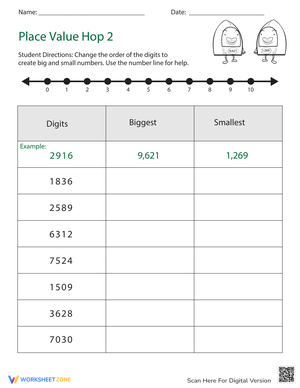
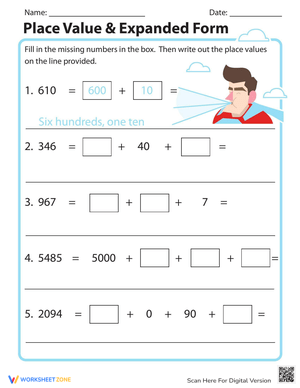
Strong place value instruction moves along a concrete-to-abstract path, and worksheets are the bridge in the middle. Students usually start with base-ten blocks or drawings, where a hundred is a flat, a ten is a rod, and a one is a small cube. Worksheets then ask them to translate those pictures into expanded form, such as 300 + 50 + 2, and finally into the standard number 352.
That translation matters because it forces students to hold two ideas at once: the position of a digit and the quantity it represents. When a worksheet asks students to write 705 in expanded form, the zero in the tens place becomes a teachable moment. Many kids want to write 700 + 5 and skip the zero entirely, which is fine as an answer but worth a quick conversation about why the tens place is empty.
Common Misconceptions These Worksheets Target
Third graders make predictable place value mistakes, and good worksheets are built to surface them. The most common is reading a digit by its face value instead of its place value, so a student sees the 6 in 462 and calls it six rather than sixty. Another is transposing digits when moving between expanded and standard form, turning 208 into 280.
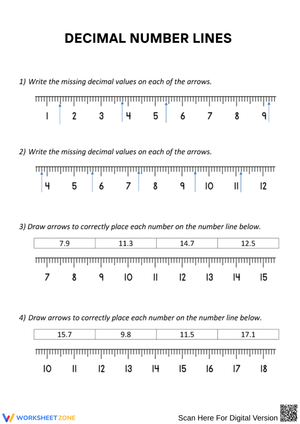
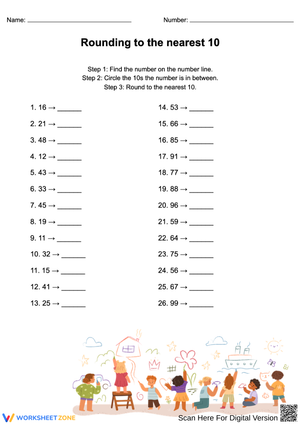
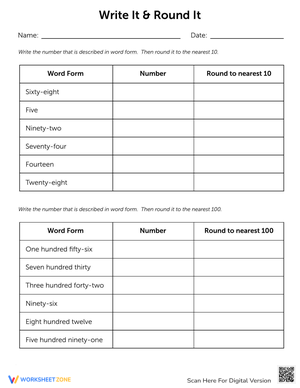
Rounding errors deserve special attention because they usually aren't careless mistakes; they're a sign that place value isn't solid yet. A student who rounds 348 to 400 is often anchoring on the biggest digit instead of the target place. That's why open number lines are so useful: instead of memorizing a rhyme, students plot 348 between 340 and 350, see it sits below the halfway mark of 345, and reason their way to 350. Worksheets that pair a number line with a rounding prompt convert a guessing game into a visible argument, and they give you a quick read on which students still need concrete support.
Teacher Tips
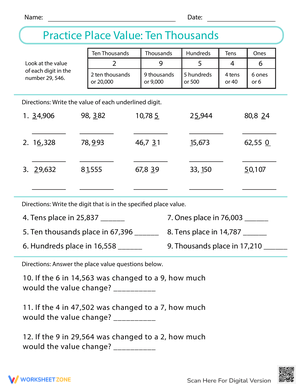
Use these worksheets flexibly rather than as a single graded packet. For whole-class review, project one problem and have students defend their digit-by-digit thinking before anyone writes. For small-group intervention, pull a short sheet that stays on one skill, like naming the value of an underlined digit, so struggling students get repetition without cognitive overload.
Differentiate by adjusting the number size, not the number of problems. A student who is shaky can work the same rounding routine with 2-digit numbers before moving to 3-digit ones, while a student who is ready can extend to numbers near 1,000. Keep an answer routine consistent across the group so the thinking, not the format, is what changes.
Finally, make student talk part of the worksheet. Ask partners to trade papers and explain one answer out loud. Place value is a language as much as a procedure, and saying "the 7 is in the hundreds place, so it's worth 700" cements the idea far faster than a silent worksheet ever will.
Frequently Asked Questions
1. What place value skills should 3rd graders master by the end of the year?
By June, 3rd graders should read, write, and compare 3-digit numbers, express them in expanded and standard form, name the value of any digit up to the hundreds place, and round whole numbers to the nearest 10 or 100 within 1,000.
2. How do these worksheets align to Common Core standard 3.NBT.A.1?
CCSS 3.NBT.A.1 requires rounding whole numbers to the nearest 10 or 100 using place value understanding. Worksheets support it by first securing digit values, then pairing numbers with open number lines so students reason about which ten or hundred is closest.
3. What is the difference between expanded form and standard form practice?
Standard form is the everyday number, like 352. Expanded form breaks it into the value of each digit, 300 + 50 + 2. Practicing both helps students connect a digit's position to the quantity it represents, which is the heart of place value.
4. How can teachers use place value worksheets for small-group intervention?
Pull a short, single-skill sheet and shrink the number size so students get focused repetition. Keep the routine identical each session, add student talk, and track one target skill, such as naming an underlined digit's value, before advancing to rounding.
5. How do these worksheets prepare students for rounding and multi-digit addition?
Place value fluency is the prerequisite for both. Students who can decompose 3-digit numbers round with reasoning instead of tricks and regroup accurately when they add or subtract within 1,000, which is exactly what CCSS 3.NBT.A.2 expects.













 Interactive Worksheet Maker
 Quiz Maker
 Word Search Maker
 Crossword Puzzle Maker
 Word Scramble Generator
 Sentence Scramble Generator
 Handwriting Worksheet Generator
 Name Tracing Generator
 Fill In The Blank Generator