

Mastering Hess's Law: Printables for 11th Grade Chemistry
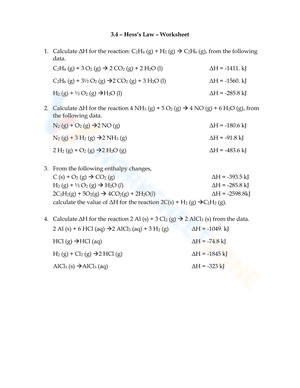
✦These 11th grade hesss law pdf worksheets give chemistry teachers a focused practice set for one of the more demanding topics in a junior-year course. Hess's Law requires students to treat chemical equations as algebraic objects — reversing them, scaling them, and combining them into a target reaction — while correctly tracking enthalpy changes across every step. The resources cover that full range, from simple two-equation entry problems to multi-step enthalpy of formation calculations.
What the Set Covers
Two rules govern every Hess's Law calculation. First: reversing a chemical equation requires flipping the sign of its delta H. Second: multiplying an equation's coefficients by a factor requires multiplying its delta H by that same factor. Those rules are easy to state. Applying them simultaneously, across three or four interconnected equations with different scaling ratios, is where students lose the thread.
The worksheets address that range of difficulty in a deliberate sequence:
- Two-step problems that build fluency with equation reversal and coefficient scaling in isolation
- Three- and four-equation combination problems where students apply both manipulation rules to separate equations within the same solution
- Enthalpy of formation calculations using reference table values and the standard formula: delta H equals the sum of n times delta Hf for products minus the sum of n times delta Hf for reactants
- Error-analysis problems where a deliberately flawed worked solution requires students to identify the exact step where the logic breaks down
That last problem type earns its place in the set. A student who can produce a correct answer doesn't necessarily understand the reasoning at each step. Finding someone else's mistake — locating the line where the sign wasn't flipped, or the coefficient wasn't carried to delta H — demands a closer reading of the mathematics than generating a fresh solution does.
Student Errors That Show Up Reliably in This Unit
The most consistent mistake is sign neglect on reversal. A student correctly rewrites a reaction in reverse, recognizes that it now aligns with the target, and copies the original delta H unchanged. In actual student work, this looks like a correctly flipped equation sitting next to a positive delta H that should be negative. Re-explaining the rule doesn't fix it at that point. Showing the error in a specific worked example, with the offending line circled, does more than restating the principle for the fourth time.
The second common failure is incomplete scaling. A student multiplies all coefficients by 2 to match the target stoichiometry, gets the equation right, and forgets to double delta H. What makes this error persistent is that the equation looks correct on the surface. A brief peer-check step — students exchange their work and verify the enthalpy value for every intermediate equation before combining — surfaces this reliably.
Formation problems introduce a third consistent error: reversing the subtraction order. Students subtract products from reactants rather than reactants from products, flipping the sign of the final answer. Writing the formula explicitly on the board before distributing the formation worksheet, and requiring students to copy it at the top of their work, anchors the direction before they start calculating.
Where These Worksheets Fit in Your Unit Plan
These 11th grade hesss law pdf worksheets integrate naturally after students have covered basic enthalpy and calorimetry but before the unit moves to Gibbs free energy. Two-equation problems work as warm-ups during the first several days of instruction — short enough to complete in the eight minutes before direct instruction begins, repetitive enough to build the sign-change and scaling habits early. The multi-step combination worksheets are better suited to small-group work later in the sequence, where students can talk through disagreements about which equations need reversing before they commit to a final arrangement. That conversation — "wait, you can't add these yet, CO₂ is still on the wrong side" — is more instructive than a correction on a returned quiz.
For exam review, a four-station rotation works well: two-equation problems at the first station, multi-step combination at the second, formation calculations at the third, and error analysis at the fourth. Rotating every twelve to fifteen minutes forces students to switch problem types quickly, which mirrors exam pacing better than completing one long problem set from start to finish.
Standard Alignment
In the NGSS framework, this content aligns with HS-PS3-1, which asks students to create computational models that account for energy changes in systems. Hess's Law problems are exactly that kind of accounting — students are demonstrating that total enthalpy change is conserved across a reaction pathway regardless of intermediate steps, not simply performing arithmetic. A correct final number without the connected reasoning doesn't fully satisfy what HS-PS3-1 is assessing.
For AP Chemistry, this material falls under Unit 6 (Thermochemistry), with Hess's Law and standard enthalpy of formation addressed in Learning Objectives 6.4 and 6.5. The formation calculation worksheet maps directly to what the AP free-response section tests: pulling values from a provided reference table, setting up the products-minus-reactants subtraction correctly, and producing an accurate delta H under time pressure. Repeated table-use practice before the exam has direct payoff on those specific questions.
Adjusting the Worksheets for a Range of Learners
When selecting from 11th grade hesss law pdf worksheets for students who are still uncertain about basic equation writing, begin with the two-step problems and require explicit intermediate steps — the written version of each equation after reversal or scaling, before any combining. Some students want to jump straight to the delta H sum. That shortcut works only if the manipulation is automatic, which it isn't yet for students at this point. The written-intermediate requirement slows them down in a useful way.
For students who move through the standard problems quickly, the error-analysis worksheet offers a different cognitive challenge. Beyond that, presenting a multi-equation problem where one of the given reactions is not needed for the target — students must identify which steps are relevant and which to set aside — adds a judgment layer that the standard format doesn't require.
Students who need more time between difficulty increases benefit from treating two-step and three-step worksheets as separate sessions spread across two or three class days rather than consecutive practice. Spacing that work gives the sign-change and scaling rules time to consolidate before the problems get harder. The goal is automaticity on the mechanics first — complexity second.
Frequently Asked Questions
Do the worksheets include worked answer keys?
Yes. Each worksheet comes with a key that shows every intermediate step, not just the final delta H value. For Hess's Law problems, a bare answer tells students almost nothing about where their reasoning broke down. The worked keys let students trace an error to the exact step — a sign flip that didn't happen, a coefficient that wasn't carried to delta H — and correct it without needing a teacher present.
Which worksheet in the set is most directly aligned to the AP Chemistry exam?
The enthalpy of formation worksheet. AP free-response questions in Unit 6 regularly require students to use tabulated formation values, set up the products-minus-reactants subtraction correctly, and report an accurate delta H with appropriate units. That worksheet mirrors that exact task structure, including reference table use under realistic problem conditions.
Can these resources be used for remediation after a poor unit exam result?
These 11th grade hesss law pdf worksheets work well for targeted remediation when you can identify which problem type a student failed on. A student who missed every formation problem needs different follow-up practice than one who consistently dropped the sign during equation reversal. Using individual worksheets to address specific error patterns — rather than reassigning the full set — is more efficient and gives the student clearer feedback about exactly where the gap is.
Clear All