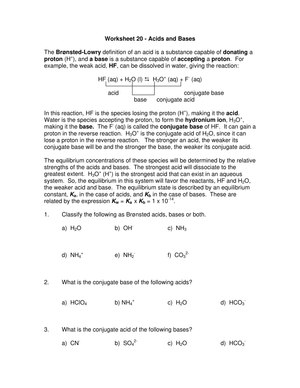
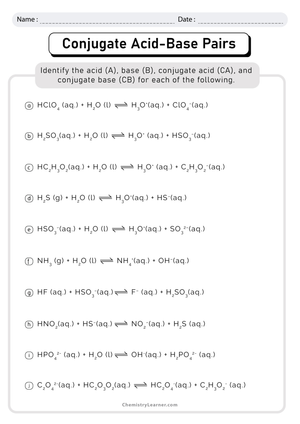
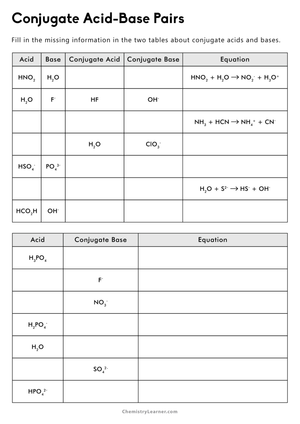
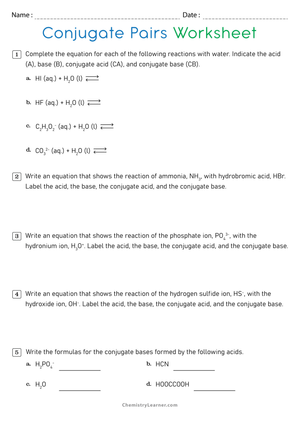
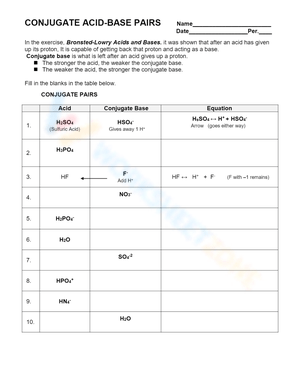
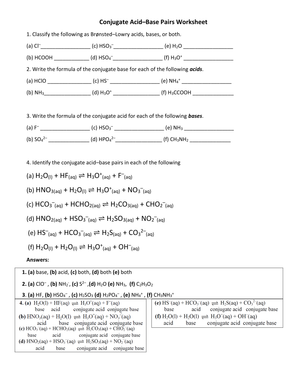
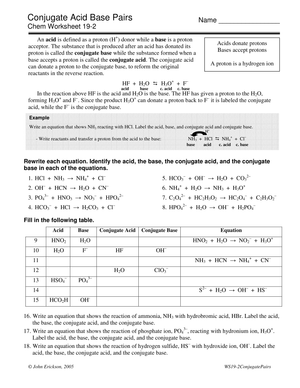
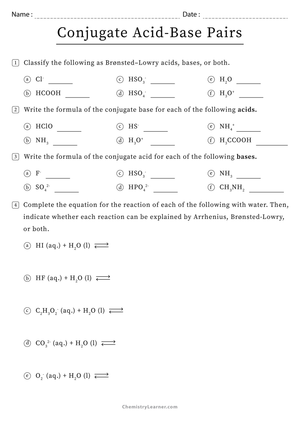
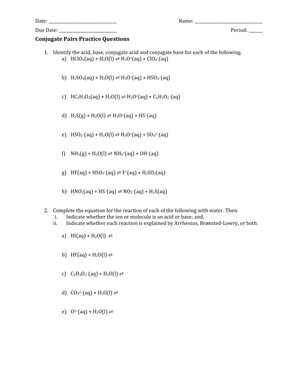
These conjugate acid base pairs printable worksheets for 11th grade give chemistry teachers a focused set of exercises that moves students from uncertain Brønsted-Lowry definitions toward reliable, independent equation analysis. The resources target proton donor and acceptor identification, conjugate labeling, and the inverse strength relationship — the three areas where 11th graders most consistently lose ground. Each worksheet stands alone, so they slot into different phases of the unit without disrupting the sequence.
The Specific Skills Covered Across the Set
Students work through the core mechanics of proton transfer in a deliberate order. Each worksheet asks them to examine a chemical equation, identify which species loses a proton and which gains one, then label the resulting conjugate pairs on both sides of the reaction. That task sounds manageable until students encounter an unfamiliar system — ammonia and water, for instance — where nothing resembles a conventional acid-base reaction at first glance.
The set builds the following skills:
- Applying Brønsted-Lowry definitions to identify proton donors and acceptors across strong-acid, weak-acid, and amphoteric reactions
- Labeling conjugate acid and conjugate base pairs in both reactant and product positions
- Using arrow notation to connect each species to its conjugate counterpart across the equation
- Predicting relative strength — understanding that a strong acid produces a weak conjugate base, while a weak acid produces a conjugate base with greater, though still limited, proton affinity
- Recognizing amphoteric species: water and bicarbonate appear across multiple worksheets specifically because students who assign each species a fixed identity will misidentify one or both the moment the reaction context shifts
- Handling polyprotic acids correctly — identifying HSO4- as the conjugate base of H2SO4 in a single reaction step, not SO42-
Frequent Student Errors Worth Catching Before the Unit Test
The most consistent error is the polyprotic shortcut: students working with sulfuric acid strip both protons at once, writing SO42- as the conjugate base in a single reaction step. A conjugate pair always differs by exactly one proton, so the correct product is HSO4-. Seeing that marked wrong in low-stakes practice is far better than encountering it mid-unit inside an equilibrium calculation.
Charge neglect is the second pattern. After HCl donates H+, a significant portion of students write Cl rather than Cl- as the product. The logic is almost audible — they located the atom, removed the H, and stopped. The +1 charge carried by the departing proton has to go somewhere, and students who skip that accounting will also miscalculate Ka relationships later. Several worksheets include dedicated charge-verification steps that prompt students to confirm charge balance before recording any answer, because the reminder embedded in the task works better than the general reminder issued at the start of class.
A third misconception is more conceptual. Students read "weak acid produces a relatively stronger conjugate base" and conclude that conjugate base is strong enough to fully ionize water. Acetate is a weak base — it simply has a greater affinity for protons than chloride does. The distinction matters when students later calculate the pH of a sodium acetate solution and have to decide whether to treat it as neutral or basic. Worksheets that include ranking tasks, rather than isolated labeling, force students into comparative language rather than the absolute terms that generate this confusion in the first place.
How to Work These Into Your Chemistry Unit
The most productive placement is immediately after introducing the Brønsted-Lowry framework and before introducing Ka and Kb values. Students who cannot reliably label conjugate pairs will struggle with equilibrium expressions, so using these worksheets as a mastery check — rather than optional reinforcement — keeps the unit from unraveling two weeks in.
- Opening equations: Put one reaction from a worksheet on the board before the bell. Students label it in the first five minutes, then the class reviews it together. This narrows the window where misidentifications go uncorrected for days.
- Paired verbalization: Assign partners and require each student to explain their labeling choices aloud before writing anything down. Students who can describe what they're doing rarely make charge-neglect errors — the verbal step forces slower, more deliberate processing.
- Door-pass exit ticket: One equation, four blanks — acid, base, conjugate acid, conjugate base. Collect at the door. Sort the stack into two groups based on whether the charge adjustment is correct. That sort alone tells you who needs reteaching before the next class.
- Pre-buffer review: Assign the strength-prediction worksheet the day before introducing buffer chemistry. Students who have internalized the inverse relationship find the Henderson-Hasselbalch logic considerably less opaque when they encounter it.
The conjugate acid base pairs printable worksheets for 11th grade also hold up well as homework assignments when the following class opens with a ten-minute debrief on the hardest equation in the set. That focused discussion reliably surfaces the polyprotic error before it appears on the unit test.
Standard Alignment
The skills these worksheets develop align with the NGSS disciplinary core idea HS-PS1.B (Chemical Reactions), which at the high school level includes proton transfer reactions and the conceptual foundation for acid-base equilibrium. For AP Chemistry teachers, the relevant learning objectives fall under SAP-9 — specifically SAP-9.A, which asks students to explain the relationship between the strength of an acid or base and the extent of its reaction with water. Conjugate pair identification is the conceptual prerequisite for that standard; students cannot meaningfully discuss the degree of ionization without first understanding what a conjugate acid and base are and why strong acids produce weak conjugate bases. In most 11th-grade chemistry sequences, this content lands in the third or fourth unit, after periodic trends and basic reaction types are established.
Adjusting the Work for a Range of Chemistry Learners
For students still uncertain about ionic charge and formula notation, starting with strong acid plus water reactions keeps the cognitive demand manageable. HCl and water is the clearest entry point: the charges are simple, the species are familiar, and the proton movement is unambiguous. Once a student labels that reaction correctly and can explain the charge adjustment, they're ready for weak acid examples and amphoteric species.
Students moving through the material quickly can extend the same worksheets by adding a second layer of analysis: determining whether the forward or reverse reaction is favored by comparing the relative strengths of the two acids in the equation. That task doesn't require a separate resource — it converts a labeling exercise into a prediction exercise, which is a meaningful step up in reasoning demand without adding new procedural complexity. For students preparing for AP Chemistry, attaching a Ka comparison to every reaction they label creates a direct conceptual bridge to the equilibrium unit that follows.
The conjugate acid base pairs printable worksheets for 11th grade span a range of reaction types precisely so teachers can assign selectively. Sending one group to the strong-acid reactions while the rest of the class works on amphoteric species is a practical way to differentiate without managing entirely separate assignments.
Frequently Asked Questions
Can water appear as both the acid and the base in these worksheets?
Yes — deliberately. Water is amphoteric: in the presence of a stronger acid it accepts a proton and acts as a base, forming H3O+ as its conjugate acid; in the presence of a stronger base it donates a proton and acts as an acid, forming OH- as its conjugate base. Several worksheets include reactions where water plays both roles across different equations, giving students direct practice recognizing that a species' behavior depends on what it's paired with, not on a fixed label.
How do I find the conjugate acid or base of any species quickly?
Add one H and increase the charge by one to get the conjugate acid of a base. Remove one H and decrease the charge by one to get the conjugate base of an acid. The charge adjustment is where students consistently slip — they locate the hydrogen atom, add or remove it, and stop. Repeated practice cements the habit of verifying charge balance as part of each answer, not as an afterthought that might get skipped.
Why include polyprotic acids if students find them difficult?
Because confusion over polyprotic species in a practice setting is far less costly than the same confusion on a unit test or in an AP free-response question. H2SO4 and H2CO3 appear in real equilibrium problems, buffer systems, and titration curve analysis. The core rule — one proton per conjugate pair, every time — is simple once stated directly, but students won't apply it reliably without encountering it in practice. Worksheets that avoid polyprotic examples leave a gap that shows up exactly when it matters most.
Where do these worksheets fit relative to Ka and Kb instruction?
Assign them before introducing equilibrium constants for acids and bases. Students who can fluently label conjugate pairs and articulate the inverse strength relationship find Ka and Kb expressions considerably more intuitive — the math maps onto something they already understand conceptually. The conjugate acid base pairs printable worksheets for 11th grade work best as the conceptual groundwork that makes the quantitative layer stick, not as a review tool pulled out after the fact.