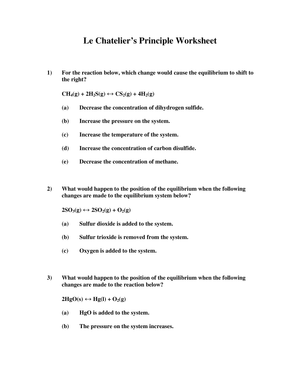
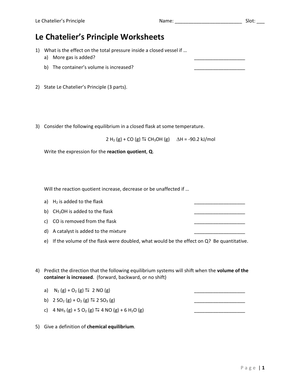
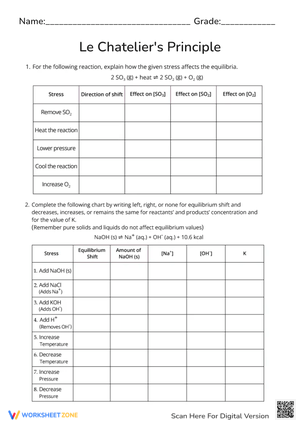
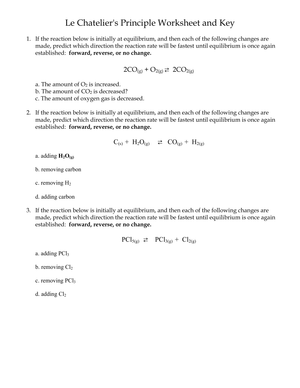
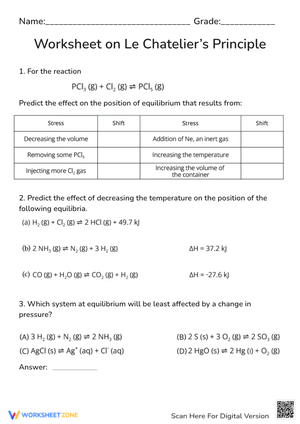
Le chateliers principle printable worksheets for 11th grade give chemistry teachers a focused set of practice resources for what is, in most honors or AP sequences, the unit that produces the widest range of student understanding — from genuine conceptual mastery to surface-level memorization that collapses on the first multi-stress problem. Each worksheet isolates a specific type of equilibrium stress, so the set works equally well as a unit sequence or as targeted pull-out practice for students who need to revisit one particular concept.
What Each Worksheet Targets
The set covers the four main stress categories that appear in 11th-grade equilibrium units, with each one receiving dedicated practice rather than being bundled together too early.
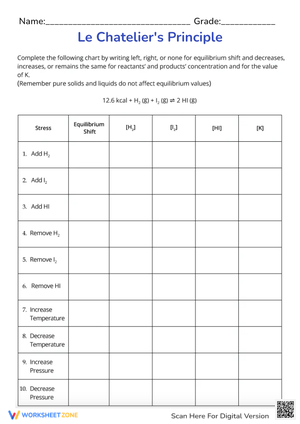
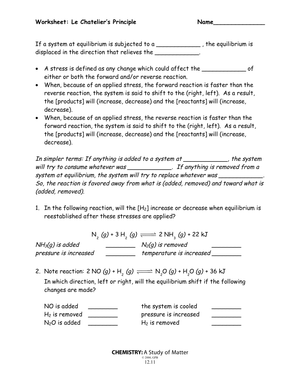
- Concentration changes — Students add or remove a reactant or product and predict the direction of shift, then trace the resulting effect on all remaining species in the system.
- Temperature effects — Exercises require students to rewrite the thermochemical equation with heat as a reactant or product before predicting the shift, and then identify whether Keq increases, decreases, or stays the same.
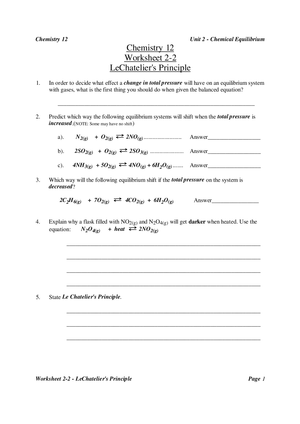
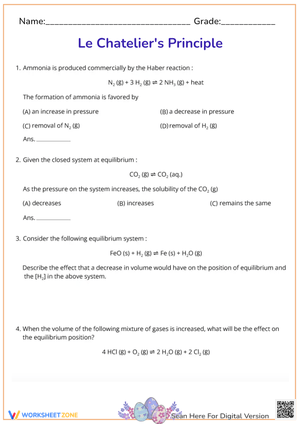
- Pressure and volume adjustments — Problems involve counting moles of gas on each side of the equation, including cases where no shift occurs because moles are equal on both sides.
- Catalyst analysis — Students examine concentration-time graphs showing a steeper initial slope with identical equilibrium asymptotes and explain why no position shift occurs.
- Graphical interpretation — Concentration-versus-time graphs require students to mark the moment a stress is applied and sketch the resulting return to a new equilibrium.
- Multi-stress scenarios — Later worksheets present two or three simultaneous changes and ask students to reason through competing effects rather than apply a single rule.
Temperature: The One Stress That Changes Keq
Temperature deserves its own discussion because it is the only stress that changes the numerical value of Keq — and students who do not internalize that distinction will make consistent errors on every temperature problem that follows. The most reliable approach is to teach students to rewrite the thermochemical equation with heat explicitly included as a reactant or product before doing anything else. An exothermic reaction that releases 92 kJ becomes immediately clearer once "92 kJ" appears on the product side — raising the temperature now reads as adding a product, and the backward shift becomes intuitive rather than a memorized rule.
These worksheets use exactly that approach. Students rewrite the equation first, then predict the shift, then identify whether Keq increases, decreases, or is unchanged. That three-step sequence slows students down at the right moment and surfaces the most common error in this topic: predicting the correct shift direction while simultaneously writing that Keq is unchanged. Both parts of that answer cannot be right, and the worksheet format forces students to confront the contradiction directly.
Mistakes Students Make That These Worksheets Surface
The most persistent error across all stress types is assuming that any stress changes the value of Keq. Students who have partially learned the material will correctly predict that adding a reactant shifts the equilibrium right — and then write that Keq increases along with it. Each worksheet includes a dedicated column for students to record whether Keq changes, which makes the distinction a required step in every problem rather than an afterthought.
Pressure and volume problems produce a different category of mistake. Students consistently forget to check state symbols before counting moles of gas. A common example: in the decomposition of calcium carbonate, students count three species and conclude a shift will occur, when CaCO₃ and CaO are both solids and CO₂ is the only gaseous species — making the total moles-of-gas comparison one to one on neither side in the way students assumed. Worksheets that include an explicit "state symbol check" prompt before the shift-prediction step cut this error noticeably in classroom use.
Catalyst problems generate a third category of confusion. Students who have internalized "adding something shifts the equilibrium" sometimes extend that logic to catalysts, predicting a rightward shift simply because something new was introduced to the system. Graphs showing identical equilibrium asymptotes for catalyzed and uncatalyzed reactions are more persuasive than any written explanation, which is why several worksheets present that visual comparison directly alongside the prediction question rather than in a separate diagram.
How to Build These Worksheets Into Your Unit Plan
The most effective use pattern is to assign each worksheet immediately after the corresponding lesson — not as homework, but as the last 10 to 12 minutes of class while the new information is still in working memory. Students who attempt concentration-shift problems the same period they receive instruction on collision theory retain the conceptual link significantly better than those who encounter the practice a day later. In that context, the worksheets serve as in-class formative checks, not follow-up assignments, and they give teachers real information about where the class actually stands before moving to the next stress type.
For review days before a unit test, le chateliers principle printable worksheets for 11th grade work well in a stations format. Four stations, one stress type each, with the multi-stress worksheet held as a fifth challenge station for students who move quickly. This structure keeps the review period from becoming a passive re-reading session and gives teachers real-time information about which stress type needs additional whole-class attention before the assessment.
The graphical worksheets are particularly useful the day after students complete a lab on the iron thiocyanate equilibrium system. Students who have physically watched the solution darken when SCN⁻ is added make the conceptual connection to concentration shifts much faster when they immediately annotate a matching concentration-time graph on the worksheet.
Standard Alignment
These worksheets align primarily with NGSS HS-PS1-6, which asks students to refine the design of a chemical system by applying principles of equilibrium — including predicting the effects of changing conditions on reaction direction. In most 11th-grade sequences, this standard appears between the kinetics unit and the acid-base unit, typically in the fourth or fifth marking period. The pressure-and-volume worksheets also connect to HS-PS3-1 insofar as students reason about energy distribution in systems under physical constraint. Teachers following College Board frameworks for AP Chemistry will find the content maps directly onto Big Idea 6 (Equilibrium) and the associated Science Practices for analyzing and interpreting graphical data.
Differentiating the Set Across Ability Levels
Le chateliers principle printable worksheets for 11th grade span a meaningful range of complexity within the set, which makes differentiation manageable without requiring separate materials entirely. Students who need additional support work through the single-stress worksheets where the thermochemical equation-rewriting step is prompted explicitly — that built-in structure reduces cognitive load without removing the conceptual challenge. Students who have the basics secure move directly to the multi-stress worksheets and the graphical sketching tasks, both of which require integrating stoichiometric mole ratios with equilibrium reasoning at the same time.
For students who are significantly ahead, the catalyst worksheet pairs productively with a potential energy diagram activity where students draw both catalyzed and uncatalyzed pathways and label the activation energies for forward and reverse reactions. Asking those students to explain in writing why the equilibrium position is unchanged — using activation energy arguments rather than simply restating Le Chatelier's rule — pushes them toward the mechanistic reasoning that AP and IB assessments reward. Students who need the most support, by contrast, benefit from completing the concentration-shift worksheet alongside a physical token activity — using colored pieces to represent reactants and products — before they transition to working on the printed problems independently.
Frequently Asked Questions
Does adding an inert gas to a sealed container shift the equilibrium?
No — and this is a question that appears on AP Chemistry exams often enough to warrant explicit practice. Adding an inert gas to a fixed-volume container increases the total pressure but does not change the partial pressures of the reacting gases. Because the individual concentrations of reactants and products are unchanged, the equilibrium position does not shift. If the container volume were allowed to expand to maintain constant pressure as the inert gas was added, the partial pressures of the reacting species would decrease, and a shift could occur depending on the moles of gas on each side. The worksheets include a version of this scenario so students encounter the distinction before an exam forces it.
Why does Keq change with temperature but stay the same when concentration or pressure changes?
Keq is the ratio of the forward rate constant to the reverse rate constant. Temperature changes the kinetic energy of the particles and disproportionately affects those two rate constants because the forward and reverse activation energies are not equal. When the two constants change by different magnitudes, their ratio — Keq — changes as well. Concentration and pressure changes temporarily push the system away from equilibrium, but once the system re-establishes balance, the ratio of products to reactants returns to the original value dictated by the unchanged rate constants. Students who understand this mechanistic explanation stop conflating position shifts with constant changes.
Where do these worksheets fit in a unit that also covers ICE tables and Keq calculations?
Qualitative Le Chatelier prediction problems work best before students encounter ICE table algebra. Once students can reliably predict the direction of a shift under a given stress, the quantitative ICE table process has a conceptual home — students understand what they are calculating and why the equilibrium concentrations move as they do. The practical sequence is to assign the shift-prediction worksheets first, then introduce ICE tables, then return to the graphical worksheets as a bridge connecting the two approaches. The multi-stress worksheets function well as a capstone after students have ICE table practice in hand, since those problems require holding multiple simultaneous changes in mind while reasoning through the net effect — the same kind of thinking that complex Keq calculation problems demand. Teachers using le chateliers principle printable worksheets for 11th grade in that sequence consistently find students enter the ICE table lessons with a clearer sense of direction and purpose.