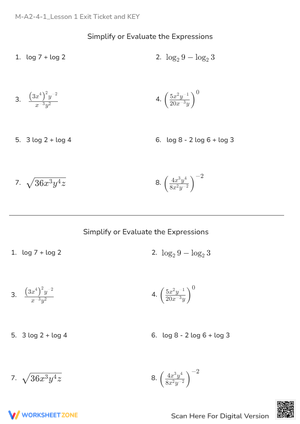
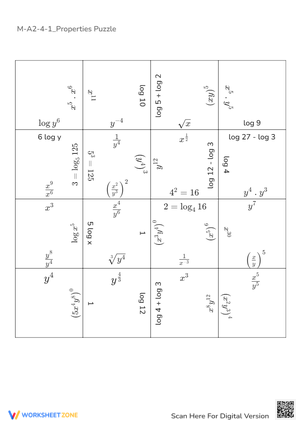
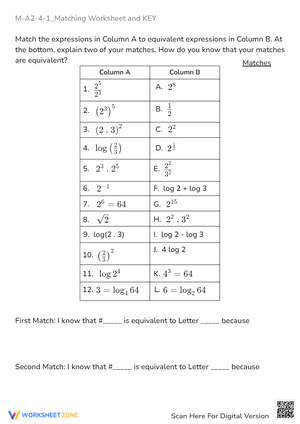
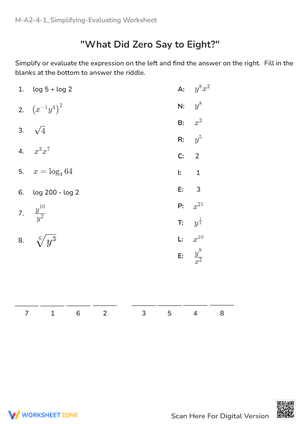
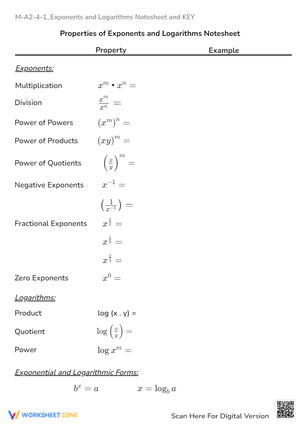
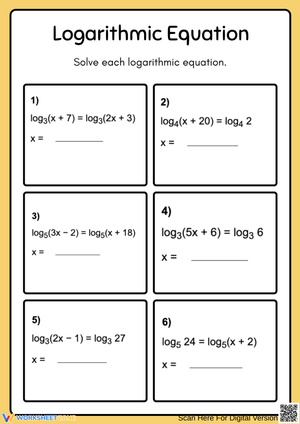
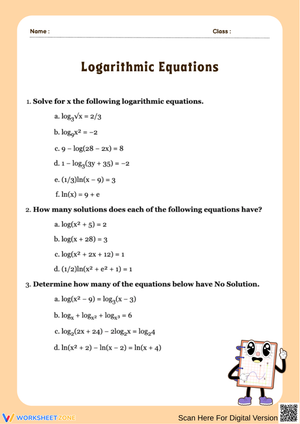
These 11th grade properties of logarithms worksheets printable cover the product rule, quotient rule, power rule, and change of base formula through structured problem sets that move from single-rule expansion to multi-step condensing and back. Each worksheet isolates a specific rule or pairing so teachers can assign exactly what a class needs on a given day, rather than cycling through material students already control.
What Students Practice Across the Set
The worksheets span the full range of log-property work that typically appears in an 11th grade algebra or precalculus course. Students expand complex logarithmic expressions into sums and differences of simpler ones, then reverse the process by condensing multiple log terms into a single expression. Both directions matter: expansion builds rule fluency, and condensing is where students discover that getting the order of operations wrong produces a fundamentally different result.
- Product rule expansion: rewriting log_b(mn) as a sum of two separate logarithms, including cases where m or n are themselves products
- Quotient rule problems: translating a fraction inside a logarithm's argument into a difference, and recognizing that order matters — numerator log minus denominator log, not the reverse
- Power rule practice: pulling exponents and fractional exponents down to coefficients in front of the log, including radical expressions rewritten first
- Change of base: converting expressions like log base 5 of 12 into a ratio of common or natural logs for calculator evaluation
- Condensing: combining sums and differences of logs into a single logarithm, including the step of moving coefficients back to exponents before combining
- Mixed rule sets: multi-step expressions requiring students to decide which rule applies first and track each transformation cleanly
- Error analysis: identifying the mistake in a completed example, naming the rule that was violated, and rewriting the solution correctly
Misconceptions That Show Up in Almost Every Class
The error teachers encounter most reliably is false distribution: students write log(x + y) = log(x) + log(y). This feels logical to students who just learned the product rule, and it's easy to see why — they're carrying over a distributive instinct from earlier algebra. The fix isn't simply to say "that's wrong." Show them a numerical counterexample immediately: log(10 + 90) = log(100) = 2, while log(10) + log(90) is roughly 1 + 1.954 = 2.954. The numbers make the violation concrete in a way that restating the rule does not.
A second consistent problem surfaces during condensing. Students correctly move a coefficient to an exponent but then combine two logarithms that have different bases, treating them as compatible. In written work, this shows up as clean, correct steps right up to the final line, where a subtraction of unlike-base logs gets collapsed into a single expression. Error analysis worksheets catch this because students have to read someone else's steps critically rather than just produce their own.
There's also a subtler issue with the power rule and radical expressions. When a square root appears inside a log, students who haven't rewritten it as a one-half exponent first will either ignore the radical entirely or try to apply the product rule to the radicand. Rewriting the radical as a fractional exponent before doing anything else is the step that has to become automatic, and early worksheets that require this as a visible first step train the habit effectively.
Building These Worksheets Into Your Lesson Flow
The most effective use pattern treats each worksheet as a daily practice object rather than a unit-end review. A five-problem expansion worksheet works well as a Monday warm-up after students first encounter the product rule — it's short enough to finish in eight minutes and reveals immediately which students left the previous lesson without the concept. Collecting it takes thirty seconds; reading through the stack that evening tells you whether Tuesday needs reteaching or can move forward to the quotient rule.
For the condensing worksheets, small-group work pays off. Condensing requires students to think backward — coefficients become exponents, sums become products, differences become quotients — and the conversation that happens when one student disagrees with another's final form produces exactly the kind of reasoning practice that written drills alone don't generate. Assigning one student to record each transformation step while a partner checks the line is more productive than leaving the group dynamic unstructured.
The 11th grade properties of logarithms worksheets printable in this set also serve as reliable formative checkpoints. Assign a mixed-rule worksheet two or three days into the logarithms unit, collect it before students leave, and sort the papers into three rough groups: students who applied all four rules correctly, students with one consistent error type, and students whose work shows fundamental confusion between expanding and condensing. That sort takes about ten minutes and gives you a concrete grouping for the next day's differentiated practice.
Adjusting the Set for Different Readiness Levels
Students who are still uncertain about exponent rules will struggle with logarithm properties before they even reach the log-specific errors. A brief review of the laws of exponents — particularly the product, quotient, and power rules — before assigning the first log worksheet removes a major source of confusion. Pairing an exponent-laws reference card with the early worksheets gives students a concrete anchor without slowing the whole class down.
For students who move through the basic worksheets quickly, the mixed-rule and error analysis worksheets provide the right level of challenge. Multi-step problems where students apply three rules in sequence, then condense the result, demand the kind of sustained attention that single-rule drills don't require. Asking advanced students to generate their own incorrect worked examples for classmates to analyze adds another layer — writing a plausible-but-wrong solution is harder than identifying the error in someone else's.
The 11th grade properties of logarithms worksheets printable are also useful for students retaking precalculus or reviewing for a placement exam. The set's organization — one rule per worksheet before moving to mixed sets — makes it straightforward to target a specific gap without assigning material a student has already mastered. A student who controls the product and quotient rules but is uncertain about the power rule can start exactly there, without wading through problems they don't need.
Standard Alignment
These worksheets align with CCSS HSF-BF.B.5, which addresses the inverse relationship between exponential and logarithmic functions and the application of logarithmic properties to equation solving. In classroom terms, this standard sits between the introductory unit on exponential functions and the unit on solving equations that contain variables in exponents or inside logarithms — it's the bridge content that makes equation-solving mechanically possible. Students who don't reach fluency with the four properties at the level this standard requires will stall when they attempt to isolate a variable trapped inside a logarithm or perched in an exponent.
Frequently Asked Questions
How do you handle square roots or radicals inside a logarithm?
Rewrite the radical as a fractional exponent before doing anything else. A square root becomes an exponent of one-half; a cube root becomes one-third. Once the expression is in exponential form, the power rule applies cleanly — move the fraction to the front as a coefficient. Students who skip this rewrite tend to misapply the product rule to the radicand, which produces a different and incorrect result.
What order works best for teaching the four properties?
Starting with the product rule, then quotient, then power works well because the first two establish the core idea — the log of a combined expression splits into simpler parts — and the power rule then reads as a natural extension of that pattern. Change of base typically comes last because it's less about algebraic manipulation and more about calculator use, and students understand why it's necessary only after spending time working with non-standard bases in purely symbolic form.
Should expanding and condensing be taught together or in separate lessons?
Separate lessons first, then a combined review. When students learn both directions in the same lesson, they frequently conflate the two processes and lose track of which operation they're supposed to perform. Teaching expansion to fluency, then introducing condensing as the deliberate reverse — with explicit attention to where the steps differ — produces cleaner results than presenting them as two sides of the same coin from the start.
When does the change of base formula show up on assessments?
Most end-of-course exams and standardized precalculus assessments include at least one item requiring numerical evaluation of a logarithm with a non-standard base. Students who have only seen the formula in abstract symbolic contexts sometimes don't recognize the calculator-use situation when it appears on a test. The 11th grade properties of logarithms worksheets printable in this set address that by including problems that ask for a decimal approximation, not just a symbolic rewrite — so students practice the formula in the context where it actually gets used.












 Interactive Worksheet Maker
 Quiz Maker
 Word Search Maker
 Crossword Puzzle Maker
 Word Scramble Generator
 Sentence Scramble Generator
 Handwriting Worksheet Generator
 Name Tracing Generator
 Fill In The Blank Generator