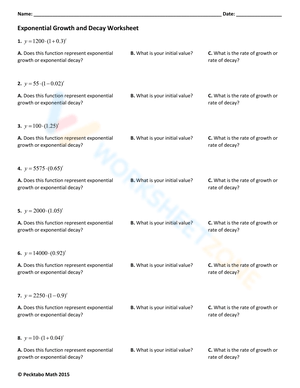
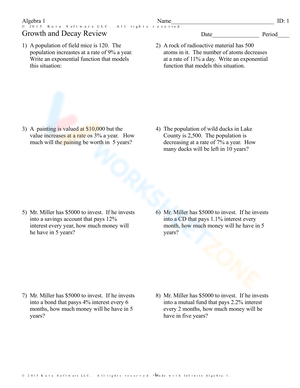
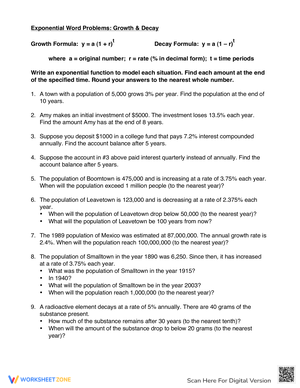
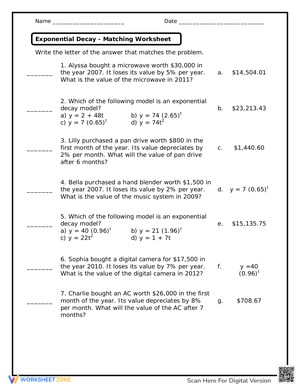
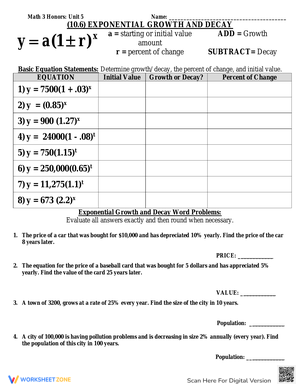
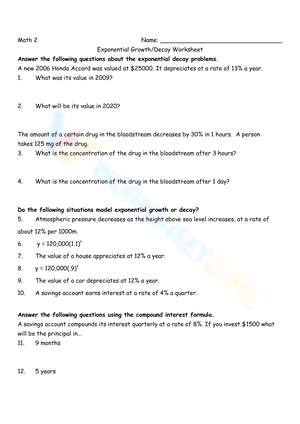
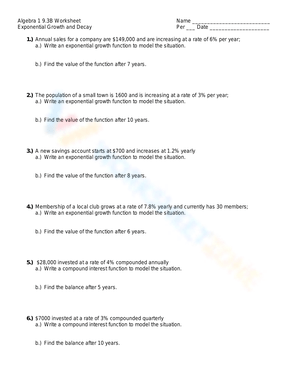
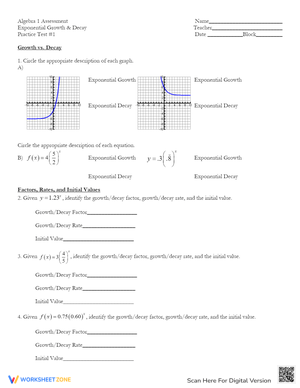
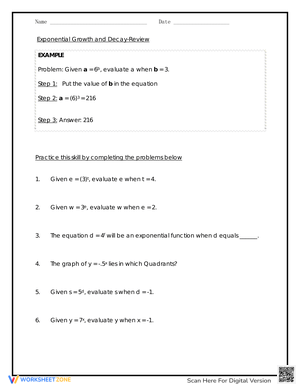
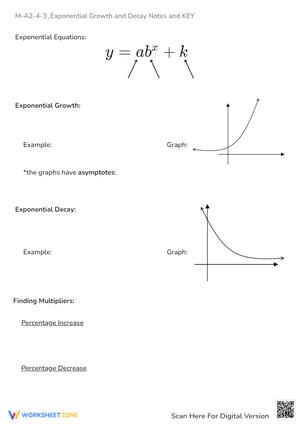
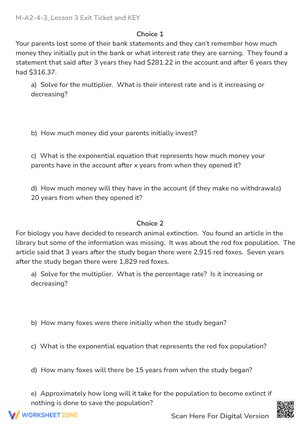
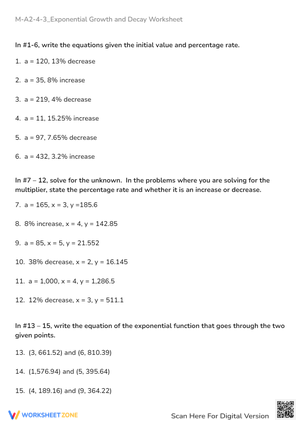
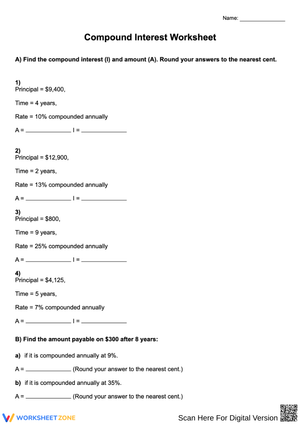
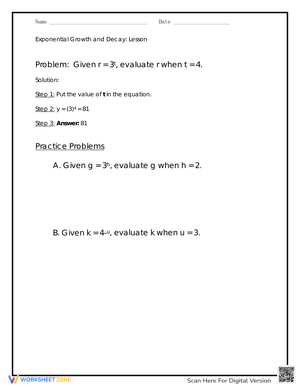
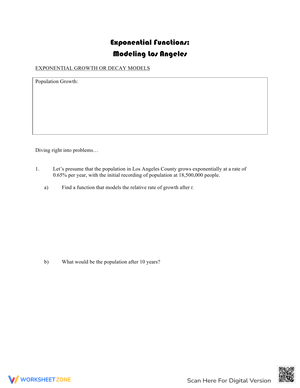
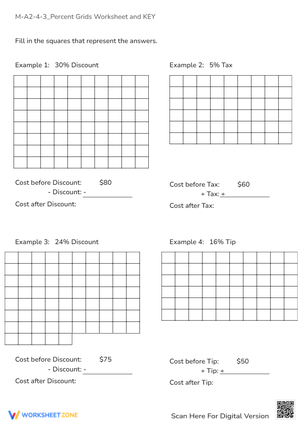
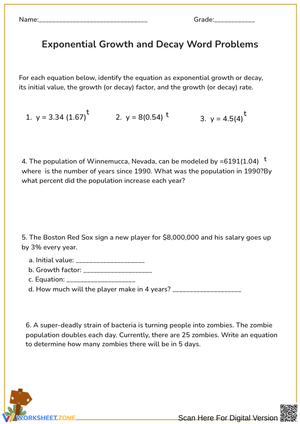
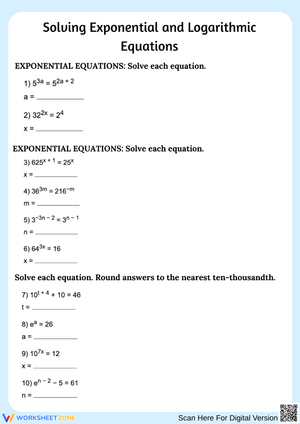
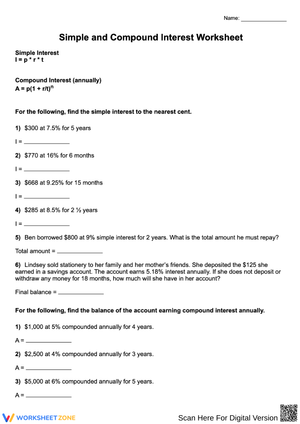
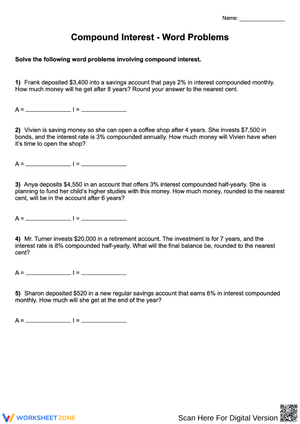
These exponential growth and decay worksheets pdf for 11th grade give teachers a focused set of practice materials for one of the most conceptually demanding transitions in the high school math sequence — the moment students must stop thinking additively and start reasoning about multiplicative change. The set covers discrete and continuous models, percentage-based growth factors, natural base applications, graphical analysis, and logarithmic solving. Each worksheet stands alone as a classroom-ready tool you can assign, collect, and use to direct the next day's instruction.
The Specific Skills These Worksheets Build
The core procedural work is identifying and applying both the standard formula y = a(b)^t and the continuous growth formula A = Pe^rt. Students practice converting a stated percentage rate — a 3.5% annual growth rate, for instance — into the correct decimal base, which turns out to be a more persistent problem than it first appears. Beyond the formulas, students work through identifying the initial value a correctly from word problem context, locating horizontal asymptotes in decay graphs, and applying logarithms to isolate a variable exponent when solving for time.
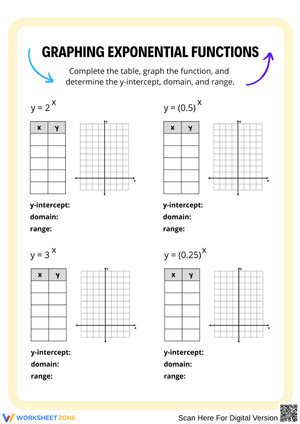
Graphing exercises ask students to plot exponential curves from a table of values, then describe end behavior and contrast the long-term trajectory of different growth bases. Understanding why a base of 1.08 produces dramatically different long-term outcomes than a base of 1.02 — even though both look nearly identical over a two-year window — is exactly the proportional reasoning the set develops. Several worksheets close with interpretation tasks: given a graph or equation, students write a sentence explaining what the model predicts and where its predictions would break down.
Errors Worth Anticipating Before You Assign These
The most stubborn error pattern involves identifying the initial value a. In word problems that mention a quantity at some point after the start — "after three years, the population is 4,200" — students routinely plug that 4,200 in as a. They read for the biggest number rather than for the condition t = 0. The set includes problems where the starting value has to be back-calculated, which forces students to articulate what a actually represents before they can proceed.
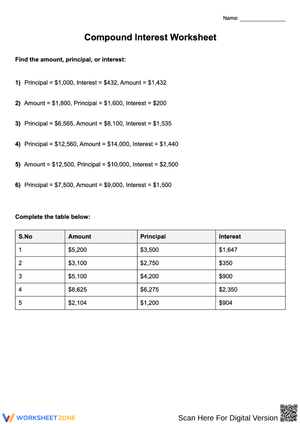
A second error that shows up consistently is a unit mismatch between rate and time. An annual interest rate compounded monthly requires aligning r and t to the same interval, but students will divide the rate by 12 or multiply t by 12 inconsistently — sometimes doing one, sometimes the other, sometimes both, sometimes neither. This is a different error from simply misreading the formula; it reflects a shaky understanding of what the exponent is actually counting. The problems in the set name the compounding interval explicitly so students must confront that decision before any calculation begins.
A third error appears when students encounter a negative exponent: y = 500(2)^(-t) gets classified as decay because they see a minus sign, even though the base 2 is greater than 1. Students focus on the sign rather than the base. They also frequently confuse this form with y = 500(0.5)^t, which models the same relationship but looks different. Asking students to rewrite both forms and verify that they produce matching tables of values is one effective way to surface and resolve this confusion before it reaches the assessment.
Fitting These Into the Week Without Losing Momentum
The most practical entry point is using individual worksheets as warm-up sets at the start of the unit's second and third weeks, once students have had initial instruction on the formulas. One worksheet before the lesson gives immediate formative data — the error pattern you see tells you exactly where to focus instruction before moving on. Collect and scan them; don't just check for completion.
Station work is another strong fit. Assign one worksheet on compound interest applications to one group, one on half-life and radioactive decay to another, and one focused on solving for t using logarithms to a third. Rotating groups through three or four different context types in a single class period keeps the underlying math consistent while varying the situation enough that students must actively read and interpret rather than pattern-match their way to an answer.
For review before the unit assessment, pull two or three problems from different worksheets and project them without the answers. Ask students to work independently for four minutes, then compare their setups — not their final values — with a partner. Disagreements about the setup reveal conceptual confusion far more reliably than wrong final answers do.
Standard Alignment
The exponential growth and decay worksheets pdf for 11th grade address CCSS.MATH.CONTENT.HSF.LE.A.1 (distinguishing between situations modeled by linear versus exponential functions), HSF.LE.A.4 (using logarithms to solve exponential equations), and HSF.BF.A.1 (building functions that model relationships between two quantities). In practice, LE.A.4 is where most 11th graders need the most concentrated work: the procedural step of taking a logarithm of both sides is not itself difficult, but deciding which logarithm to use and interpreting the result in context requires repeated exposure. Several worksheets target that standard directly by providing the equation and asking only for the time value, removing the modeling layer so students can focus on the algebraic technique before they have to carry both tasks simultaneously.
Adjusting the Set for a Mixed-Ability Classroom
The exponential growth and decay worksheets pdf for 11th grade work across a range of readiness levels with targeted adjustments. For students still consolidating the basic formula structure, remove the word-problem layer initially: give them the equation in standard form and ask them to evaluate it at several values of t, then graph the result. Once that step is fluent, the word problems become a reading task rather than a simultaneous math-and-reading task.
Students who move through the standard problems quickly will find real challenge in the continuous compounding and logarithm-solving worksheets. A worthwhile extension: give those students access to an online compound interest calculator and ask them to reverse-engineer the interest rate from a known starting value, ending value, and time span. They have to set up the equation, apply the natural log, and interpret the result — all three relevant standards addressed in one self-generated problem.
Students who freeze on multi-step word problems often make more progress when they first complete a structured entry prompt — a designated space for a, for r, for t, and for what they are solving — before writing any equation. That kind of guided entry is easy to provide on a separate half-sheet alongside any worksheet in the set, and it reduces the cognitive burden of parsing a dense paragraph while simultaneously recalling formula components.
Frequently Asked Questions
How do students determine whether a function represents growth or decay?
The base of the exponential term is the deciding factor, not the sign of the exponent. If the base is greater than 1, the function grows. If the base is between 0 and 1, the function decays. Students need to learn to rewrite equations to expose the base before classifying — a function written as y = 300(2)^(-t) requires rewriting as y = 300(0.5)^t before the classification becomes visually clear. Several problems across the set require that rewriting step as part of the solution process.
When should students use A = Pe^rt instead of y = a(1 + r)^t?
The continuous model applies when the problem explicitly states continuous compounding, or in biological contexts where change is essentially uninterrupted — bacterial growth, Newton's law of cooling. The discrete model applies when compounding happens at countable intervals: annually, monthly, quarterly. Mixing the two models on the same problem type is a reliable error source in 11th grade. The set includes problems that require students to identify which model applies before they set up any calculation.
How and when do logarithms enter these problems?
Logarithms become necessary when the unknown is in the exponent — specifically when a problem asks how long it takes for a quantity to reach a target value. Students apply a logarithm to both sides, use the power rule to bring the exponent down as a coefficient, then solve algebraically. The most common point of confusion is choosing between common log and natural log; both work, but natural log is typically more efficient when the base is e. The worksheets present both types of equations so students practice the technique in both contexts.
Can individual worksheets from the set be used as quiz grades?
Several teachers use the multi-step application worksheets as in-class assessments rather than homework, particularly for the logarithm-solving and continuous compounding materials, because those topics are difficult to evaluate with a few multiple-choice items. The exponential growth and decay worksheets pdf for 11th grade include enough variety in problem type that pulling five or six problems for a short quiz produces a reasonable spread of difficulty, and the answer keys make scoring straightforward.
What prerequisite skills do students need before these worksheets are productive?
Students should be comfortable evaluating integer and rational exponents, working with decimal multiplication, and reading word problems for key quantities. The logarithm-focused worksheets additionally require that students have had at least introductory instruction on logarithmic notation — specifically the property that log(b^x) = x·log(b) — before the procedural steps will make sense. Assigning those worksheets before students have that vocabulary tends to produce a lot of copying from neighbors rather than working through the logic independently.












 Interactive Worksheet Maker
 Quiz Maker
 Word Search Maker
 Crossword Puzzle Maker
 Word Scramble Generator
 Sentence Scramble Generator
 Handwriting Worksheet Generator
 Name Tracing Generator
 Fill In The Blank Generator