10th Grade Osmosis and Tonicity printable worksheets
These 10th grade osmosis and tonicity printable worksheets resources give biology teachers a direct line from membrane vocabulary to cell behavior analysis — the kind of work that separates students who can recite definitions from those who can actually explain why a red blood cell bursts in distilled water. The set spans diagram labeling, compare-and-contrast charts, real-world application problems, and data interpretation, covering all three tonicity types and both animal and plant cell responses.
Skills and Concepts Across the Set
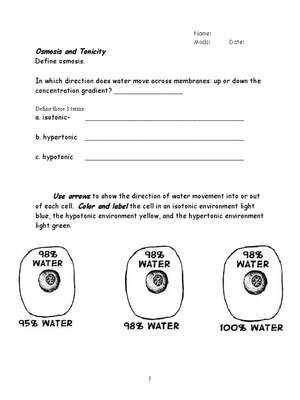
Osmosis and tonicity form one of the denser conceptual clusters in 10th grade biology because they require students to hold several related ideas in parallel: water moves by diffusion, but in response to solute concentration gradients; "hypertonic" and "hypotonic" describe the solution relative to the cell, not the cell itself; and plant cells respond differently than animal cells because of the cell wall. Each worksheet targets specific pieces of this cluster rather than asking students to manage everything at once.
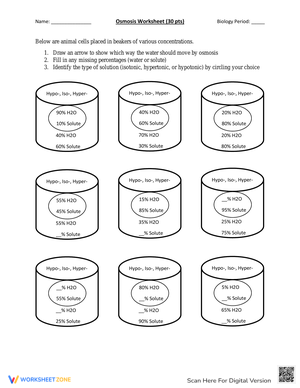
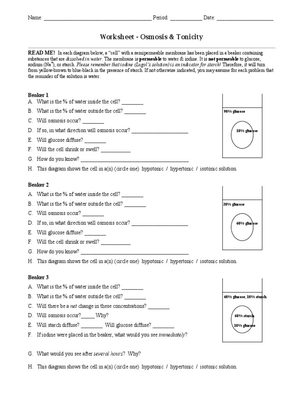
- Osmosis mechanics: Students trace water movement across selectively permeable membranes, working through the logic that water moves toward areas of lower water concentration — toward higher solute concentration.
- Tonicity identification in context: Rather than pure memorization, worksheets present tonicity scenarios and ask students to identify the solution type and justify their answer, which forces reasoning through the definition rather than recalling a label.
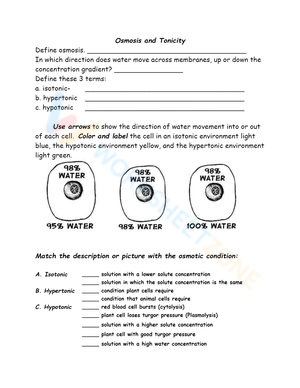
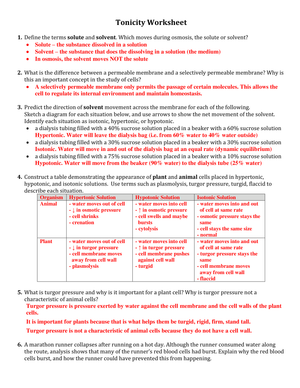
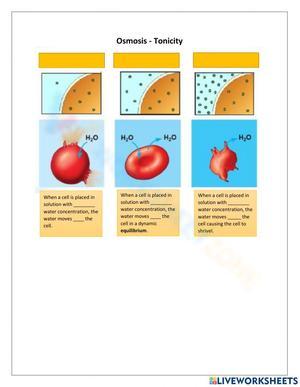
- Cell response predictions: Students describe or draw what happens to animal cells — crenation in hypertonic solutions, potential lysis in hypotonic ones — and plant cells — turgor pressure and plasmolysis — given specific solution conditions.
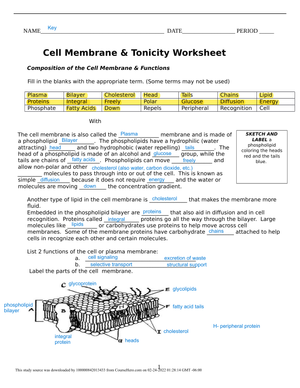
- Vocabulary in use: Terms including plasmolysis, turgid, crenation, cytolysis, and semipermeable membrane appear across matching exercises and fill-in-the-blank sentences that require students to apply terms in context rather than just define them.
- Real-world application: Scenarios involving IV fluid selection in clinical settings, food preservation through salt and sugar, and the behavior of plant cells in dry soil push students to transfer concepts to situations they haven't explicitly been shown.
- Data interpretation: Some worksheets present mass or volume change data for cells placed in solutions of varying concentration; students identify trends, determine water movement direction, and explain their reasoning in writing.
Where Students Reliably Go Wrong with Osmosis and Tonicity
The hypertonic/hypotonic distinction creates predictable confusion at this level. Students learn that "hyper" means more, but many mentally attach that to the cell rather than the solution — so they conclude that a cell in a hypertonic solution is the one with more solute inside it, rather than recognizing that the surrounding solution has the higher concentration. A reliable indicator: any student who predicts cells swell in a hypertonic solution has the terms reversed. Redefinition rarely fixes it on its own; students need to work through several labeled scenarios from scratch before the distinction stays put.
Plasmolysis is a separate sticking point. Because the word sounds like lysis, students frequently describe it as the membrane or wall rupturing. What actually happens — the membrane pulling inward and separating from the wall as water leaves — gets lost unless students are drawing it. The diagram worksheets help here because they ask students to mark the gap between the membrane and wall and label what that space represents. A quieter but equally persistent error: students assume plant cells will burst in hypotonic solutions just like animal cells do, because they haven't yet internalized that the cell wall exerts a physical resistance the membrane alone cannot provide.
How to Build These Worksheets Into Your Lesson Plans
The 10th grade osmosis and tonicity printable worksheets set sequences well when teachers front-load vocabulary and diagram work, then move toward application and data analysis as students become fluent with core terms. Starting with a diagram-labeling worksheet — one that asks students to predict water movement direction before they see the answer key — uses the predict-observe-explain structure that consistently produces stronger conceptual correction than explanation-first instruction. When students write down a prediction first, they are more likely to notice and engage with their own error when the correction arrives.
The potato-in-salt-water demonstration pairs naturally with the diagram work. Students who have already drawn arrows showing water leaving a cell in a hypertonic solution will connect the demo to the concept almost immediately. Data interpretation worksheets work best later in the unit, once students have the vocabulary to say what a mass decrease in a potato slice actually means. Running those worksheets before students understand solute concentration gradients produces guessing, not analysis — and the written explanations in the answer section make that visible fast.
Standard Alignment
These worksheets align most directly with NGSS HS-LS1-3, which asks students to plan and conduct investigations that provide evidence feedback mechanisms maintain homeostasis. Predicting how a cell responds to shifts in external solute concentration is exactly the structure-function reasoning that standard targets: the cell adjusts water intake or loss in response to environmental conditions, which is a feedback mechanism in the most direct sense. Many state science frameworks for grades 9 and 10 echo this under cell biology objectives related to membrane transport and the cell's internal environment. Teachers using these resources in AP Biology courses will also find the content aligns with College Board Big Idea 2, particularly the section on selective permeability and passive transport.
Adjusting the Worksheets Across Ability Levels
For students who are still building confidence with the vocabulary, the diagram worksheets become significantly more accessible when paired with a reference sheet listing the three tonicity types, their definitions, and the expected cell response for each. That kind of support is not a shortcut — it reduces cognitive load enough for a student who is working hard to actually reason about water movement direction, rather than spending all available working memory trying to remember what "hypotonic" means. The goal is getting students to the conceptual thinking, not testing whether they've memorized a word list.
Students working above grade level get considerably more from the 10th grade osmosis and tonicity printable worksheets resources when the extension questions ask them to move beyond description and into design. A prompt such as "A patient receives a hypotonic IV solution by mistake — describe what happens at the cellular level and identify what physiological symptoms might result" requires applying tonicity logic to a clinical context, which is meaningfully harder than labeling a diagram. Osmolarity calculations, while typically introduced in AP or college coursework, can also function as extension work for students who have strong quantitative reasoning alongside their biology understanding.
Frequently Asked Questions
How is osmosis different from diffusion, and should I teach them together?
Diffusion is the broader process — any molecule moving down its concentration gradient across a permeable barrier. Osmosis is specifically the diffusion of water molecules across a selectively permeable membrane. Teaching them together at the start of the unit works well because you establish the logic of concentration-driven movement once, then narrow the focus to water specifically. Students who understand osmosis as a subset of diffusion stop asking why water "doesn't follow the diffusion rules" once they realize it does, just with a membrane regulating passage.
Why do plant and animal cells respond so differently to the same solution?
The cell wall is the functional difference. Animal cells have only a lipid bilayer membrane, so in a hypotonic solution there is nothing to resist inward water pressure — the cell swells and may lyse. Plant cells have a rigid wall that resists expansion, converting inward water pressure into turgor pressure that actually holds the plant upright. In hypertonic conditions, a plant cell loses water and the membrane pulls away from the wall — that's plasmolysis — while an animal cell simply crenates. Worksheets that show both cell types responding to the same solution, side by side, give students a persistent visual anchor for keeping those outcomes distinct.
Where do these worksheets fit in relation to a hands-on osmosis lab?
The 10th grade osmosis and tonicity printable worksheets activities slot in at different points depending on type. Diagram labeling and tonicity identification work well before the lab, giving students the vocabulary to describe what they observe. Data interpretation worksheets fit after the lab, when students have actual mass change numbers to give that analysis meaning. Teachers who sequence it that way consistently find that student lab write-ups are more precise — because the worksheets trained them to connect "water left the cell" to a specific explanation involving solute concentration gradients, rather than simply noting that the potato slice got lighter.
Clear All