Specific Heat worksheets for 10th Grade
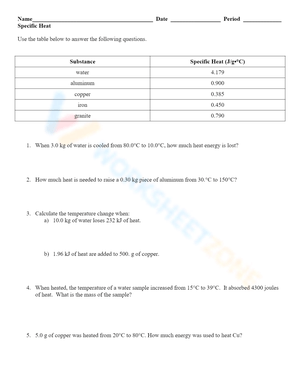
These specific heat worksheets for 10th grade cover the complete problem-solving arc of q = mcΔT: direct calculation of heat, algebraic rearrangement to isolate mass or specific heat capacity, and multi-step calorimetry problems where two substances exchange thermal energy until they reach a shared equilibrium temperature. The set fits both the chemistry and physics tracks at the sophomore level, wherever the thermal energy unit falls in the course sequence.
What Students Practice Across the Set
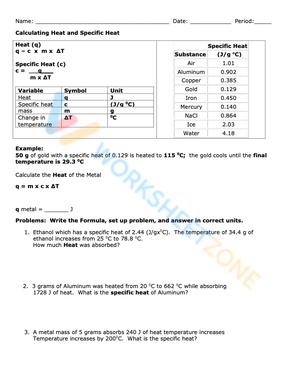
Each worksheet targets a distinct layer of the concept. The first worksheets keep all variables visible — students are given mass, specific heat constant, and both initial and final temperatures and calculate heat (q) directly. That sounds straightforward, but it's where unit errors appear first. Students who haven't internalized the difference between Joules and kilojoules will get answers off by a factor of 1,000 and accept them without hesitation.
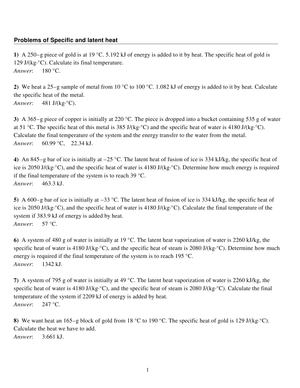
The middle worksheets rearrange the formula. Students isolate mass, c, or ΔT depending on which variable the problem withholds — real algebraic manipulation, not pattern-matching. The later worksheets introduce calorimetry: the heat released by a warm metal sample equals the heat absorbed by the surrounding water, and students set up and solve the heat-lost-equals-heat-gained equation to find an equilibrium temperature. The final group uses specific heat values as identification tools, asking students to calculate c from given data and match the result to a reference table of common substances.
- Direct calculation of q given mass, specific heat, and temperature change
- Formula rearrangement to solve for mass, c, or ΔT
- Two-substance calorimetry with unknown final equilibrium temperature
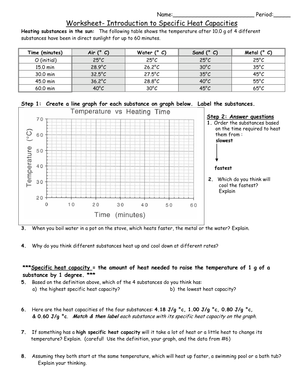
- Substance identification by comparing calculated c to a reference table
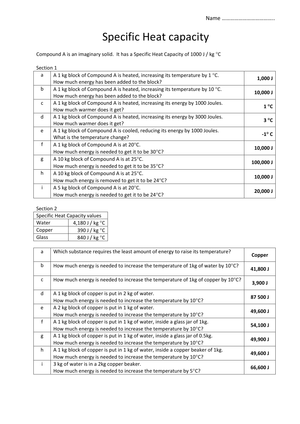
- Unit conversion practice — Joules to kilojoules, grams to kilograms
Mistakes Students Make That These Worksheets Help You Catch
The most consistent error is a sign mistake in ΔT. Students subtract final temperature from initial temperature instead of the reverse. The result is a negative heat value in a problem that clearly describes an object being heated — and most students accept it without questioning the physical meaning. Several worksheets ask students to label each substance as gaining heat or losing heat before writing any numbers. That one step forces them to think about direction before the arithmetic starts, and it surfaces the sign confusion before it becomes an incorrect final answer.
Unit mismatches are the second recurring problem. A problem might give mass in grams and specific heat in J/g°C but express the heat value in kilojoules. Students who run the formula without checking units end up exactly 1,000 times off — a clean enough error that it jumps out in a stack of papers. A smaller but persistent issue involves confusing a temperature change in Celsius with an absolute temperature; a handful of students will attempt Kelvin conversions the problem never asked for, which sends their ΔT calculation in the wrong direction entirely.
Fitting These Worksheets Into Your Instructional Sequence
These worksheets work best after students have watched the formula applied to real data — a metal block submerged in water, temperatures recorded before and after. The specific heat worksheets for 10th grade land well as the same-day follow-up to that demonstration or as a Monday re-entry task at the start of a new week, when students need a low-stakes return to the formula before the class pushes forward. The early worksheets give students a productive place to start without demanding the algebraic confidence they haven't fully built yet.
The calorimetry worksheets are better placed two or three days before a lab session, not on the same day. Students who have wrestled through the two-substance calculation on paper will set up their lab data tables with more intention. Assigning the rearrangement and calorimetry worksheets as formative check-ins after direct instruction gives a clear read on which students have the equation fluency to move into lab work and which ones need more time with the algebra before measurement error becomes an additional variable to manage.
Standard Alignment
The worksheets connect directly to NGSS HS-PS3-1, which asks students to create a computational model to calculate changes in energy within a system using the relationship between energy, temperature, mass, and specific heat. The specific heat worksheets for 10th grade address the quantitative core of this standard — students construct and manipulate the q = mcΔT model across multiple problem contexts, including identification tasks that parallel how scientists actually use specific heat data. For teachers in states where science instruction connects to mathematics standards, these also support HSA-CED.A.4, which covers rearranging literal equations to highlight a quantity of interest — exactly what students do when they isolate mass or c from the formula.
Adjusting the Work for Students at Different Points in the Curve
Students who stall at the algebraic rearrangement step respond well to a partially completed equation setup: write out q = mcΔT, substitute the known values, circle the unknown, and ask the student to solve from that point. This removes the variable-identification step that can block students before they reach the math itself. For those students, the substance-identification worksheets are not appropriate until the direct-calculation work is solid — adding the multi-step identification format before the base formula is fluent increases confusion rather than building understanding.
For students who move through the direct problems quickly, the calorimetry and identification worksheets offer genuine extension. Ask them to write a brief explanation of why their calculated specific heat places a sample in one material category rather than another — copper (0.385 J/g°C) versus aluminum (0.900 J/g°C) versus iron (0.449 J/g°C). That qualitative reasoning separates students who can operate the formula from students who understand what the number means about the material's internal structure. The specific heat worksheets for 10th grade naturally support this kind of tiered assignment because the early and late worksheets in the set carry meaningfully different cognitive demands.
Frequently Asked Questions
Can these worksheets be used in both chemistry and physics courses?
Yes. Specific heat appears in both disciplines at the sophomore level, and the worksheets use Joules and grams throughout, which matches the unit conventions in most general chemistry and introductory physics courses. Teachers in physics courses that work with calories or kilocalories will want to note the unit difference before assigning, or use the unit conversion items as an explicit bridge between the two conventions.
How are the worksheets ordered within the set?
Each worksheet addresses a distinct problem type, arranged in order of increasing algebraic demand. Direct calculation of q comes first. Rearrangement problems come next. Calorimetry setups and substance identification come last. Teachers can assign the entire set in sequence across a unit or pull individual worksheets to match wherever the class is in the lesson progression.
What prerequisite knowledge do students need before starting?
Students need a working understanding of temperature change as ΔT = Tf minus Ti, basic single-variable algebra, and the general idea that different materials heat at different rates. Students who have not yet worked through unit analysis — tracking what happens to grams, Joules, and degrees Celsius as they move through an equation — will need that background before the rearrangement worksheets make sense. Skipping it and hoping students pick it up during the worksheet tends to produce systematic errors rather than understanding.
Do the worksheets include a specific heat reference table?
The identification worksheets include a table listing values for water (4.184 J/g°C), aluminum (0.900 J/g°C), iron (0.449 J/g°C), copper (0.385 J/g°C), lead (0.128 J/g°C), and glass (0.840 J/g°C). Students calculate c from the given data and match the result to the table. The direct-calculation and rearrangement worksheets provide the specific heat constant within each problem, so students are not expected to have values memorized for those sections.
Clear All