


























1 / 2
0
Views
0
Downloads

Save
0 Likes
Share
Worksheet: Calculating pH and pOH for Chemistry Students
0 Views
0 Downloads
Paste this activity's link or code into your existing LMS (Google Classroom, Canvas, Teams, Schoology, Moodle, etc.).
Students can open and work on the activity right away, with no student login required.
You'll still be able to track student progress and results from your teacher account.
Information
Description
What It Is:
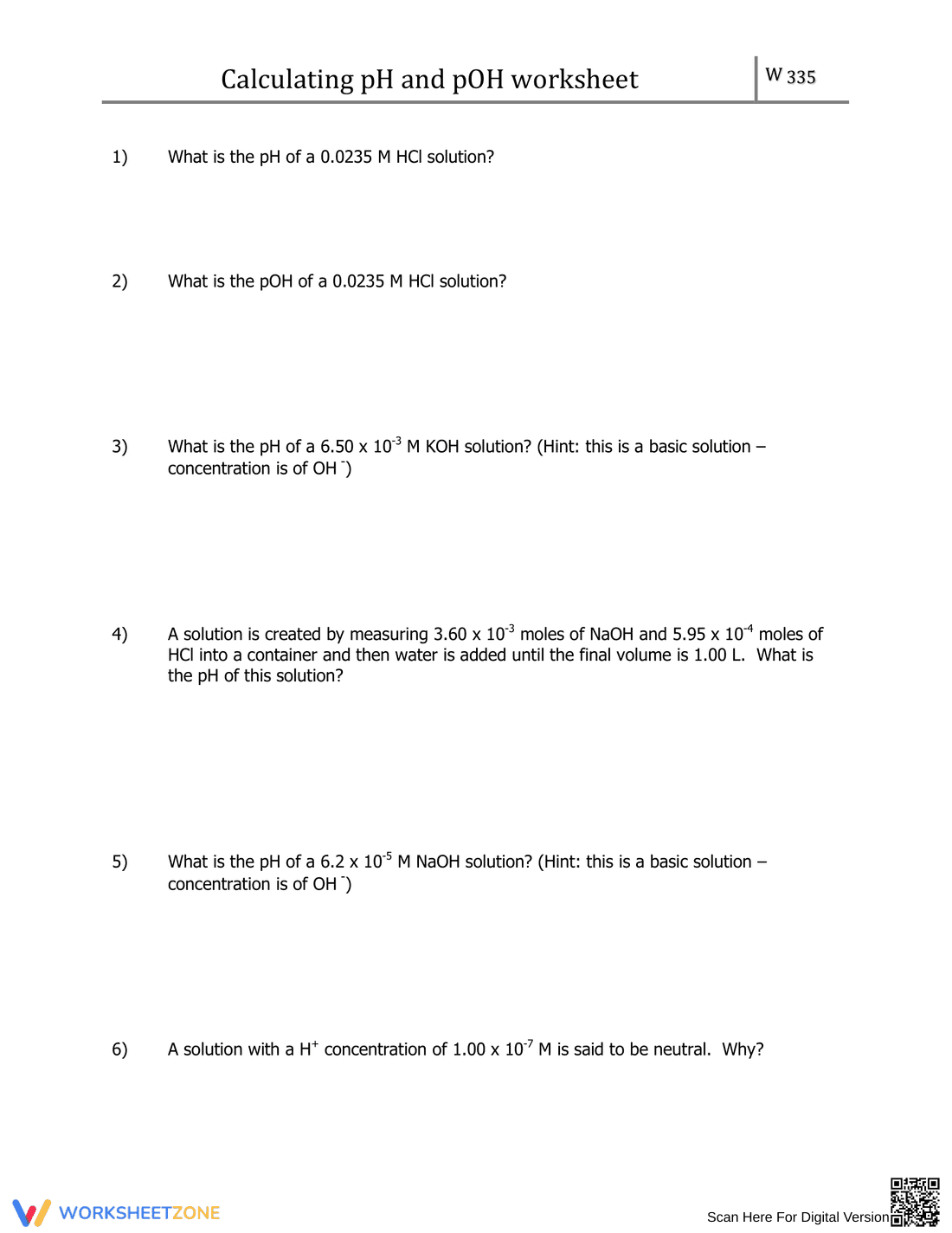
This is a worksheet titled 'Calculating pH and pOH.' It contains six problems related to calculating pH and pOH of solutions. The problems involve calculating pH and pOH from molar concentrations of strong acids (HCl) and strong bases (KOH, NaOH). One problem involves calculating the pH after mixing solutions of a strong acid and a strong base. The worksheet includes hints for problems involving bases, reminding students that the concentration of OH- is relevant. The last question asks why a solution with a H+ concentration of 1.00 x 10^-7 M is considered neutral.
Grade Level Suitability:
This worksheet is suitable for high school chemistry (Grades 11-12) or introductory college chemistry. It requires knowledge of molarity, strong acids and bases, and the logarithmic relationship between pH, pOH, and ion concentrations. The problem involving mixing acids and bases requires stoichiometry.
Why Use It:
This worksheet reinforces the concepts of pH and pOH calculations. It helps students practice converting between molar concentrations and pH/pOH values. It also helps students understand the relationship between pH, pOH, acidity, and basicity. The worksheet tests the students' ability to apply these concepts to different scenarios, including solutions of acids, bases, and mixtures.
How to Use It:
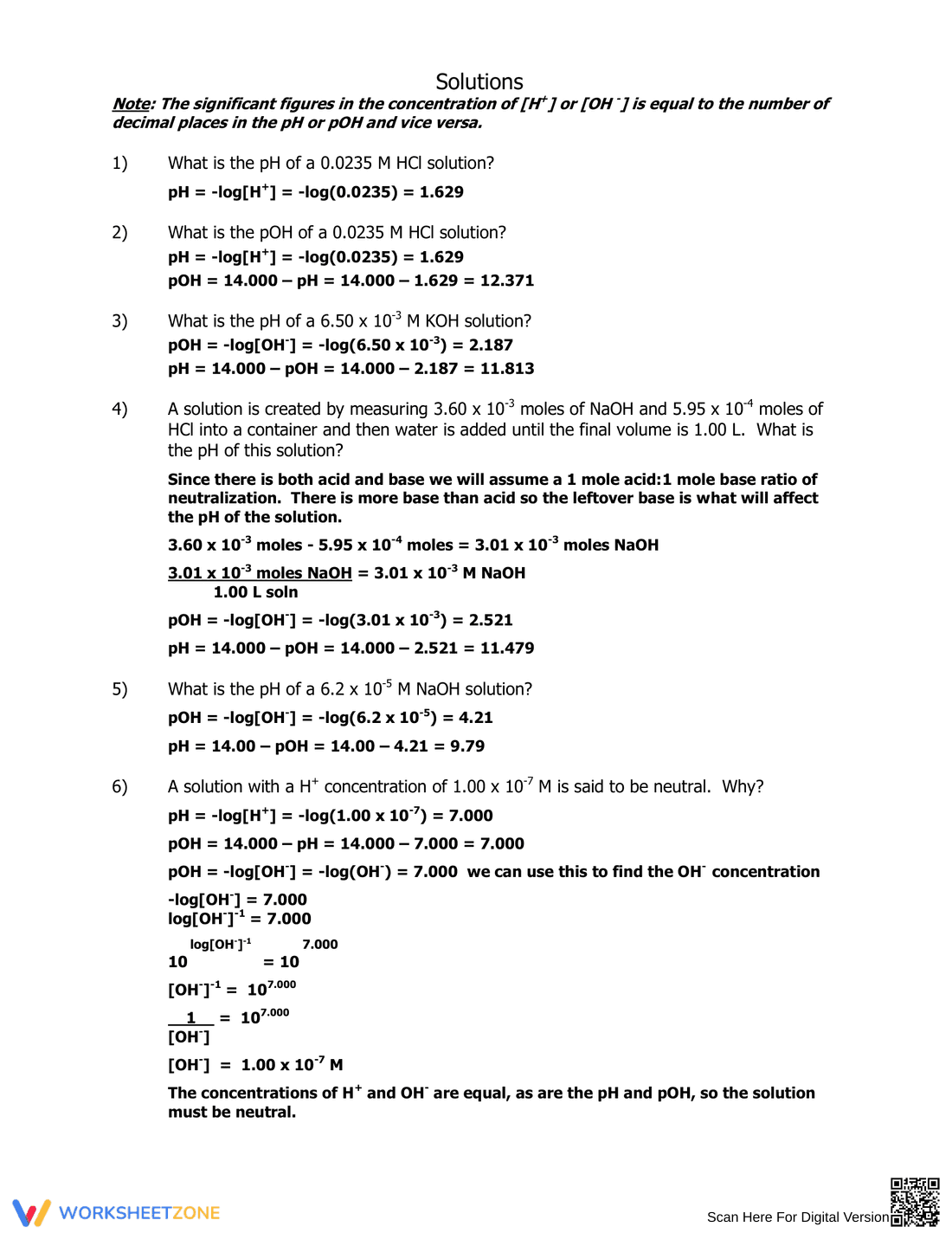
Students should first review the definitions of pH and pOH, as well as the relevant formulas. They should then work through each problem step-by-step, showing their calculations. For problems involving bases, they should use the hint provided to calculate the pOH first and then convert to pH. For the mixing problem, they should calculate the moles of acid and base, determine the limiting reactant, and then calculate the final concentration of H+ or OH- to find the pH.
Target Users:
The target users are high school or college students studying chemistry, particularly those learning about acids, bases, and pH. It is suitable for students who need practice applying the formulas for calculating pH and pOH. It can also be used as a review or assessment tool.
This is a worksheet titled 'Calculating pH and pOH.' It contains six problems related to calculating pH and pOH of solutions. The problems involve calculating pH and pOH from molar concentrations of strong acids (HCl) and strong bases (KOH, NaOH). One problem involves calculating the pH after mixing solutions of a strong acid and a strong base. The worksheet includes hints for problems involving bases, reminding students that the concentration of OH- is relevant. The last question asks why a solution with a H+ concentration of 1.00 x 10^-7 M is considered neutral.
Grade Level Suitability:
This worksheet is suitable for high school chemistry (Grades 11-12) or introductory college chemistry. It requires knowledge of molarity, strong acids and bases, and the logarithmic relationship between pH, pOH, and ion concentrations. The problem involving mixing acids and bases requires stoichiometry.
Why Use It:
This worksheet reinforces the concepts of pH and pOH calculations. It helps students practice converting between molar concentrations and pH/pOH values. It also helps students understand the relationship between pH, pOH, acidity, and basicity. The worksheet tests the students' ability to apply these concepts to different scenarios, including solutions of acids, bases, and mixtures.
How to Use It:
Students should first review the definitions of pH and pOH, as well as the relevant formulas. They should then work through each problem step-by-step, showing their calculations. For problems involving bases, they should use the hint provided to calculate the pOH first and then convert to pH. For the mixing problem, they should calculate the moles of acid and base, determine the limiting reactant, and then calculate the final concentration of H+ or OH- to find the pH.
Target Users:
The target users are high school or college students studying chemistry, particularly those learning about acids, bases, and pH. It is suitable for students who need practice applying the formulas for calculating pH and pOH. It can also be used as a review or assessment tool.


