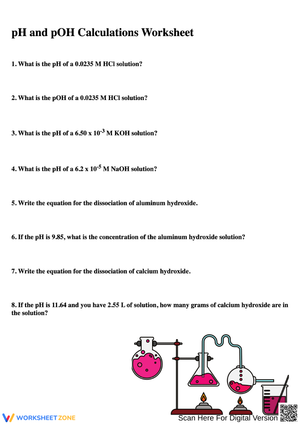
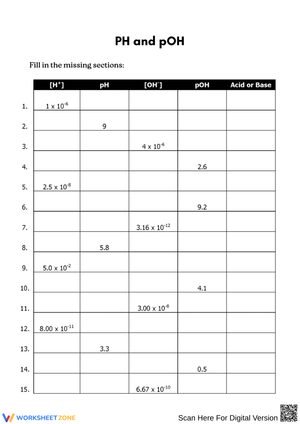
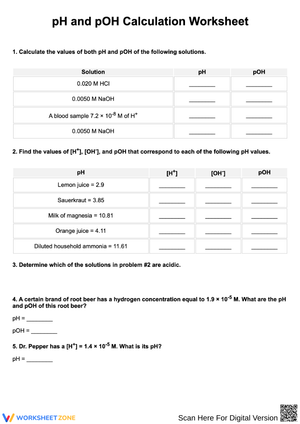
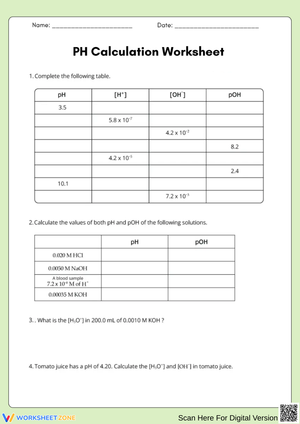
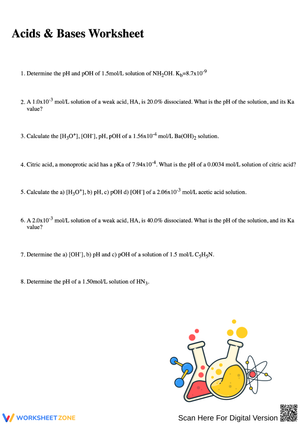
10th Grade pH Calculations printable worksheets
These 10th grade ph calculations printable worksheets resources give chemistry teachers a copy-ready set of focused practice materials built around the three core operations the unit demands: calculating pH from hydronium ion concentration, finding pOH from hydroxide concentration, and using pH + pOH = 14 at 25°C to convert between all four quantities. The worksheets move from direct calculation into inverse problems — the step where most 10th graders stall — and that progression matters more than total problem count. A set that revisits scientific notation entry and the negative sign in pH = -log[H+] catches the errors that a generic review worksheet misses.
What Each Worksheet Covers
Each worksheet targets a specific set of skills that appear together on unit tests and state chemistry assessments. The sequencing within the set moves from interpretation to calculation to conversion, with mixed problems reserved for the later worksheets.
- pH scale interpretation: classifying solutions as acidic, basic, or neutral and explaining why a solution at pH 3 is more acidic than one at pH 6 — not just identifying which value is lower.
- Direct pH calculation: applying pH = -log[H+] to concentrations given in scientific notation.
- Direct pOH calculation: applying pOH = -log[OH-] and distinguishing which ion drives each formula.
- Inverse calculation: recovering [H+] or [OH-] from a given pH or pOH using [H+] = 10^(-pH) and [OH-] = 10^(-pOH).
- Relationship conversion: using pH + pOH = 14 at 25°C when only one of the two values is given.
- Mixed problem sets: ranking solutions from most acidic to most basic and solving multi-step items that require switching between pH and pOH.
Errors Students Make That These Worksheets Surface Early
The most persistent calculation error in pH work is dropping the negative sign. A student who enters log(1.0 × 10^-7) on a TI-84, sees -7 in the display, and writes pH = -7 has lost track of what the formula actually says: pH = -log[H+], so pH = -(-7) = 7. An answer of -7 is physically impossible under typical classroom conditions, but students accept it without questioning because they do not yet have a strong intuition for what pH values represent. Any worksheet that includes a brief prompt — "Is this answer within a reasonable pH range?" — catches this pattern before the test does.
A second consistent problem is substituting [OH-] into the pH formula or [H+] into the pOH formula. Under time pressure, students grab the first concentration listed in the problem and run it through whichever log equation they remember first. Sequencing problems so that all [H+] items appear before any [OH-] items — and labeling each problem's given quantity clearly — builds the distinction into the practice itself rather than leaving it to verbal reminders from the teacher.
Inverse log problems generate a third error pattern. Students who calculate pH without trouble often cannot reverse the operation. They know pH = -log[H+] but cannot reliably derive [H+] = 10^(-pH). Some attempt to divide pH by a version of the concentration from the previous problem, essentially inventing a procedure. A worksheet dedicated entirely to inverse problems, with the first two items worked out step by step in the margin, surfaces this gap before it costs students points on a test.
Building These Worksheets Into the Chemistry Week
A full 10th grade ph calculations printable worksheets set supports an entire instructional sequence without requiring teachers to write new problems from scratch each day. On day one, a short pH scale worksheet works well as an opening activity — six to eight classification and comparison items completed in the first eight minutes of class while attendance is taken and materials are distributed. On day two, direct calculation problems using pH = -log[H+] and pOH = -log[OH-] work as guided practice, with the teacher modeling the first item and students finishing the rest independently.
By days three and four, most classes are ready for inverse calculations and relationship conversion. Running one worksheet as partner work — where students solve the same item independently and then compare the calculator steps they used — surfaces notation disagreements before they become individual test errors. The last day of the sequence works well with a mixed-review worksheet used as a quiz-style exit ticket: four to five problems, no formula prompts, returned the next morning with an answer key.
One detail worth building into any pH worksheet: a line below each problem labeled "calculator entry" where students write exactly what they typed. On a TI-84, the correct sequence for pH = -log(1.0 × 10^-7) is: negative sign, LOG, 1, 2nd, EE, (-), 7, ENTER. Students who use the caret key or the regular multiplication sign instead of EE often get errors or wrong values — and without that written record, there is no way to tell whether the error was conceptual or a keyboarding mistake.
Standard Alignment
pH calculation connects to the disciplinary core idea HS-PS1.B (Chemical Reactions) within the NGSS framework, which addresses the behavior of acids and bases at the molecular and conceptual level. The procedural skills these worksheets build — applying logarithms, converting scientific notation, and using inverse operations — align with CCSS.MATH.CONTENT.HSF-BF.B.5, the high school standard covering inverse functions including logarithms. Most state-level 10th grade chemistry frameworks include pH calculation as a required skill within the acids and bases unit, though the specific performance expectation language varies by state.
This dual alignment — chemistry content and high school math fluency — matters in practical terms. Students who struggle with pH calculations are often running into a math gap rather than a chemistry gap. A student who sets up pH = -log[H+] correctly but enters the concentration wrong on the calculator is not confused about acid-base chemistry; they need support with scientific notation entry. These 10th grade ph calculations printable worksheets resources make that distinction visible by separating the formula setup step from the computation step within each problem.
Adjusting the Set for Mixed Math Readiness
The most effective differentiation lever in pH practice is the complexity of the concentration given. For students who need additional support, start with concentrations that are exact powers of 10 — [H+] = 1.0 × 10^-4, for example — where the log operation yields a clean whole number and the negative sign is the only potential stumbling block. Once that step feels automatic, introduce concentrations like 3.7 × 10^-3, where the log produces a decimal result and students must handle a second layer of computation.
For students ready for more challenge, mixed worksheets that require switching between pH and pOH within a single problem, or that present a list of solutions without indicating which are acids and which are bases, raise the thinking demand without leaving the pH framework. A two-version print approach — one worksheet with the relevant formulas boxed at the top and a worked example in the margin, one without any such support — keeps the assignment target identical for the whole class while giving less confident students an entry point that prevents them from sitting frozen for the first few minutes. Print both versions, distribute based on what you know about each student's math fluency, and grade from the same answer key.
The instinct to reduce problem count for struggling students is usually the wrong move. Five well-chosen problems at the right concentration complexity produce more diagnostic information than two easy ones followed by eight that the student skips. Matching the concentration type to a student's current fluency with scientific notation is a more useful adjustment than cutting the worksheet short.
Frequently Asked Questions
What calculator skills should students have before starting these worksheets?
Students need to locate the LOG key, enter scientific notation using the EE or EXP key rather than the caret symbol or regular multiplication sign, and recognize that the log of a number less than 1 returns a negative value. On a TI-84, the correct key sequence for pH = -log(1.0 × 10^-7) is: negative sign, LOG, 1.0, 2nd, EE, (-), 7, ENTER. Students who use the × symbol for scientific notation will receive an error message or an incorrect result. A two-minute calculator check before distributing the first worksheet prevents a significant amount of confusion during independent practice.
Should scientific notation review come before or alongside the pH unit?
Alongside, not before. When notation review runs as a separate prerequisite, students rarely connect it to concentration values in chemistry. A more effective approach is a three-item notation warm-up at the top of the first calculation worksheet — convert 0.00037 to scientific notation, rewrite 4.2 × 10^-5 in standard form, enter 6.3 × 10^-8 on the calculator. That positions notation as a tool the student needs right now, which makes it transfer more reliably than isolated drills do.
How many problems should each pH and pOH worksheet include?
Eight to twelve problems works well for direct calculation practice. Fewer than eight does not give enough repetition for the formula to feel automatic; more than fifteen turns the worksheet into a volume exercise. Mixed-review worksheets can run shorter — six to eight items — because switching between problem types slows the pace. Exit tickets should stay at two to four problems targeting a single operation, such as finding [H+] from a given pH value.
Do these worksheets cover strong and weak acid calculations differently?
The 10th grade ph calculations printable worksheets set works with concentrations already provided in each problem, so students are not expected to derive [H+] from Ka values. Whether an acid is strong or weak does not affect the calculation steps in these worksheets — the procedure is identical once [H+] is given. The distinction between strong and weak acids becomes relevant in later units that introduce Ka and Kb expressions. Teachers who want to preview that connection can add a margin note to a mixed-review worksheet, but it is not required for the core pH calculation skill.
Clear All