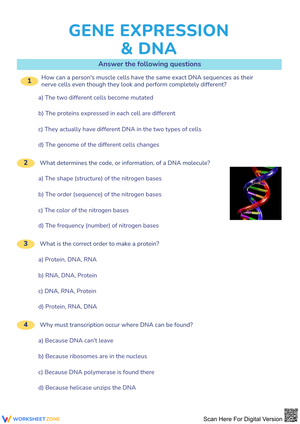
10th Grade Gene Expression worksheets for Biology
These 10th grade gene expression worksheets give biology teachers a structured, printable set of resources that covers the full arc from transcription through translation, gene regulation, and mutation analysis — the sequence most 10th-grade curricula work through across two to three weeks. Each worksheet targets a discrete step in the process so teachers can assign them individually, in sequence, or as review at any point in the unit.
What Each Worksheet Covers
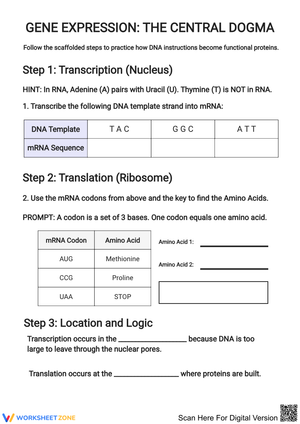
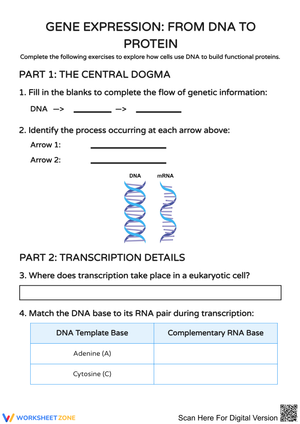
The set moves through four interconnected areas of gene expression. Transcription worksheets present a DNA template strand and ask students to write the complementary mRNA sequence, correctly substituting uracil for thymine — a rule students read quickly and misapply constantly. Translation worksheets supply mRNA sequences and a codon table; students identify each codon, record the corresponding amino acid, and build out the polypeptide chain from start codon to stop. A separate set of worksheets focuses on tRNA and ribosome mechanics: students label the ribosomal A, P, and E sites, draw anticodon pairings, and trace where the growing polypeptide attaches.
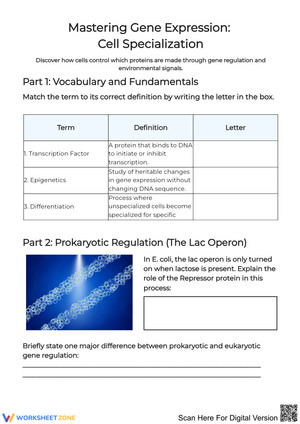
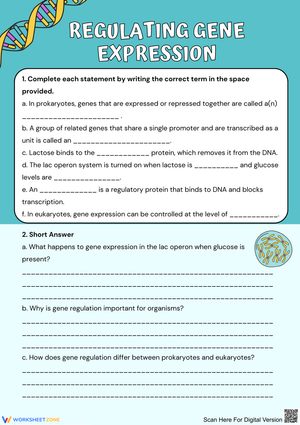
Gene regulation worksheets use the lac operon as a concrete model before moving to eukaryotic transcription factors. Students mark which genes are active or silenced under different cellular conditions and explain the role of activators and repressors in controlling RNA polymerase binding. Mutation worksheets provide paired sequences — one original, one altered — and ask students to classify the change as a substitution, insertion, or deletion, then predict the downstream effect on the protein. That "before and after" format is particularly useful for distinguishing silent mutations from frameshift mutations, which students routinely conflate.
Why These Errors Keep Appearing in Student Work
Two mistakes show up so reliably in 10th-grade gene expression work that they're worth preparing for directly. The first involves strand directionality. Students learn that DNA is read 3′ to 5′ during transcription and write this rule correctly on a quiz — then immediately apply it backward when they're working through a problem without pausing to label the strands. The worksheets include strand orientation labels on every diagram precisely because removing that scaffold produced more errors, not better thinking.
The second persistent error occurs during codon reading. Students who use the codon table accurately on simple three-codon sequences will group nucleotides incorrectly when a sequence runs twelve or fifteen bases long. They lose the reading frame somewhere in the middle without noticing, arrive at the wrong amino acids, and assume the codon chart is wrong. Having students mark codon boundaries with a pencil slash before they look up a single amino acid eliminates most of these errors. Several worksheets build that step in as an explicit instruction rather than leaving it to student judgment.
Fitting These Worksheets Into the Week
Transcription and translation each benefit from a two-day structure: introduce the mechanics through direct instruction or modeling on day one, then use the corresponding worksheet as guided practice the same afternoon or the following morning before new material adds to cognitive load. Waiting until Friday to assign the translation worksheet after four days of new content means students are trying to consolidate too many overlapping processes at once.
The mutation worksheets work well as a Monday warm-up once protein synthesis is solid, because they force retrieval of codon reading under a new analytical frame — students have to hold the original sequence in mind while simultaneously processing the altered one. That interleaving, rather than massing mutation practice at the end of the unit, produces better retention. The gene regulation worksheets pair naturally with a short whole-class discussion of cell differentiation: give students ten minutes to mark the lac operon diagram independently, then debrief as a class before they write their explanations.
Adapting the Worksheets Across the Range of Learners
For students who are still building fluency with base-pairing rules, the transcription and translation worksheets can be used with the codon table fully open and the strand labels pre-filled. Removing one variable at a time lets those students successfully complete the analytical steps — predicting amino acids, identifying mutation effects — without getting stranded at the notation stage. That scaffolded version also works well for students who are catching up after an absence during the initial direct instruction.
Students who are ready for more challenge can work the mutation worksheets without the codon table as a reference, relying on the codons they've internalized, and can be asked to extend their analysis: given this frameshift, at what point does the protein likely become nonfunctional, and why? The gene regulation worksheets support a similar extension — students design their own hypothetical regulatory scenario using the same promoter-operator-repressor logic before the class discusses real eukaryotic examples.
Standard Alignment
These worksheets address NGSS HS-LS1-1, which asks students to construct explanations for how DNA structure determines protein structure. That standard lands in 10th grade because students arrive with enough chemistry background — basic molecular bonding, an introduction to macromolecules — to engage with nucleotide base pairing and amino acid sequencing without those ideas being entirely abstract. The worksheets operationalize the standard by requiring students to move between levels of representation: nucleotide sequence to codon to amino acid to protein function. The mutation analysis portion satisfies the evidence-based explanation dimension of the standard by asking students to connect a specific molecular change to a downstream functional consequence rather than describing mutation in general terms.
Frequently Asked Questions
Do the worksheets include a codon table, or do students need a separate reference?
Most worksheets in the set include a codon table printed directly on the worksheet. A few translation exercises intentionally omit it so teachers can use those as assessment tasks once students have had enough practice to work from memory or from a table they bring to the assessment themselves.
How long does each worksheet typically take to complete in class?
Transcription and translation worksheets run roughly 20 to 30 minutes for most students when the codon table is provided. Mutation analysis worksheets take closer to 35 minutes because students need to work through the sequence comparison carefully before writing their explanations. Gene regulation worksheets vary more — the labeling portions are quick, but the written explanation questions at the end slow students down in ways that are productive.
Can I use these worksheets for review before a unit exam?
They work well as structured review when students use them actively — covering their previous answers and working through the sequence again from scratch — rather than simply reading over completed work. The mutation worksheets in particular make strong pre-exam review because they require students to integrate codon reading, strand orientation, and protein function reasoning simultaneously rather than practicing each skill in isolation.
Clear All