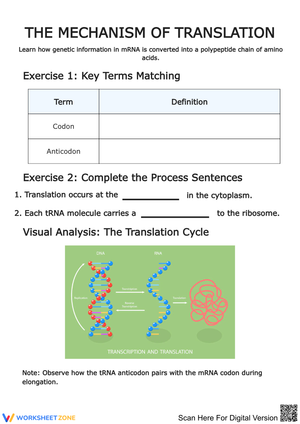
Codon Printable Worksheets for 10th Grade
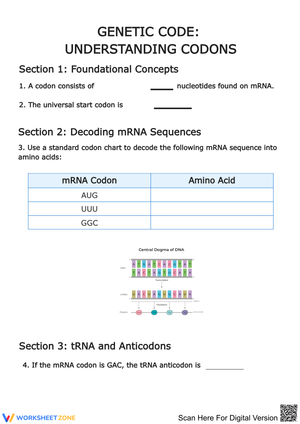
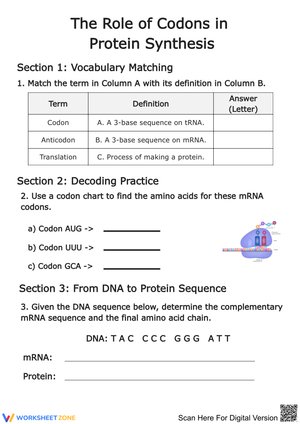
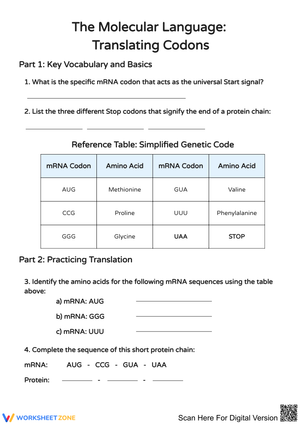
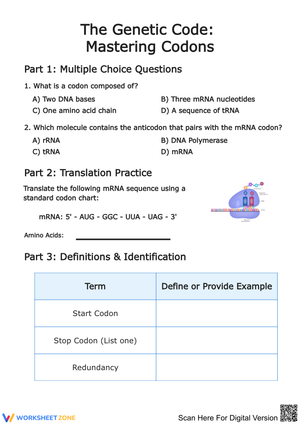
These codon worksheets for 10th grade walk students through the full central dogma sequence — from reading a DNA template to identifying the amino acids a ribosome would assemble — in a format that keeps each step visible and checkable. Each worksheet in the set is structured around a specific stage of that process, so teachers can assign them in sequence during a translation unit or pull individual worksheets as targeted review.
The Specific Skills Targeted
Tenth grade is where students stop treating transcription and translation as vocabulary definitions and start following them as a process. These codon worksheets build that procedural fluency across several connected tasks. Students transcribe a DNA template strand into mRNA using correct complementary base-pair rules — including the substitution of uracil for thymine. They divide the resulting mRNA into triplets, use a codon table to name each amino acid, and identify where translation begins and ends based on start and stop signals.
Later worksheets in the set introduce mutation comparisons. Students read an original sequence alongside a modified version and determine whether the substitution, insertion, or deletion changed the amino acid sequence, introduced a premature stop, or shifted the reading frame entirely. That last scenario — the frameshift — consistently surprises students who assume that one changed base means at most one changed amino acid. Seeing a frameshift on paper, working through every downstream codon, makes the consequence concrete in a way a lecture doesn't.
Mistakes Students Make That These Worksheets Help You Catch
The most persistent error in codon work isn't chart misuse — it's misgrouping. Students who understand the concept will still produce wrong amino acid sequences because they started counting from the wrong base or lost their place mid-strand. A small but effective classroom habit is to have students draw slash marks between every codon boundary before they consult the codon table at all. That one step catches a large share of translation errors before they happen, and it makes the source of remaining mistakes much easier to diagnose.
Several other errors appear reliably in student work. Some students translate the DNA template directly, skipping the mRNA step entirely, because they see a sequence and want to move to the chart immediately. Others write T in the mRNA strand out of habit — especially students who have just finished a unit on DNA replication where thymine appears constantly. A few will recognize AUG as the start codon in isolation but still begin translating at the first triplet in a sequence regardless of whether it codes for methionine. And strong students sometimes continue reading past a stop codon because they aren't sure whether UAG or UGA is "really" a stop signal. Each worksheet is structured so these specific errors either surface clearly or are blocked by the task format before they become entrenched habits.
How to Build These Worksheets Into Your Lesson Plans
The set works best when introduced during guided instruction rather than assigned cold. Project one worksheet under a document camera and model the full sequence — DNA to mRNA, mRNA to codons, codons to amino acids — before students attempt their own. The first time through, narrate the codon boundary decisions out loud. Students who watch that process once make far fewer grouping errors than students who receive a completed example and a blank page.
From there, the worksheets fit several spots in a typical week. During the initial unit, one worksheet per day sustains practice without overwhelming a class that's also processing the mechanics of ribosomes and tRNA. The mutation comparison worksheets work well on the Friday before a quiz — they require students to integrate everything rather than practice one step in isolation. For bell ringers, a single mRNA strand with three to five codons gives students something to do in the eight minutes before announcements end and class settles, and the answers take less than two minutes to review aloud.
When used as exit tickets, the translation worksheets double as formative data. A quick scan of whether students correctly placed the slash at AUG — rather than at position one of the strand — tells a teacher before the following day whether the class needs re-teaching or is ready to move into gene expression and mutation types.
Adjusting the Worksheets for a Range of Learners
Students who are still building confidence with base-pair rules benefit from worksheets that include a labeled reference box — the DNA-to-RNA pairing rules and the codon table printed directly on the same worksheet. Removing the memory burden lets those students focus on the process itself. Once the process is automatic, the reference box can be withheld so students practice retrieval as well as application.
For students moving quickly, the mutation comparison worksheets offer natural extension. Asking a student to design a three-base substitution that leaves the final protein unchanged — exploiting codon redundancy deliberately — is a genuinely challenging task that requires deep understanding of how the code is structured. That kind of question also reveals whether a student understands why multiple codons can specify the same amino acid, which is a more sophisticated idea than simply using the chart correctly.
In mixed-readiness classes, both versions of a worksheet can run simultaneously without signaling ability grouping — the difference in scaffold level isn't visible to students sitting next to each other, and the questions both versions answer are drawn from the same biology standard.
Standard Alignment
These worksheets align to NGSS HS-LS1-1, which asks students to construct an explanation for how the structure of DNA determines the structure of proteins that carry out the essential functions of life. The progression from DNA template to mRNA sequence to amino acid chain maps directly to the cause-and-effect reasoning that standard requires. The mutation comparison worksheets extend into HS-LS3-2, which addresses how variations in DNA sequences can affect protein structure and function. In classroom terms, that standard is most accessible after students have practiced normal translation enough times that a disrupted sequence reads as clearly wrong rather than just different.
Frequently Asked Questions
Do students need to memorize the entire codon table to use these worksheets?
No, and they shouldn't be expected to. The worksheets are designed for use with a codon table, which mirrors how biologists actually work. The skill being assessed is reading and applying the table accurately, not recalling all 64 codons from memory. Most teachers do expect students to know AUG as the start codon and to recognize UAA, UAG, and UGA as stop signals without looking them up, since those signals anchor every translation problem.
At what point in a genetics unit should these worksheets appear?
After students have covered DNA structure and base-pairing rules, but before they're expected to analyze mutations independently. The transcription worksheets should come before the translation worksheets — asking a student to decode codons before they can reliably write a complementary mRNA strand sets them up for compounded errors. The mutation comparison worksheets belong near the end of the unit, once the baseline process is solid.
How long does a typical worksheet take to complete?
Most worksheets in the set take 12 to 20 minutes for students who have had prior instruction. Students encountering the codon table for the first time will need closer to 25 minutes. The shorter translation worksheets — single sequence, five to six codons — work well for the 15-minute window at the end of a class period when a longer activity wouldn't fit.
Can these be used for makeup work or sub plans?
Each worksheet includes an answer key, which makes both scenarios workable. The task format is consistent enough that a student completing makeup work independently can follow the steps without additional explanation, and a substitute can administer the worksheets without content expertise.
Clear All